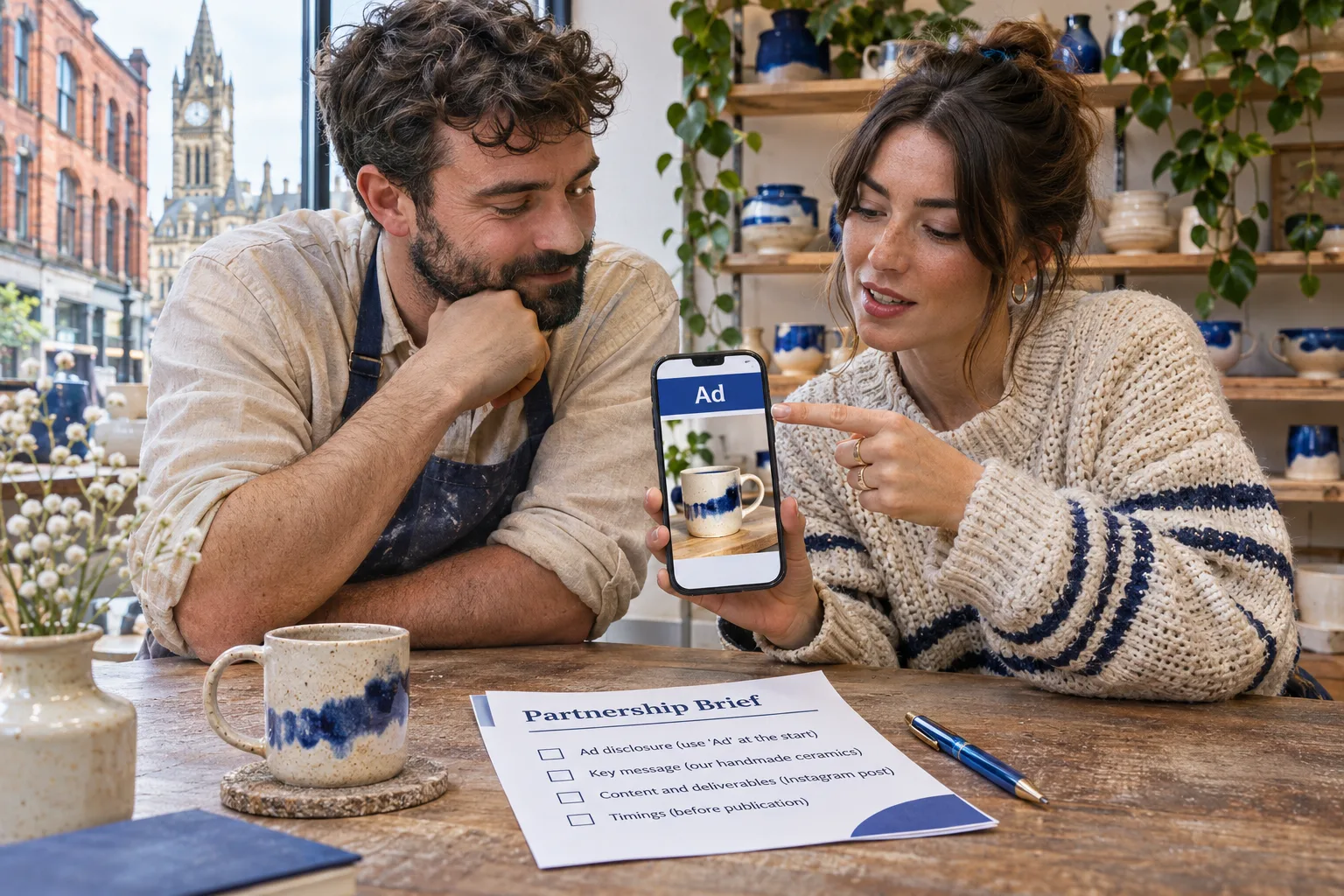

A commissioning sheet for a fictional UK pottery shop and one local creator
| Decision | Write in the brief | Proof or handoff check | If it changes |
|---|---|---|---|
| Customer task | Show how a made-to-order mug is selected and collected | Current product page and collection terms | Pause the draft if availability or terms change |
| Deliverables | One creator Reel, one still, caption and agreed post date | Final files, caption draft and live URL | Agree extra work and fee before adding formats |
| Use rights | Creator post; separate permission for shop repost; no paid ad unless agreed | Written licence with channels, duration and territory | Ask for a new permission before a new use |
| Disclosure and claims | Identify the incentive and check the final ad label and product facts | Approved factual sheet and live labelled post | Correct a changed claim or unclear label promptly |
| Review | One factual review owner, response date and correction contact | Dated approval note and link test | Escalate delays; never imply silence is approval |
| Measurement | Track an agreed enquiry or booking route alongside post delivery | Dated source-labelled observations and shop records | Keep attribution limits visible in the review |
Begin with the customer task, not a creator list
A useful collaboration begins with something a customer needs to understand. Imagine a fictional ceramics studio in Bristol that makes a blue mug in small batches. The owner wants a local creator to show how someone chooses a glaze and arranges collection. That is a narrower job than 'make us go viral'. It also creates a testable handoff: the product page and collection information must match what the creator says. If the product is unavailable, the team can pause the work before a misleading invitation goes live.
Write one sentence for the job: 'Help a Bristol visitor see the mug's size, glaze and current collection route.' Then list what an ordinary viewer will do next: open a public listing, ask a question, or visit the studio at a stated time. Check that the business can staff that route. An attractive video has little practical value if the linked page offers a different mug or staff cannot answer collection enquiries. This guide focuses on the business commissioning the work; a separate UK guide covers a creator assembling a media kit.
Meta has described Instagram's creator marketplace and project messaging for brands and creators, including an expansion to the UK. Those tools can help introduce people when available to a particular account, but they do not decide this shop's stock, terms, approval responsibilities or legal permissions. A direct local relationship can use the same brief. Avoid assuming every business or creator sees the same marketplace controls. The agreement should remain understandable if the platform interface changes.
- Write the customer question in one sentence.
- Choose a specific current offer or information page.
- Name the staff member who can answer what follows.
Shortlist for a verifiable local fit
Ask what the creator has actually produced for a business with a comparable customer task. A homeware creator who can demonstrate how a mug feels in the hand may fit the Bristol studio better than an account whose large audience mainly follows unrelated entertainment. Review recent original posts, voice, disclosure practice, comment quality and whether an ordinary viewer can understand the offer. A profile's follower number alone does not tell you where people live, who notices a particular post, or who is ready to collect a mug.
If local reach matters, request recent, dated audience information the creator is willing and able to share from legitimate account tools, and label the period and metric. Ask what can be verified, not for a password or a full export of private follower information. A creator may choose not to share detailed data; that is an input to your decision, not a reason to invent certainty. You can still assess portfolio fit and arrange a modest test with a clear destination. Do not turn an unverified screenshot into a claim about UK buyers.
Check whether the creator can make the required content and whether the business can supply the product, access, filming time and factual answers. Discuss conflicting partnerships or exclusivity only when they would actually affect this project, and write any restriction precisely. Where staff, customers or a location appear, plan permission and practical filming boundaries early. The media-kit guide helps interpret creator evidence; this brief is where the shop turns a possible fit into a scoped job.
- Look at relevant recent work and ask what the creator actually made.
- Verify the audience evidence and date that matter to this brief.
- Avoid treating the visible follower count as proof of local customers.
Choose the deliverable and its destination
A deliverable is more specific than 'some Instagram content'. State whether the creator will make a Reel, still photograph, Story, carousel or combination; how many; approximate duration or frame count if useful; whose account publishes; and whether the business receives editable files. A proposed Instagram Collab post is a particular platform invitation, not a synonym for any partnership. The Global guide explains how invitations are sent and accepted, while this agreement should say who is responsible if an invitation is missed or unavailable.
For the studio example, a single creator Reel could show selecting the glaze and collecting the finished mug. Its next step might be a current shop page with the correct size, price and collection details. If the creator adds a Story, identify the available link route and how long its message is relevant. Do not assume a link in every caption behaves like a clickable shop button, or that every account has the same commerce controls. Test the destination in the same public state a viewer will see.
Decide whether the creator is producing content for the shop to post, publishing on their own account, or both. These are different jobs with different review, disclosure and rights questions. A business can choose the smallest format that answers the customer task and make a later decision about more work. Several near-identical posts do not become a better campaign simply because they raise a deliverable count. The table above can be copied into a brief and changed to match the actual offer.
Write the working brief before filming
Put the core facts on one page: the customer question, exact product or service, public destination, format, account, draft and live dates, fee or product supplied, factual approval owner, correction contact and reporting date. Give the creator product details they can verify, such as mug dimensions, current glaze options, price, collection process and whether the pictured version is for sale. Mark information that may change. The brief should explain the facts without scripting a personal opinion the creator does not hold.
Set a realistic review window. For example, the shop owner can check factual accuracy and usage permissions within an agreed period before the creator posts. The creator retains responsibility for an honest account of their experience; the brand can ask them to remove an unsupported claim. If feedback arrives late, agree a new publication time rather than treating silence as approval. Name who can act on a weekend or when the owner is away. A campaign that depends on one person's inaccessible inbox is fragile even when the video is ready.
Include a change rule. If the studio changes the mug price, runs out of the featured glaze or stops offering collection, the shop must tell the creator and revise the destination before publication. Define what counts as a small factual correction and what would require new work or a new fee. Ask for accessible, accurate captions where the Reel uses speech or essential on-screen details. Meta's professional-account education can offer creation guidance, but the shop's verified product facts and agreed handoff govern this particular job.
- List every file, format, post surface and deadline.
- Give one owner for factual approval and one creator contact for corrections.
- Agree the cost of extra work before asking for it.
Agree payment, gifting and expenses without ambiguity
State the creator fee, payment timing and what it covers. If the creator receives a free mug, discount, commission, travel reimbursement or studio access, record that too. A gifted item can affect advertising identification even when no cash changes hands. The exact disclosure depends on the relationship and content, so check current ASA/CAP and CMA guidance rather than assuming a gift is 'organic'. Keep the financial arrangement in the same brief as the content so the people approving it can make the right disclosure decision.
Separate project expenses from extra deliverables. If the studio asks the creator to attend a second shoot, make a new cut for another format or provide raw files, agree whether that is included before work begins. If the creator is expected to keep a post live for a stated period, write it down and discuss what happens if a product changes or a post must be corrected. Avoid vague promises of future exposure in place of a clear fee or value exchange. Both sides should know the scope before they invest time.
Set an invoice and contact route that is workable for both parties. The shop should not ask for account credentials or a private audience list to verify delivery; public post links and proportionate agreed evidence are usually more relevant. If the business wants an affiliate code or tracked link, define how it works, when it expires and who will handle customer questions about it. A code is a measurement aid, not permission to claim every use came solely from the creator's post.
License each use of the creator's work separately
The shop may pay for a Reel without automatically owning the footage. GOV.UK's copyright-ownership guidance says that in general the person who creates a commissioned work is its first copyright owner unless there is a written arrangement to the contrary. The parties can agree a licence for a defined use. Put the actual planned uses in writing before filming: publication on the creator account, an organic repost on the studio account, a website product page, an email, a paid social ad or a printed sign. A simple 'we can use it' line leaves too much open.
For each use, specify where, for how long, in which territory and whether cropping or editing is allowed. Ask about music, stock material, other people in frame and location permissions: a creator may own their footage but not every element in it. If the creator used music available within an Instagram surface, that does not by itself establish a separate licence for the studio's website or a paid ad. For the fictional mug, the shop could agree one creator post and one organic brand repost now, then request a separate written licence if it later wants advertising use.
A content file and a licence are different handoffs. Save the agreed permission next to the final asset and its expiry or review date. When the use is outside the original scope, ask again before repurposing. Customer photographs need their own permission process, covered in the separate UK customer-photo guide; a creator contract does not automatically clear a customer's face or words. This is a practical planning framework, and a complex commercial arrangement may need professional contract advice tailored to the parties.
- Name creator-account publication separately from brand reuse.
- Specify organic posts, website use, paid ads, duration and territory if needed.
- Record whether editing, cropping, music or third-party material is covered.

Make the ad label and product claims easy to check
The creator and business should identify whether the post is advertising and what disclosure must be clear when a viewer first encounters it. ASA/CAP's current influencer guidance and CMA endorsement guidance address commercial connections, including incentives beyond a straightforward fee. A platform paid-partnership control can be useful, but check the actual presentation and required wording for this post. A brand tag, a Collab badge or a disclosure buried after many caption lines should not be treated as a universal solution.
Give the creator a fact sheet rather than a praise script. The studio can verify glaze, size, collection hours, price and whether a mug is made to order. It cannot require the creator to say the mug is their favourite if it is not. If the creator makes a durability, health, environmental or performance claim, ask what evidence supports it before approving. A general statement about a handmade object can still mislead if the shown sample differs from the version a buyer can obtain. Remove or revise claims that the shop cannot substantiate.
Review the post in the format and surface where it will appear, including the opening seconds and small-screen crop. Check that the label is legible, the product is the correct one, any offer conditions are visible enough, and the link works. The separate UK ad-disclosure article covers label choices by format in more detail; this section gives the commissioner a decision checkpoint. When circumstances change after publishing, update both the underlying offer and the creator's invitation rather than leaving a stale claim in public.
Approve facts while protecting an authentic voice
An approval process should divide factual accuracy from personal opinion. The studio owner can confirm the mug pictured, the price, collection process and permitted wording about materials. The creator can describe their actual experience in their own voice. If a draft is not truthful to either side, revise the factual information or stop the claim. A business should not manufacture a first-person endorsement; a creator should not have to guess what a changing shop policy means. Put the two responsibilities in the brief.
Use one versioned draft and one named approver instead of scattered edits across messages. Record the feedback date, which text or frame changed, and whether the changed version was actually approved. A small error, such as an old opening time in a Story frame, can have a practical cost for a visitor. If the creator is shooting on site, tell staff what may be filmed and whether customers must be kept out of view. Check relevant permissions before using recognisable people in a promotional asset.
Plan the response after publication too. The creator might receive a product question that only the studio can answer; the studio might see a complaint under the creator's post. Assign a route for factual corrections and private order enquiries. Public comments are not a place to ask someone to share private order details. The UK customer-enquiry guide explains that handoff. For the campaign itself, a good approval note is short: verified facts, disclosure decision, rights decision, destination check and named next action.
Verify the actual publication and save the handoff
Do not close the job because a scheduler says 'published' or because a file was delivered. Open the live Reel or post as an ordinary viewer. Confirm the correct account, product, caption, advertising identification, visible link route and current destination. Test on a phone. If a Collab invitation is part of the arrangement, check whether it was accepted and what now appears on each profile; the app mechanics are covered separately. A missing acceptance can change the appearance of the final asset, so it belongs in the handoff record.
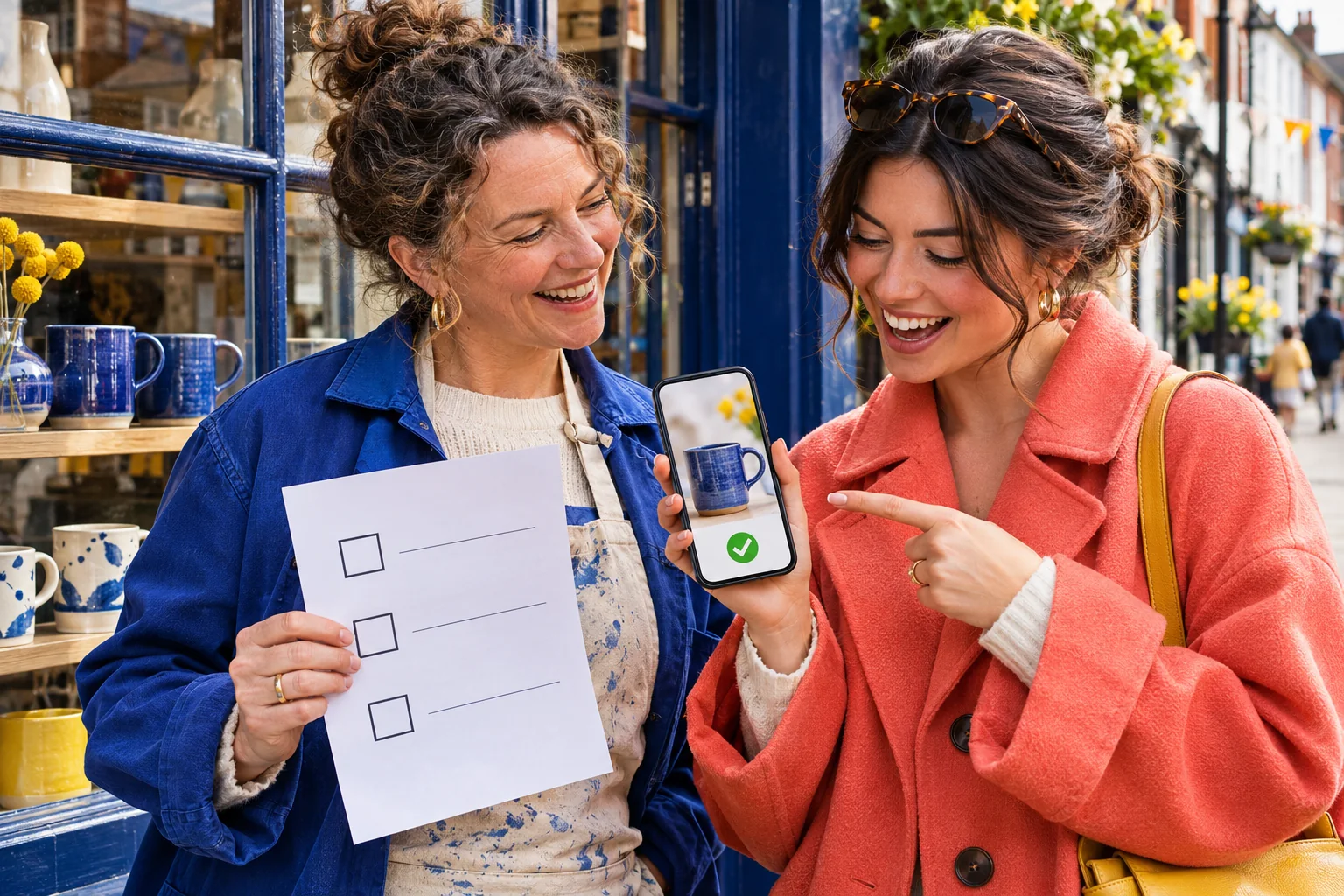
Save the live URL, publication date, final approved caption, files, rights note and a contact for corrections. If a Story is time-limited, agree a screenshot or other reasonable evidence at the agreed point; do not assume it will still be visible later. Record which use was licensed rather than storing one image in an unlabeled folder for future campaigns. The photograph in this section depicts the moment of checking a post with a blank approval sheet, not a promise that an app checkmark equals legal approval.
If the offer has changed between approval and publication, act while the message is still useful to correct. Pause a paid promotion or a scheduled reuse if the shop cannot fulfil the pictured offer. Ask the creator to correct or withdraw a materially wrong statement using the route in the brief. A public post can continue circulating after the original handoff, which is why an owner and a correction mechanism matter more than a ceremonial sign-off email.
- Open the live post as an ordinary viewer.
- Check the disclosure, item, link and current offer.
- Save a dated URL and a correction contact.
Measure the job without inventing attribution
Start the review with delivery: was the agreed content made, published, labelled and kept live for its agreed period? Then record observations with dates and sources. The creator may share a proportionate account insight snapshot for the specific post. The shop can count enquiries, bookings or orders in its own records where a supported route lets it identify them. Keep a tracked link or code distinct from a broad impression estimate. None of these figures alone proves why a person decided to buy.
For the Bristol shop, a customer could have seen the creator Reel, walked past the window and later ordered through an unrelated route. Another might tap a link but never complete a purchase. Report the actions the shop can actually confirm and describe the attribution limit. Do not turn profile follows into sales, views into unique local buyers, or comments into qualified leads without evidence. The creator's relevant work and a clear customer route can be judged even if there is no headline metric to celebrate.
A separate UK Instagram follower service may be relevant to a business considering its own profile presentation. If the shop explores that option, compare the service terms on the UK follower page and evaluate the count separately. A purchased count cannot establish creator fit, campaign reach, ad performance, recommendations, enquiries or sales. Keep any service decision outside the creator's delivery evidence. This distinction helps the owner choose a collaboration on the quality of its work and the needs of the business rather than on an unrelated profile number.
- Record delivery and observations under separate headings.
- Use business records for confirmed enquiries or orders where available.
- State what cannot be attributed to the creator post.
Close the project and decide what can be reused
At the agreed review date, confirm payment, live post status, any correction, the files delivered and the remaining licence period. Record where the shop has already reused the content. If a product or claim has expired, remove an old Story Highlight, pinned post or ad that still suggests it is current. Do not quietly extend the original licence because the content performed well or because the creator is happy with the shop. Ask for any new use in writing and check the rights of music, other people and third-party material again.
Keep a short learning note: which customer question the work answered, whether the public destination was usable, what staff were asked, what factual corrections occurred, and what could be clearer next time. The answer may be to improve the shop page or response process rather than commission more posts. If no local fit emerged, do not publish a thin partnership simply to fill a calendar. A useful next brief grows out of a real unresolved customer task and the business's ability to fulfil it.
The first collaboration should leave both parties with a clean record: what was promised, what appeared, what was paid, what may be reused and what remains unknown about outcomes. That record makes future work easier to scope without pretending one post proves growth. The separate UK media-kit, disclosure and customer-image guides can be used when those narrower questions arise. This brand-side brief is complete when the customer-facing content and the rights behind it are both clear.
Frequently asked questions
How do I brief a local Instagram creator for my UK shop?+
Give one customer task, exact product facts, public destination, formats, account, dates, fee, usage rights, disclosure decision, factual reviewer and correction route. Check the live outcome against that brief.
Does a large follower count prove a creator will reach local customers?+
No. Review relevant work and dated, legitimate audience evidence where available. A visible count does not establish location, attention to this post, enquiries or sales.
Is a free product enough to require an ad label?+
A gift can be a material commercial connection. Check current ASA/CAP and CMA guidance against the actual arrangement and post; do not assume that the absence of cash removes disclosure duties.
Does paying for a Reel mean my business owns it?+
Generally, paying for commissioned creative work does not automatically transfer copyright. GOV.UK advises checking written ownership and licensing terms. Agree each planned use before filming and seek tailored advice for a complex contract.
Can I turn the creator's organic Reel into a paid ad later?+
Only if your agreement and all relevant material rights cover that paid use. Specify channel, duration, territory, editing and any music or third-party material. Ask for new permission when the original licence does not cover it.
Is Instagram's paid-partnership label always sufficient in the UK?+
Do not assume so. Check the whole presentation against current ASA/CAP and CMA guidance, including whether people can recognise the ad when they first encounter it. The separate UK disclosure guide explains format checks.
What should I save when the creator publishes?+
Save the live URL, date, final caption or asset, evidence of the agreed label, public destination test, approval note, permission terms and correction contact. Keep any insight snapshot dated and named.
Can creator views or new followers be reported as campaign sales?+
No. Views and follows are different measures from confirmed enquiries or orders. Use available business records for actual customer actions and state when attribution to a creator post is uncertain.
Compare Instagram Followers packages.
Prepare the public destination, then review the quantity and terms that fit your goal.
Compare UK Instagram follower options separately