
A practical disclosure decision sheet for one Instagram item
| Situation | What to establish | Publication check | Do not rely on |
|---|---|---|---|
| Paid post or service | Who pays, what is supplied and who approves the post | Make the ad clear upfront and check the whole claim | A private contract or brand tag |
| Gift, free experience or loan | What was received, from whom and whether the post refers to it | Review current ASA/CAP and CMA guidance before posting | Saying only gifted or thank you |
| Affiliate link or code | What can earn commission and which content promotes it | Check the post and the destination for clear advertising disclosure | The code revealing the relationship by itself |
| Own brand or employer | Whether viewers can recognise the commercial connection from this account and item | Make the connection clear where context does not already do so | A profile bio or previous post |
| Unpaid, self-bought mention | Whether any gift, benefit, personal or commercial connection exists | Record why it is independent; reassess if circumstances change | Assuming every unbilled post is independent |
| Shared Collab post | Which account promotes whose product and under what arrangement | Check the published shared item and any disclosure in context | Collab status as a substitute for disclosure |
Start with the relationship behind one post
Disclosure is a question about the content a person will actually encounter, not a badge attached once to a whole creator account. Before writing, name the creator, the business or product, the exact Instagram item, the audience and what each party receives. A paid Reel, a gifted sample mentioned in Stories and an affiliate link in a product recommendation create different records. Looking at them separately avoids a vague promise that every collaboration will be handled by one label copied from a prior campaign.
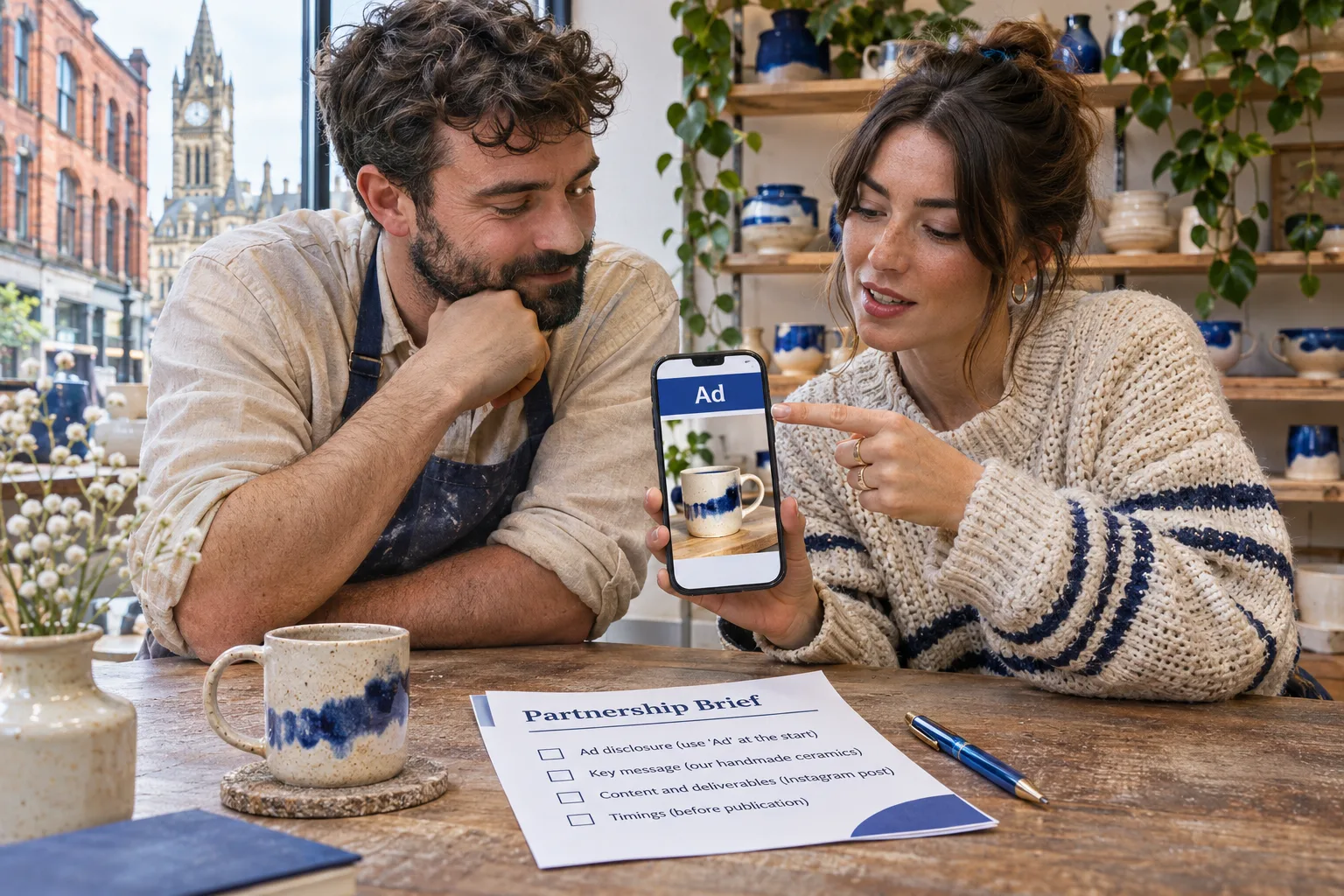
Imagine a Manchester ceramics shop working with a local creator on a handmade mug. The example is fictional and reports no campaign result. The shop offers the creator the mug and a fee to show its features in a Reel, while the creator keeps control of an honest account of using it. The agreement says when the draft is due, what the shop may verify, whether it may reuse the footage and who checks the published disclosure. A clear record lets both parties identify an error; it cannot make an inaccurate product claim true.
This article is the publication step after a business and creator have decided to work together. A media kit answers a different question: whether a creator can show relevant past work and dated audience information to a potential partner. An Instagram Collab invitation is a platform control for sharing a post; it does not decide whether an audience understands the commercial relationship.
Check payments, gifts and personal connections
The ASA/CAP influencer guide was updated on 23 October 2026 and covers payments, other incentives, affiliate arrangements, labelling and examples. The CMA's GOV.UK guidance also addresses gifts and informal arrangements, including an item sent without a contractual obligation to post. Use the sources for the specific situation rather than assuming that only a cash fee counts. A free service, reduced price, loan, travel invitation or commission can change how the audience should understand an endorsement.
The relationship check should also ask whether the creator owns the business, works for it, has a stake in it or has another relevant personal connection. A post about a family business can look like an independent recommendation if that link is hidden. The regulator guidance treats the viewer's ability to recognise the commercial nature of the content as the central issue. Record the facts honestly before choosing wording; a label selected before the arrangement is known can be the wrong one.
There is no follower threshold that removes this obligation. A small local creator may influence a purchase decision, and a larger creator may publish an entirely independent mention. If the shop is unsure whether an unsolicited gift, an old ambassadorship or a later commission affects a draft, pause it and use the current ASA/CAP and CMA guidance or obtain case-specific advice. This guide is a workflow, not a legal ruling on every possible arrangement.
- Record every payment, gift, loan, discount, commission or other benefit connected to the post.
- Identify ownership, employment, family or other commercial and personal connections.
- Check the current ASA/CAP and CMA material for that particular arrangement before choosing a label.
Use a decision sheet before writing the caption
Start with the table above and write one row for each proposed item. The first column is an example, not a universal legal category that mechanically produces an answer. What matters is the real exchange of value, the creator's connection and what the public item says or shows. If a brand pays for a Reel, the job record should name the fee, claims the brand will check and the point at which the creator can decline an inaccurate claim. If the item is gifted, note what was supplied and whether the creator will refer to it.
An independent mention has to be genuinely independent. Someone who bought an item at the ordinary retail price and has no other relevant relationship may be describing their own purchase. But 'the brand did not ask me to post' does not settle the question if the item was free, a commission is possible or a personal connection exists. The opposite is also true: do not label a genuine independent review as a paid partnership simply to make a campaign look formal. Record the actual facts and explain them truthfully.
Before approving, ask four plain questions: Who benefits from this post? What did the creator receive or expect? What can the viewer tell on the first view? What evidence supports the product claims? If one answer is missing, send the item back to the owner of that fact. A checklist is useful because the shop and creator may each know different parts of the arrangement.
- Ask what the viewer will see first, before tapping more or visiting a profile.
- If the relationship is uncertain, pause publication and seek current regulator guidance or case-specific advice.
- Do not treat a promotional code or hashtag as a disclosure decision.
Make the advertising nature obvious at first view
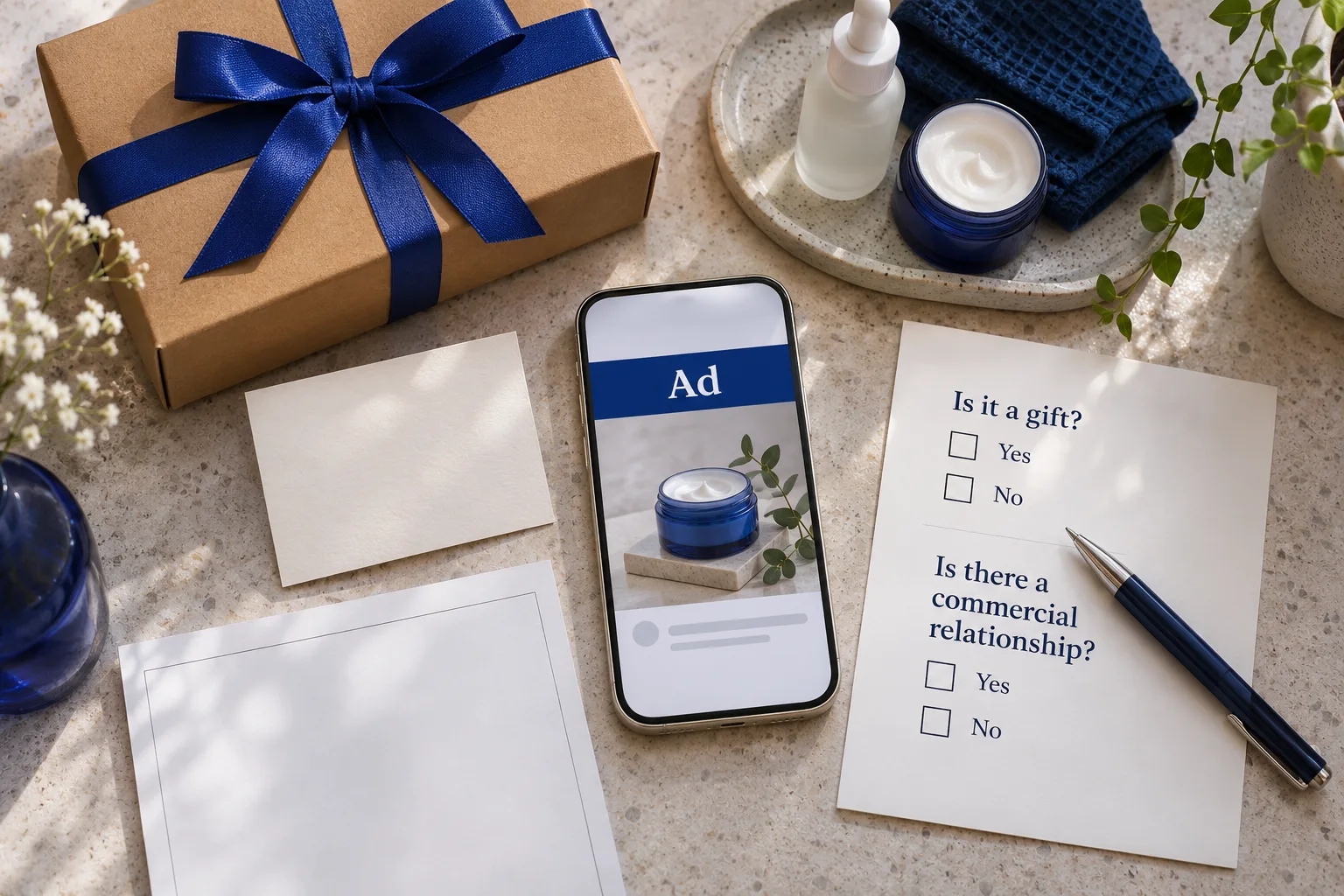
UK guidance is concerned with whether a viewer can identify advertising immediately. The ASA/CAP advice generally expects a prominent, upfront Ad label on influencer advertising. GOV.UK likewise recommends plain words such as Ad or Advert and warns that a label tucked among many hashtags, under a caption expansion or behind a profile visit is not enough. Place the disclosure where someone sees it before they read, watch, tap or otherwise engage with the promotion. Then inspect the real presentation on a phone.
Use ordinary language. 'Gifted', 'thanks to', 'affiliate', a partner's @mention or a personalised discount code can explain a detail but may not make the advertising nature clear. A creator can add detail after Ad, such as that a product was supplied for free, if it is truthful and helpful. A large label hidden behind a Story interface or blended into the photograph is still a poor label. Check contrast, size and the cropped first frame rather than deciding solely from the editable design file.
A clearly identified shop account promoting its own goods is a different context from an outside creator's personal feed. CAP says brand-owned social posts can often be recognisable as advertising from the account and surrounding context. The CMA guidance advises that creators promoting their own or connected brand make the commercial connection clear. For either case, look at the specific item and account; do not assume a bio, an older post or a familiar business name tells every new viewer enough.
Use Instagram's partnership tools without assuming they finish the UK check
Meta describes branded content and partnership ads as distinct from a normal paid ad bought in Ads Manager. It has a Paid partnership label and partner-tagging controls for eligible content and accounts. The exact screens and eligibility can change, so check Meta's current Help Centre for the account and format in use. A creator and business should agree which account will be tagged, whether permissions are needed and whether the brand is being allowed to use the content in a separate advertisement. Those rights are not implied by an ordinary tag.
Use the relevant Meta control where its policy requires it, but evaluate the public item under UK disclosure guidance as well. ASA/CAP says a Paid partnership tool can help if its label is upfront, clear and prominent; it may still be insufficient in a particular presentation. A screenshot of a setup screen does not show how the finished Reel, Story or post appears to a viewer. If the platform label is obscured or easy to miss, add a clear upfront Ad label in the content and check it again after publication.
An Instagram Collab post asks another account to accept a shared publication. It does not by itself tell the audience whether money, a gift or affiliate commission changed hands. A brand tag is also just a link to an account. Check both the platform requirements and the audience-facing wording before either partner signs off.
- Use the platform partnership tool where Meta's policy and the account's controls call for it.
- Preview the public result and check whether an ordinary viewer sees that it is an ad immediately.
- Add a separate upfront Ad label when the platform presentation is not sufficiently clear.
Treat affiliate links and discount codes as commercial content
If a creator may earn commission from a tracked link or code, record that arrangement before publishing the recommendation. ASA/CAP's affiliate guidance explains that a post referring to a product tied to an affiliate route can fall within the advertising rules, even when the link is not in the first sentence. A personalised code can tell a viewer where to save money while leaving them unaware that the creator benefits. The code therefore cannot carry the disclosure by itself. Make the advertising nature clear in the item people see.
Trace the real path from a Reel, Story or carousel to the affiliate destination. If a Story has a link sticker, check the first frame and the frame carrying the recommendation. If a caption says to use the link in bio, do not rely on the bio as the only place that explains the commercial relationship. If a later Story repeats the endorsement and someone can view it independently, reassess that frame. The exact placement depends on the format, but the viewer should not need to solve a puzzle to understand who benefits.
The business should know what the affiliate is authorised to claim, how a code is displayed, how long the offer actually runs and what happens if it changes. A creator should not imply they bought and tested a product if they received it free or have never used it. Disclosure and truthfulness are separate checks: an obvious Ad label will not fix a false discount, untested result or expired offer. Keep the current landing page and price evidence with the campaign record.
Separate a gift, a review and a product claim
A brand can send an item without demanding coverage, but the creator still needs to consider the gift if they later post about it. The current CMA guidance explicitly discusses gifts without an obligation to post. ASA/CAP's guide distinguishes different regulatory routes behind commercial content, so do not flatten every case into the same legal explanation. A useful operational default is to record the gift, check the current guidance and make the audience-facing relationship unambiguous when the item is promoted. Avoid presenting a supplied sample as a personally purchased product.
The creator needs freedom to describe the real experience. A shop can verify its product's material, dimensions, stock and care instructions, but should not write a glowing first-person reaction for a creator who has not tested the item. If a skincare product was sent, a visible label says why the item is being discussed; it does not establish that it works for every person. If the item has not been used, say so or leave out experiential claims. Keep a copy of any objective information the brand provided and the creator's own observations separate.
Different rights can arise around the content itself. Permission to send a gift, permission for a creator to publish a review and permission for a brand to reuse that review in paid advertising are not identical. Put reuse channels, duration and approval in writing before the business downloads or promotes a creator's image. The UK customer-photo guide handles permission for ordinary customer images; this guide addresses the separate commercial-disclosure question when a creator is incentivised to recommend or promote the brand.
Plan the label for posts, Reels, carousels and Stories
A text caption can be truncated on a phone. A Reel may start playing before the viewer reads that caption. A Story can be entered at a later frame or viewed with controls overlaid on the design. Draft for the first interaction in each format. The label should be noticeable in the part of the item a viewer sees without tapping more. If the format permits a platform Paid partnership label, inspect that presentation too. Do not treat a universal template as safe without previewing the final crop and background.
For a carousel, review each card that independently conveys the commercial claim, because a viewer may see or share a later card without the first one. For a sequence of Stories, a person may arrive midway; check the frames that carry the endorsement or offer. ASA/CAP guidance discusses the need for disclosure across independently viewed parts, while GOV.UK stresses that a viewer should not have to rely on previous content. The practical test is whether a new viewer understands the relationship from the item in front of them.
Plan accessibility alongside disclosure. Contrast and size matter for the label, and the spoken message in a Reel should be accurately captioned where possible. Keep important offer terms in readable text instead of making a viewer decipher tiny writing in an image. Give the preview a real reviewer and an explicit pass or fix result.
- Review the first visible caption line, thumbnail, video opening and each independently viewed Story frame.
- Keep the Ad label readable against the background and away from interface controls.
- Recheck cropped previews on a phone before approving the final item.
Check the actual published first view
The best place to find a disclosure problem is the public item, not a draft. Open the published post from a normal viewer account or a logged-out browser where possible. On a phone, look at the top of the caption, the video thumbnail and first seconds, or the initial Story screen. Ask whether the Ad label is visible before interacting and whether it is legible on the actual background. If a platform label appears, ask whether it communicates an ad clearly in that context. Do not infer the answer from the editing screen.
For the fictional Manchester ceramics Reel, the shop owner and creator open the public link separately. They see the Ad label at the beginning, confirm that the mug shown is the agreed product and check that any price or availability still matches the destination. A colleague who was not in the briefing should be able to tell that the post is promotional. If not, the team changes or withdraws the item. That external-view check is especially useful when everyone who made the post already knows about the fee or gift.
Keep a dated screenshot of the first public view and the exact URL with the brief. This is not a substitute for fixing a problem viewers can still see; it is a way to know what was checked and to avoid relying on memory. Reinspect after an edit, a changed offer or a new Story version. If a label disappears because of a repost or another account's crop, assess that item separately rather than assuming the original approval travels with the asset.
Give the creator and brand separate approval jobs
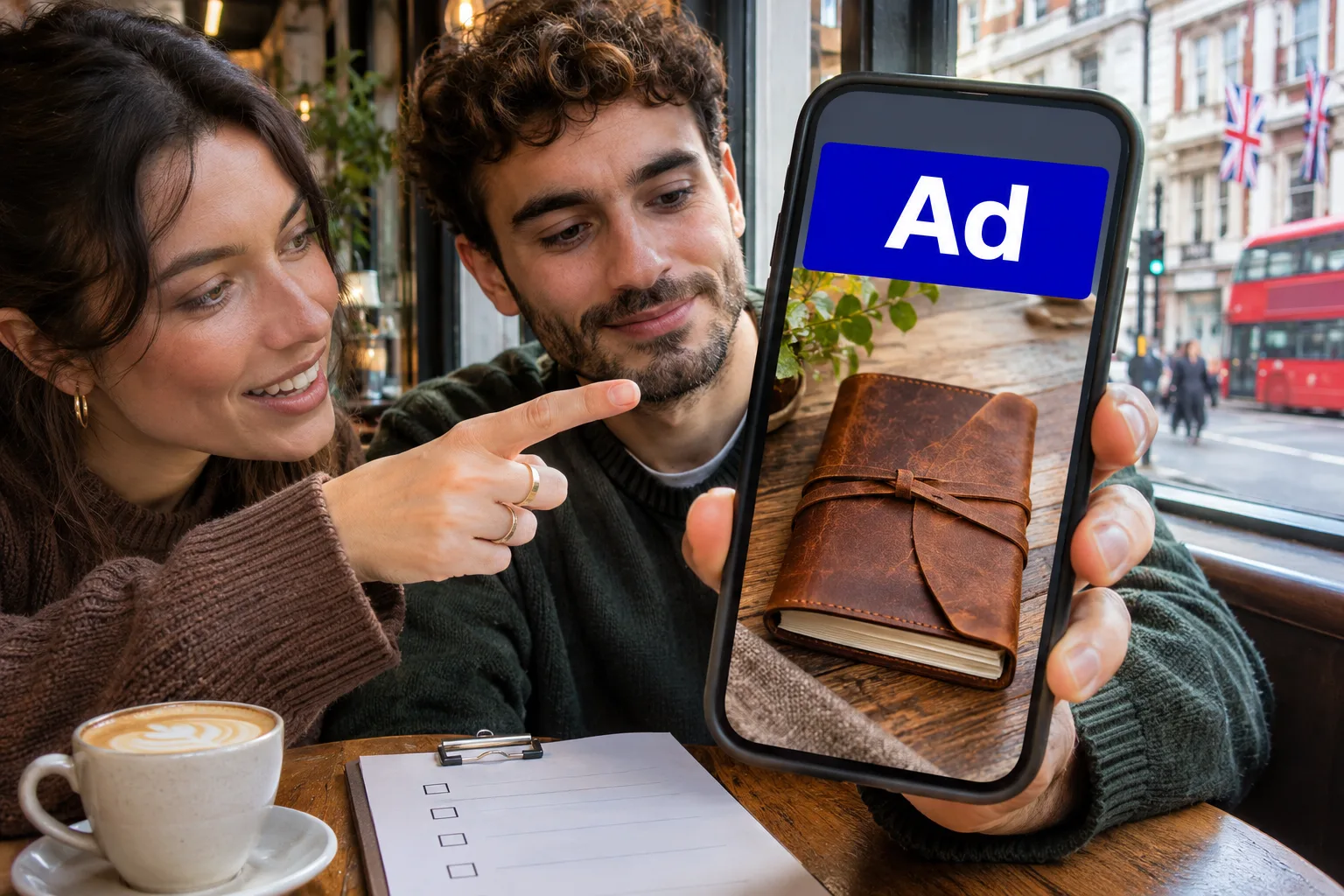
A good brief says who supplies product facts, who can approve a claim, who confirms rights to images and music, who checks disclosure, and who owns a correction. The brand can verify dimensions, ingredients, dates and a live offer. The creator can verify whether the first-person account matches their own use. Neither party should ask the other to certify a claim they cannot know. Both have an interest in ensuring advertising is recognisable, and ASA/CAP guidance describes responsibility on both sides of an influencer ad.
Make approval practical: save the draft, the agreed relationship, the first-view label, the landing page and the named reviewer. If the brand changes a product price after approving the Reel, someone must compare the published claim with the new offer. If a creator adds an affiliate code later, someone must reassess the item and its disclosure. If a consumer points out an error, acknowledge the specific issue, verify the fact and correct or withdraw the public item rather than leaving a misleading post visible because it once passed a review.
Treat audience numbers as a separate reporting question. A follower count, views or likes do not prove that a viewer recognised an ad, believed a claim or bought the product. Do not present a purchased count as organic audience evidence in a media kit or campaign report. A business may compare current UK Instagram follower packages for a separate profile-presentation choice, but that service cannot make a paid recommendation compliant and cannot guarantee genuine engagement, leads, recommendations or sales.
- Agree who verifies claims, rights and the public disclosure before publication.
- Keep the final post URL and an image of its published first view for the job record.
- Correct or withdraw a problematic item and record what changed.
Run a compact final check before and after publication
The final check should fit on one page: identify the item and account, write the real commercial relationship, verify the claims and permissions, select a clear audience-facing disclosure, then inspect the first public view. Record who approved each step and what would trigger a correction. For a small shop, this can be a shared document rather than a complex system. What matters is that the person publishing knows when to pause and whom to ask, especially if a gift, code or reuse right changes between drafting and posting.
Try the framework on three different examples. A paid ceramics Reel needs the relationship made clear and the mug claims checked. A creator's gifted skincare Story needs a fresh look at what was supplied, what the Story says and where the label appears. A notebook affiliate link needs the commission relationship apparent in the promotional content, not only behind a bio link. These examples are illustrative, not a blanket determination of how a regulator would rule on an unseen post. Use the latest ASA/CAP and CMA material for the real facts.
After publication, save the public link, the first-view check and any later correction. If you plan another campaign, review what people actually asked about the product and whether the disclosure remained visible across every format used. Keep the marketing result separate from platform counts and from the legal clarity of an Ad label. The goal is an audience that can understand both the product and the commercial relationship without guesswork.
Frequently asked questions
Does a UK Instagram creator need a minimum follower count before ad rules apply?+
No. ASA/CAP says there is no particular follower threshold for an influencer. Review the specific post and any payment, gift, affiliate, ownership or other relevant connection.
Is #gifted enough for a free product?+
Do not rely on #gifted alone to show that content is advertising. GOV.UK lists it among ambiguous terms. Check the actual arrangement and use a clear, prominent Ad or Advert label where the guidance calls for disclosure.
Does an unsolicited gift count if I was never asked to post?+
It can matter. The current CMA guidance covers gifts sent without an obligation to post. If you later discuss the item, check that guidance and ASA/CAP's current influencer guide for the facts of your post before publishing.
Is Instagram's Paid partnership label always enough in the UK?+
It can help when it is upfront, clear and prominent, but ASA/CAP says it may not be enough in every presentation. Check the public item; add an upfront Ad label if the commercial nature is still unclear.
Can I put the ad disclosure only in my Instagram bio?+
No. A viewer may encounter the post without opening the profile. Current ASA/CAP and CMA guidance expects the commercial nature to be clear from the promotional item at the first interaction.
Do affiliate codes need a disclosure when the creator is not paid a flat fee?+
Potential commission is a commercial relationship. Check ASA/CAP affiliate guidance and make the advertising nature of the relevant promotional content clear; a personalised code alone does not explain it.
Does an Instagram Collab invitation disclose a paid brand deal?+
No. A Collab invitation arranges shared publication. The viewer still needs to recognise advertising where a commercial relationship exists; check the displayed post and use the relevant Meta tools and clear UK-facing wording.
What should a brand do if the published ad label is hidden?+
Have the owner correct or withdraw the affected item promptly, verify the new public view and keep the correction in the campaign record. Recheck each separately viewed Story frame or reused version rather than assuming the draft approval covers it.
Compare Instagram Followers packages.
Prepare the public destination, then review the quantity and terms that fit your goal.
Compare UK Instagram follower options