

A four-phase seasonal truth and publishing sheet for a fictional Leeds gift shop
| Phase | Useful Instagram item | Verify before publishing | Change trigger |
|---|---|---|---|
| Early planning | Show the range and how to choose among gifts | Products, variants, prices and working destinations | A featured version is unavailable or pictured incorrectly |
| Active season | Demonstrate a gift and answer a repeated buyer question | Current stock, delivery area, charges and response cover | An answer or service option changes |
| Approaching fulfilment limit | Explain remaining delivery or collection options | Shop's capacity, carrier information and staffed collection hours | The shop cannot support an earlier delivery claim |
| After the occasion | Close dated invitations and explain the next supported step | Returns route, current availability and links still open | An old Story Highlight or pinned post implies a past offer continues |
Choose the seasonal customer task before choosing a posting target
A Christmas campaign for an independent shop is a changing set of gift decisions, fulfilment choices and customer questions. It is not one product going on sale once. Start by listing the people the shop can actually help: someone comparing gifts, someone checking collection, and someone asking whether an order can be delivered to a particular address. Then map the shop's real products and service routes to those tasks. The campaign should make these choices easier to understand, not simply fill every date in a calendar.
Imagine a fictional Leeds shop that sells notebooks, wool scarves and small home gifts. Its owner wants to use Instagram through November and December while stock and opening hours change. This example does not claim to describe a real HitsBoost customer or a measured campaign result. The team can group gifts by recipient need or use, but must show the actual version offered. If a scarf colour is gone, a beautiful photograph of that colour cannot remain an invitation to buy it without a clear correction.
This guide has a different job from the existing UK product-launch and local-event guides. A product launch checks one new item from sample to checkout. A local event checks one venue and date. A seasonal shop campaign has several available items, multiple fulfilment routes and repeated changes that may invalidate already-published posts. Treat those changes as the central planning problem. A modest, accurate programme is more useful than an ambitious schedule the shop cannot maintain.
Make a live gift and stock truth sheet
Before shooting content, create one line for every featured product: its exact name, variant, current price owner, stock source, link, delivery areas, collection status and the person who approves a change. A paper sheet or ordinary shared document is enough if everyone knows which copy is current. The key question is whether the item in the photograph is the same item a visitor can order. A different size, colour or included accessory can change the offer even when the product family name stays the same.
For the Leeds shop, a winter scarf post could show three colours, while only two are currently available online. The team should photograph the available choices or make the limitation clear where the visitor encounters the offer. If stock is made to order or coming later, describe that arrangement plainly and verify the actual production and fulfilment plan before suggesting a delivery time. Do not use a generic 'limited stock' phrase as drama when there is no checked record behind it.
Give the sheet a review rhythm tied to real change. The stock owner updates it when a sale, supplier change or quality check alters availability; the social owner checks it before a draft is scheduled and again before a time-sensitive reminder goes live. GOV.UK's distance-selling guidance describes information sellers need to provide before a customer orders. The social post need not reproduce an entire contract, but it should lead to a current and understandable public offer. Stop the post if that destination contradicts the sheet.
- Name each item and exact variant shown in a planned post.
- Check physical stock or a plainly described preorder arrangement.
- Record who can approve a price, availability or fulfilment change.
Check the offer page, total price and returns route
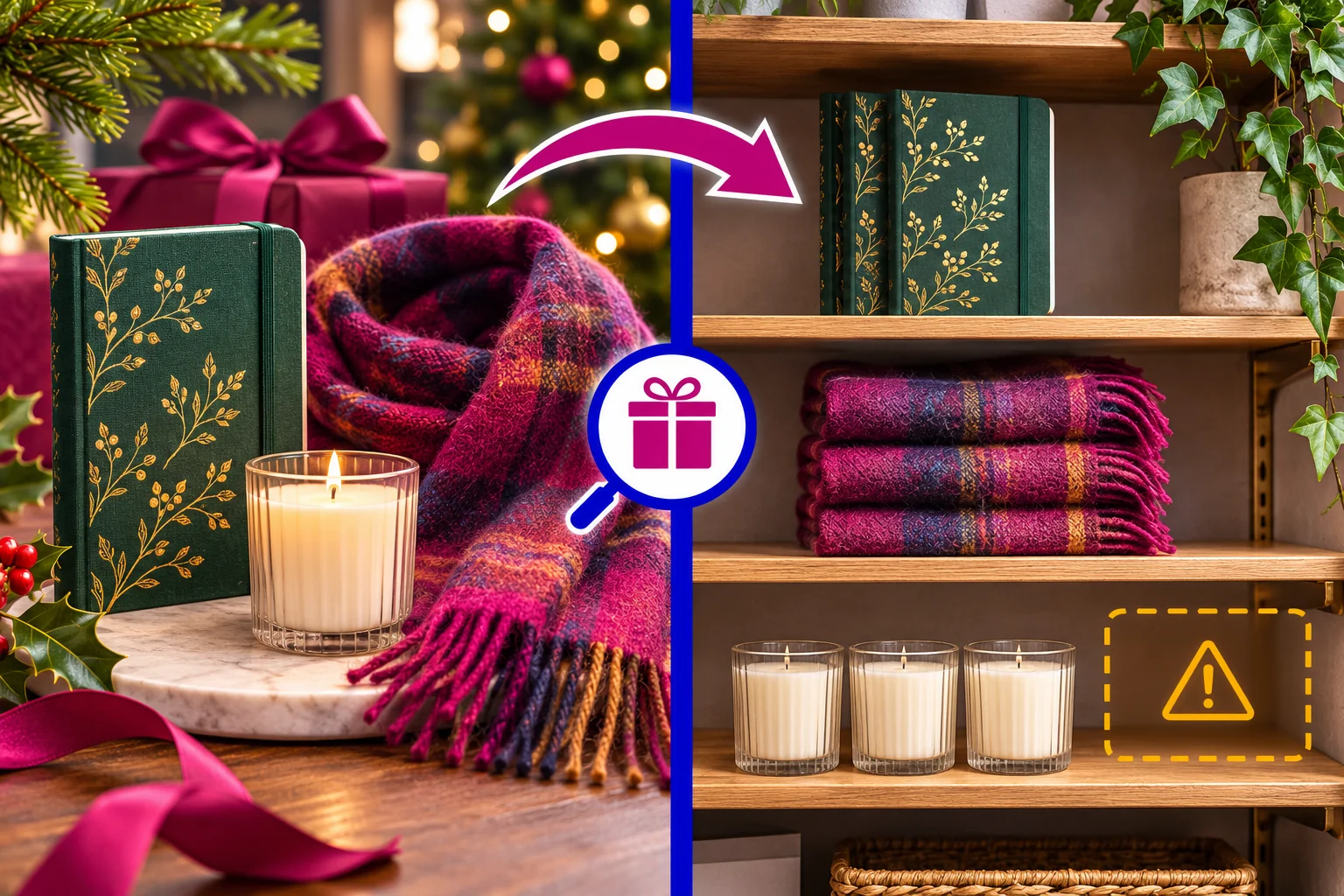
Every promotional route should land on a page where the shopper can find the pictured gift and see the actual decision before paying. Test the link while logged out on a phone. Check the chosen variant, total price including applicable taxes, delivery charges and options, collection terms if offered, payment step and order confirmation. A generic homepage is useful only if the advertised item is simple to find there. A Story sticker that opens a sold-out listing wastes the customer's time even when the sticker itself works.
The shop should also make its returns and problem route findable before the seasonal rush. GOV.UK explains the general duties for distance selling and separately says buyers retain refund rights when an item is faulty or not as described, including during a sale. The precise cancellation treatment can vary by item and sale type, so check current official guidance for the particular offer rather than copying a blanket 'no Christmas returns' line. A gift receipt or extended goodwill policy, if the shop actually offers one, should be described separately from legal rights.
Record which published posts point to each product page. If the shop changes a bundle, a price, a delivery method or a returns statement, check the post as well as the destination. A corrected checkout does not fix an old pinned caption that still states the previous terms. Where editing is unavailable or would leave the public message misleading, publish a clear correction or withdraw the item. The aim is one coherent offer across the photograph, caption, link and final order step.
- Open every public offer page as an ordinary phone visitor.
- Check the total price, available delivery or collection route and returns information before payment.
- Record the correction owner and the public posts that point to the page.
Choose Instagram formats by the question they answer
Use a format because it helps a buyer, not because the team has been told to make a Reel each day. A short Reel might show the texture and size of a notebook or how a scarf looks when worn. A carousel can compare several real gift options without claiming one is best for everyone. A Story can explain a current collection option if staff can keep its information up to date. A still photograph can be the clearest way to show the exact item and colour the customer will receive.
Make the next step specific and available to the account. The profile destination can lead to a shop page that clearly groups current gifts; an available Story Link sticker can point to an individual listing. Test the published route from a phone, including any page reached after a tap. Do not assume a caption URL is clickable in the same way in every Instagram surface or that every account has identical shopping features. When a control is missing, use a simpler route the team can verify now.
Keep the profile understandable for a first-time visitor. The shop's public description should identify what it sells and where someone can get help, while current posts explain actual offers. If an item is available only in the Leeds shop, do not let a national-looking post imply UK-wide dispatch. If a product is available online but collection has different hours, separate those facts. Instagram content can help someone find and understand a product; the seller still owns the accuracy of the buying path.
Build a flexible four-phase content plan
Use the four phases in the table as a decision sheet, not as a compulsory number of posts. Early material may introduce the range and help people compare useful gifts. During the active season, demonstrate a real product and answer recurring questions. As fulfilment options narrow, replace broad gift messages with current delivery or collection information. After the occasion, close dated invitations and give an honest next step. Each phase can be short or long depending on the shop's products and staff.
Write one job beside each proposed post. Examples are 'show notebook paper quality', 'compare available scarf colours', 'explain collection hours' and 'answer whether a particular parcel service is offered'. Add the public destination, an owner for factual approval, a planned review point and a correction trigger. If the image, caption or link has no useful answer, it can stay out of the queue. A few recurring themes and open slots are enough; the stock-and-service truth check matters because a seasonal offer can become wrong overnight.
Leave deliberate room to change a draft. The shop may have filmed a product that sells out, or a supplier may change the available variant. Replace the item with another verified question rather than preserving a schedule at the expense of accuracy. Meta describes an Instagram best-practices area in the professional dashboard, but a platform education hub does not know this shop's stock or staffing. Use available account tools for creation and review while letting actual business facts determine what is safe to publish.
- Give each proposed post one customer question to answer.
- Leave room to replace a draft when stock or delivery information changes.
- Review the next scheduled item against the live destination before it appears.
Produce useful product visuals and accessible explanations
Film or photograph the real product under consistent light and show details that help a buyer decide. A close view of a notebook's paper, a scarf's texture or the size of a candle can explain more than a crowded festive tabletop. If a prop is not included, keep it visually separate or say so plainly. Use the exact version that the linked listing offers. A video demonstration should show what actually happens, not a different sample arranged only for a more persuasive shot.
Keep important facts in ordinary text as well as imagery. A tiny price on a decorative card is hard to read on a phone and can be missed by people using assistive technology. Use accurate alt text for informative photographs where Instagram provides the control. Check spoken captions against the video and the current offer, and avoid covering the product with unreadable stickers. People should understand the gift and the next step with the sound off or at a small screen size.
Batch production only where the facts are stable. The team can record several product demonstrations in one afternoon, but time-sensitive stock, delivery and collection claims need a later check. Keep raw footage and an approval note tied to the variant shown. If a supplier swaps a colour before the post goes live, the team should choose a correct frame or reshoot. A polished visual is valuable only when the content beside it remains truthful at publication.
Treat delivery and collection as separate promises
A carrier's Christmas last-posting dates are useful planning inputs, but they do not automatically become the shop's order cutoff or an arrival guarantee. Royal Mail publishes current service dates and notes that they may change. The Leeds shop must add its own time for making, packing, payment checks and handoff, then consider the destination and service selected. If it uses a different carrier, it needs that carrier's current terms instead. Do not copy a date from another shop's Instagram caption or last year's graphic.
Before publishing any 'arrives in time' message, ask the fulfilment owner what the shop can actually support for that item, postcode and service. Some products may need more preparation than others. If a promise depends on an order time, stock state or delivery option, make that condition clear where the customer sees the claim and on the order page. ASA/CAP guidance on Christmas advertising warns that delivery-time claims can mislead when key limits are hidden. A deadline graphic should be withdrawn or corrected when the evidence changes.
Collection can be a useful alternative for a local customer, but only if the shop has an approved collection process, current opening hours and a way to tell someone when their order is ready. A product merely reserved in a basket is not necessarily prepared for pickup. Show the exact collection address and confirmation route at the destination. If the shop no longer has capacity for same-day collection, pause that invitation too. The image in this section shows the two routes separately because they create different expectations.
- Check the carrier's current page and the shop's own packing capacity.
- Use only a date or service level the shop can substantiate for that item and destination.
- Switch to an accurately described collection or later-delivery option when necessary.

Keep savings, scarcity and creator claims evidence based
A seasonal offer may include a genuine reduction or bundle, but the claim must match the actual items and price history. ASA/CAP guidance warns against exaggerated 'up to' savings, unclear significant conditions and countdown language that creates a false sense of urgency. The shop should save the approved prices, dates, eligible products and any conditions before publishing a promotion. If only one gift is discounted, a banner implying every gift is reduced would be a poor summary even if a small disclaimer appears later.
Availability claims need the same care. A real stock limit can be explained with a current check and a plan to update the post; a vague 'selling out fast' line is not a substitute for evidence. When a featured item is sold out, update the landing page and review active social posts, Stories, pins and ads. If a replacement is offered, identify it as a different product. Do not imply that a shopper is receiving the photographed version when the fulfilment team will send something else.
If a creator receives payment, a gift or another incentive to feature the shop, agree the exact item, factual claims, usage rights and disclosure before publishing. The current ASA/CAP influencer guidance should be checked for the particular arrangement. A shop's own recognisable account and a creator's recommendation are different contexts; a brand tag or Collab label is not a universal substitute for clear advertising identification. A partner cannot truthfully promise delivery or a price that the shop has not confirmed, so give them an approved current offer and a correction route.
Staff customer questions and corrections during the season
A campaign can make questions arrive when the packing bench is busiest. Assign an owner and backup for stock, delivery, collection, product details and returns enquiries. Decide which questions can be answered publicly from approved information and which require a private order lookup. A public comment is not the place to ask for a customer's address or order number. Give staff a way to mark a question as owned, awaiting a fact, answered or needing a correction to the public page.
Use a short response sheet instead of copying every direct message into a shared chat. Record the topic, owner and next action, and protect private customer details in the appropriate support system. If several people ask the same question, review whether the listing or Instagram post is unclear. Correct the source information first. A fast reply that contradicts the public offer may create more confusion than a slower answer that checks stock and policy.
Make corrections visible where the outdated promise still lives. A Story may expire, but its Highlight can remain; a pinned post can stay at the top of the profile; an ad can continue after a product sells out. When a shipping or collection statement changes, find all active copies and assign a staff member to review them. If the platform will not let a particular caption be changed, use a clear update or remove the misleading invitation. Staff cover and public accuracy are part of the campaign, not afterthoughts.
- Assign an owner and response route for stock, delivery and return questions.
- Keep private order details out of public comments.
- Publish a correction where an old promise remains visible.
Measure business records separately from social counts
Decide what success means before the first seasonal post. The shop might record confirmed orders for featured items, fulfilled collections, cancellations, support questions and return reasons. Those are business records, with privacy and other operational limits. Separately note each publication's date, topic, destination and whatever account insights are available. Instagram views, likes, profile activity and follower changes are different measures; none is an order or proof that a particular customer bought because of one post.
If the shop also uses email, window displays, local partners, paid ads or word of mouth, record them. A Christmas order after a Reel does not prove the Reel caused it. A tagged link may help identify some visits, but not every path or later conversation. Use the review to find practical issues: which product questions were unanswered, whether delivery wording confused people, which links broke and whether staff coverage matched the plan. Do not present an invented percentage uplift or a follower milestone as evidence of seasonal sales.
HitsBoost's UK Instagram follower service, if the shop considers it, addresses an eligible profile-count order under its current terms. That is a separate decision from this content and fulfilment plan. Check the live package page for the available tier, quantity and checkout total, and never share the Instagram password with a service. A purchased count cannot guarantee distribution, local shoppers, engagement, enquiries or sales. Compare it with its stated scope rather than treating it as proof that the Christmas campaign worked.
Close dated invitations and keep a useful record for next year
After the relevant Christmas offer ends, inspect the profile's pins, Highlights, saved destinations, still-running ads and product pages. An expired countdown or delivery claim can keep confusing people after the holiday. Update the page first, then remove or correct the public invitation wherever the platform allows. If a gift remains available with a different delivery expectation, explain the new offer rather than silently reusing the old caption. A seasonal post can be a good archive piece only when its live meaning is still accurate.
Review the shop's own record of actual orders and questions, without publishing customer details or attributing every order to Instagram. Which gift descriptions helped, which variants caused confusion and where did people ask for missing information? If the team was overwhelmed, reduce next year's draft volume and strengthen the approval and support steps. If a particular explanation helped customers decide, preserve the format and update its facts for the next season. Do not assume the same carrier dates or stock will apply later.
A recap can thank customers and show the shop's real work, but do not invent a sold-out claim or use a customer's face, message or photograph without the appropriate permission. The existing UK customer-photo guide explains a separate permission workflow. Save the truth sheet, the useful content, corrections and practical lessons in a place the shop can find next year. The lasting asset is a clearer customer journey, not a promise that repeating a posting frequency will increase sales.
- Find active pins, Highlights, ads and links after the occasion.
- Close or correct expired invitations and stale delivery wording.
- Save a short record of repeated questions for next year's planning.
Frequently asked questions
When should a UK shop start its Christmas Instagram campaign?+
Start when the featured products, buying routes and staff approval process are ready. There is no universal best date or posting quota. Use the shop's real stock and capacity to decide what can be published now.
Can I use Royal Mail's last posting date as my shop's guaranteed delivery cutoff?+
No. Check Royal Mail's current date and service updates, then allow for your own production, packing, handoff, destination and terms. Publish only a promise your business can substantiate for the particular order.
Should every Christmas gift post link to the same shop page?+
Only if that page makes the advertised item easy to find and accurately explains the current offer. A specific listing or clear gift collection may be more useful. Test the public route on a phone.
What if a featured gift sells out after I schedule a Reel?+
Pause or replace the scheduled Reel. If it is already live, correct the destination and the public invitation where possible, or post a clear update or withdraw the misleading item.
Do Christmas sale posts need to show delivery costs and conditions?+
Include significant conditions where a customer sees the claim and make the actual delivery cost and full offer clear before payment. Check current ASA/CAP and GOV.UK guidance for the specific promotion and sales route.
Can I reuse a customer's gift photo or review in a seasonal post?+
Ask for permission that covers the intended use and check that the words and product are represented accurately. The separate UK customer-photo and review guides cover those workflows.
Do I need to post every day to sell through Instagram at Christmas?+
No. Publish when a post answers a real question and the shop can keep its facts and next step current. A smaller verified plan is more useful than a daily schedule that promotes unavailable items.
Will buying Instagram followers make the Christmas campaign sell more?+
No. A follower package changes the defined profile count under its terms; it cannot guarantee reach, local customers, orders or sales. Evaluate that service separately from the shop's content and business records.
Compare Instagram Followers packages.
Prepare the public destination, then review the quantity and terms that fit your goal.
Compare UK Instagram follower options