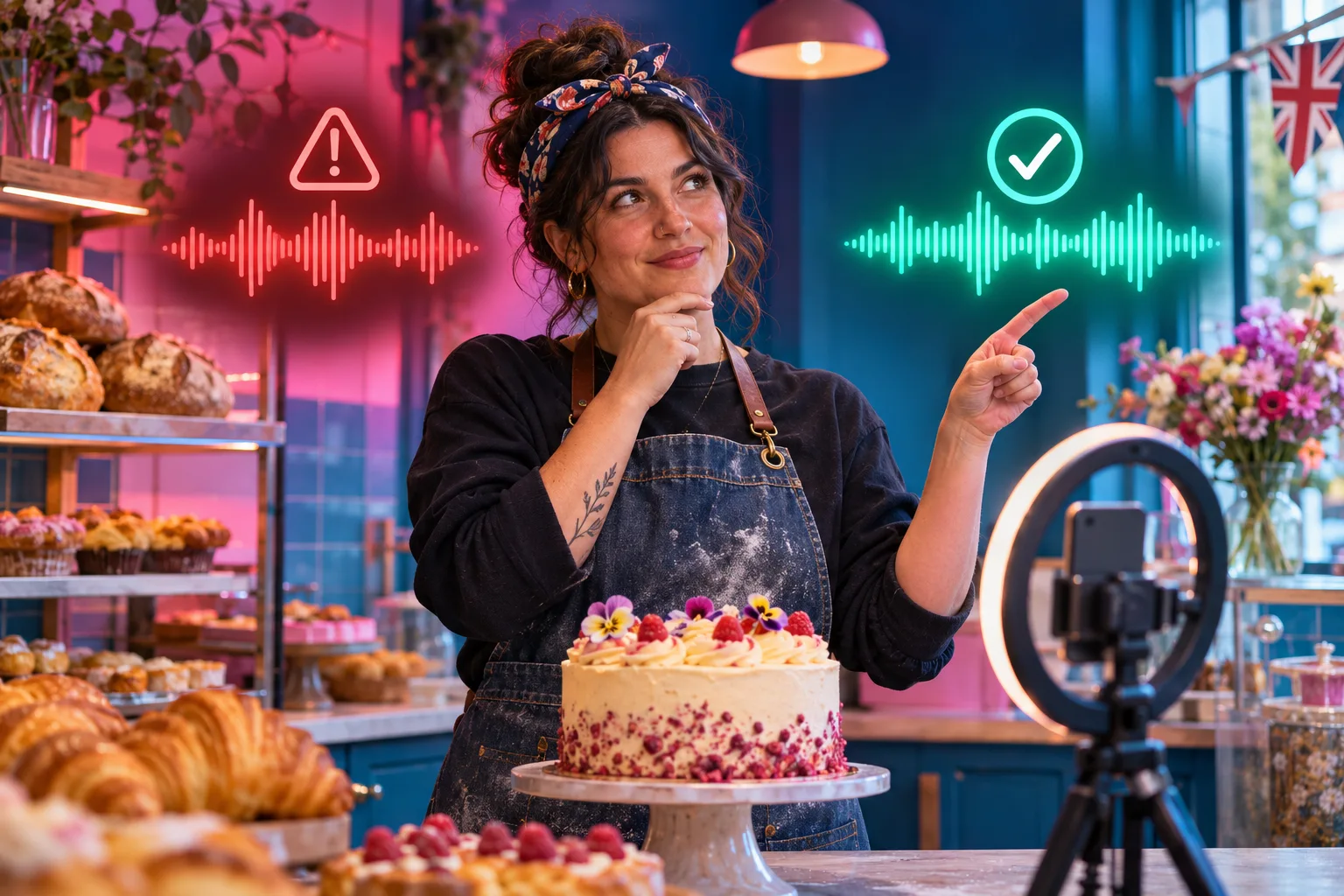
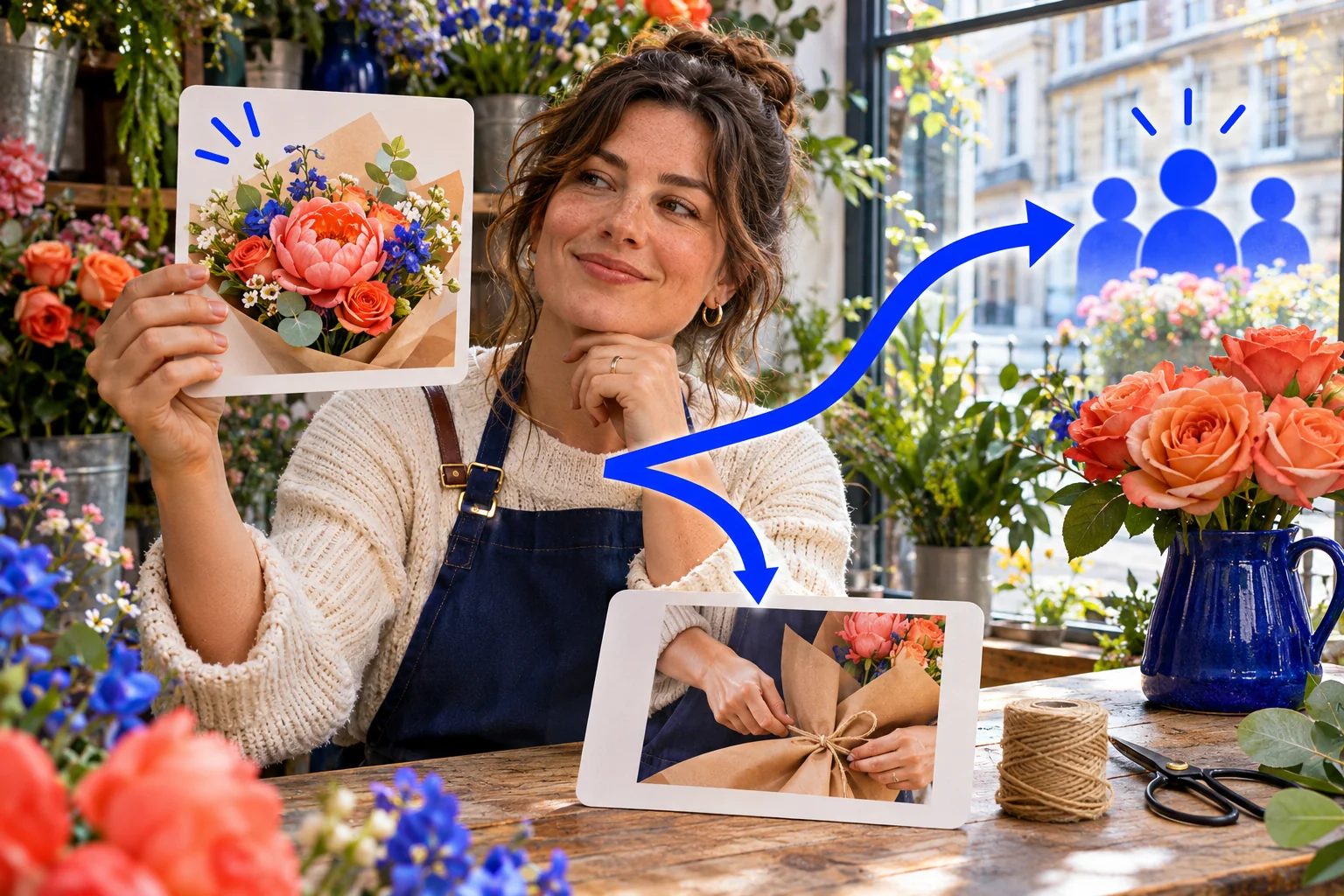
One-Trial-Reel decision sheet for a fictional UK florist
| Stage | Write down | Decision before moving on |
|---|---|---|
| Purpose | Can a close-up bouquet demonstration answer a common customer question? | Use a trial only if the question is new enough to learn from |
| Preflight | Current bouquet, availability, permission for footage, audio source and public destination | Correct any uncertain fact before publishing |
| Publish | Account, Reel link, Trial setting, automatic-share choice and local date | Confirm the published item and settings on the actual account |
| Review | Available views, likes, comments, shares and specific questions, with the same observation window | Look for comprehension and useful questions, not a magic view threshold |
| Next action | Share with everyone, revise a separate future Reel, or leave this trial unshared | Assign an owner to check the decision and any changing shop facts |
Understand what a Trial Reel changes
Instagram introduced Trial Reels as a way to share a Reel with non-followers first. In Meta's published explanation, a creator turns on Trial in the normal Reel composer before sharing. The Reel is then visible to its owner near drafts rather than appearing on the public profile's main grid or Reels tab. The owner can later choose to share it with everyone. That is a distribution choice for one piece of content, not a separate editing app, an ad campaign or a formal experiment with randomly assigned groups.
The word 'trial' can mislead a shop into thinking the post is private or risk-free. Meta says existing followers may still find a trial through a direct message or a surface connected with the same audio, location or filter. A florist should therefore publish only a Reel that is ready to be seen outside the team. The shop's ordinary standards for truthful product details, permissions, captions and a functioning destination apply before the Trial switch is touched.
A test can answer a limited creative question: do new viewers seem to understand the bouquet process, and do their comments expose a missing detail? It cannot establish how many people live near the shop or how many would buy. Meta's general Trial Reels announcement describes views, likes, comments and shares as review signals, not a local-customer count. The separate Reel-view guide explains why a view should not be read as a unique buyer or a completed watch.
Choose a suitable job for the format
The strongest first use for a small shop is a creative idea that is genuinely new but safe to publish. The fictional florist has already posted finished bouquet photographs. She wants to learn whether a short making-process Reel answers the question customers ask in person: what goes into the arrangement? A trial can provide a first look from people beyond her followers without immediately making the Reel a normal follower-facing post. The decision is about clarity of this idea, not about chasing a mysterious distribution score.
Some tasks need a normal post instead. If tomorrow's opening hours change, an out-of-stock bouquet is removed, or a paid workshop is nearly full, the shop should update its authoritative web page and use the communication route that reaches people who already need that information. A Trial Reel is a poor place to put the only copy of an urgent correction. A public post, Story, booking page or staffed support answer may be better for an existing customer question; choose the route by what the reader must do next.
Nor is a trial a substitute for the shop's broader publishing plan. One Reel may show whether a demonstration makes sense to people unfamiliar with the florist, while a calendar covers recurring themes, stock changes and staff capacity. If the shop lacks a clear answer to 'What will we learn from this Reel?', it can first make an ordinary useful Reel and measure it normally. There is no reason to create a trial merely because the control exists.
Check the control on the account you will use
Meta's June 2025 announcement said it had made Trial Reels broadly available. That is a product-level statement, not a guarantee about the exact menu on a particular shop account in November 2026. Before planning staff time around the feature, open the current Instagram app on the authorised shop account, start an ordinary Reel draft and inspect the final sharing options for Trial. Use the in-app information and Instagram Help Center to resolve account-specific eligibility or menu changes. Do not infer access solely from a competitor's screenshot or an article written for another country.
If the switch is absent, check the account actually selected in the app, the current app version and any relevant account-status notice. Note what you checked and ask official support if the issue remains unclear. Do not give a password to a tool promising to unlock Trial Reels, and do not invent a workaround that sends a shop asset to an unreviewed app. Publish an ordinary Reel or use a Story only if that route fits the reader need; neither is identical to a Trial Reel.
Before filming, review the public profile as a new viewer would. Is the bio accurate? Can someone identify the shop and the current ordering or enquiry route without guessing? A Trial Reel can be seen by non-followers, but the shop cannot assume that exposure is confined to its UK town. A location cue in the video may explain context; it is not a geographic targeting switch. Keep a realistic plan for answering general questions that arrive from anywhere.
- Open the Reel composer on the shop's current account and check whether the Trial setting is actually offered.
- Record the app version and the date of the check if staff need to revisit a missing control.
- Keep an ordinary Reel or Story plan available when the feature is not visible.
Plan one creative question, not a magic threshold
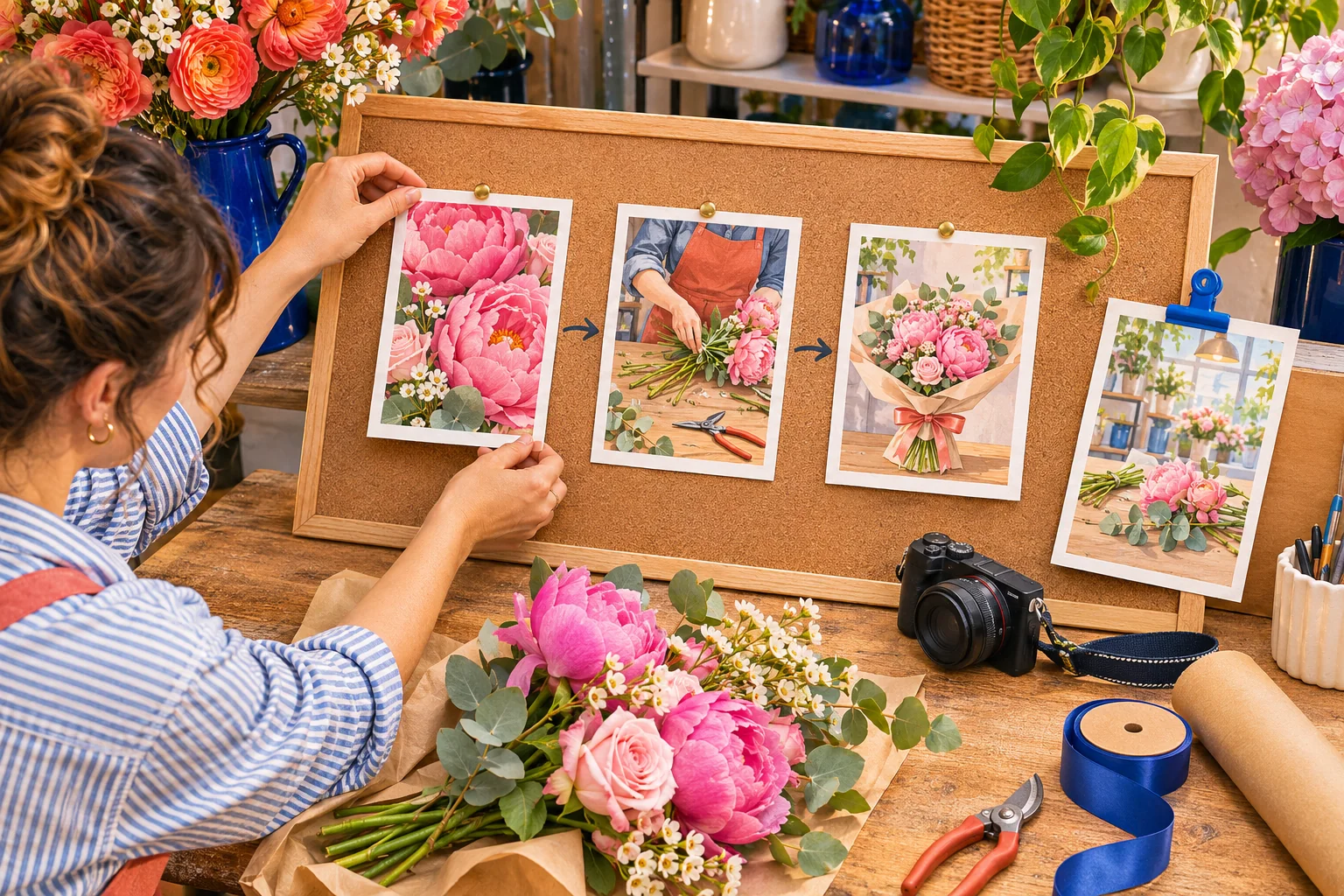
The storyboard image shows a bouquet close-up, the making process and the finished arrangement. The florist chooses that sequence because she wants to test whether an unfamiliar viewer understands how the bouquet is made. She parks a separate shop-tour opening for another day. This is a simple content decision: one concept, one promised payoff and one clear next step. It avoids changing the product, caption, audio, opening shot and destination all at once and then guessing which change mattered.
Write the question before recording: 'Does the process Reel make the bouquet easier to understand?' Then write the evidence that could help answer it. Relevant comments might ask about flower choices, care or availability. A share could indicate that someone found the explanation worth passing on. A high view number without any understandable response might still leave the shop uncertain. The worksheet captures these observations without assigning an invented success percentage or treating an early count as an official algorithm cutoff.
A shop can keep the production small. Use real stock, a calm background, a readable first frame and the actual work that the team is comfortable showing. Preview the Reel at phone size with sound off as well as on. If the first frame does not tell a newcomer why to watch, improve the edit before using Trial. This is a quality check, not a claim that one particular hook length, posting hour or view count controls Instagram distribution.
Approve the finished video as public shop content
A trial is still a published Reel. Check the bouquet in the film against what the shop can actually provide. If price, delivery area, order deadline or workshop availability appears in the video or caption, verify it from the current business record. Point the viewer to the exact current page or approved enquiry route if a next step is needed; a vague 'link in bio' is less useful when the destination does not answer the question. Do not promise that a follower, view or like will lead to an order.
Rights and accessibility need their own pass. Use footage the shop owns or may publish, obtain permission before showing an identifiable customer, and verify any soundtrack is licensed for this commercial use. Music visible inside the app is not automatically cleared for every business promotion or later paid use. Add spoken-word captions or accurate on-screen explanation where the Reel relies on speech, then review them on a phone. The separate music-rights and caption guides provide more detailed steps for those tasks.
A UK shop's promotional Reel should also be assessed as advertising where relevant. CAP's guidance on brand-owned and paid social content is a suitable reference for judging whether a commercial message is clear; the Trial label is not an ad-disclosure exemption. If a creator, partner or customer contributes content, approve the final wording, rights and any needed disclosure before publishing. Keep this as a fact and permission review, rather than a legal verdict based on a generic template.
- Confirm the bouquet, price and availability against the shop's current records.
- Use footage the shop may publish; obtain permission before showing identifiable customers or another person's work.
- Check audio rights, captions and the destination before anyone approves the finished Reel.
Publish deliberately with Trial enabled
Use the account and final file that were approved. Create the Reel through Instagram's current mobile composer, review the cover, caption, tags, audio and destination, then check the Trial option immediately before pressing Share. Meta's original instructions describe a Trial toggle on the final sharing step; screen labels may move as the app changes. If you cannot verify the setting on this account, pause and use the app's current help instead of claiming the post will be a trial.
For a first shop experiment, keep the share-with-everyone decision under human review if the current interface allows it. Meta says creators can choose automatic wider sharing based on its assessment of views within the first 72 hours, or manually share after review. The shop should inspect this choice and record it because an automatic transition could put a dated price or availability claim in front of followers after those details change. The 72-hour period describes Meta's optional automatic-sharing process, not a universal time limit for all learning or a published pass mark.
After posting, open the new Reel from the shop account and verify that it is the intended file, shows the intended Trial status, and can be located by the owner. Save its direct link and the local publication date in the worksheet. A staff member should know who will watch comments, correct factual errors and make the later sharing decision. Avoid creating several nearly identical trials at once; it becomes hard to tell what was learned and can burden the team with repetitive content.
Read the available response in context
Meta's Trial Reels announcement says key engagement figures such as views, likes, comments and shares become available approximately 24 hours after posting, alongside comparison with previous trials where provided. Treat that as guidance for when to look, not a promise that every account's metrics appear at an exact minute. Record the observation time, the period the screen covers and the metric labels. If the account supplies other Insights, use the on-screen definition instead of assuming that different counters have the same denominator.
For the florist, a question about flower care may be more useful than a reaction icon because it shows the video left a practical gap. A share may be encouraging but does not reveal whether the recipient lives nearby or bought anything. Views can include more than one play from a person, and comments are actions rather than unique prospective customers. Compare with the shop's own past trials only when the topic, observation window and available measures make that comparison sensible. A single small sample can be noisy.
Do not treat the 'first 1,000 views' idea as an official Trial Reels cutoff. Instagram has not published an exact first-1,000 cutoff in the official Trial Reels explanation. Instead ask whether the Reel answered the planned question, whether people misunderstood an essential fact, and whether the product and destination are still accurate. A qualitative note beside the numbers gives the next editor something useful to act on.
Choose to share, revise or stop
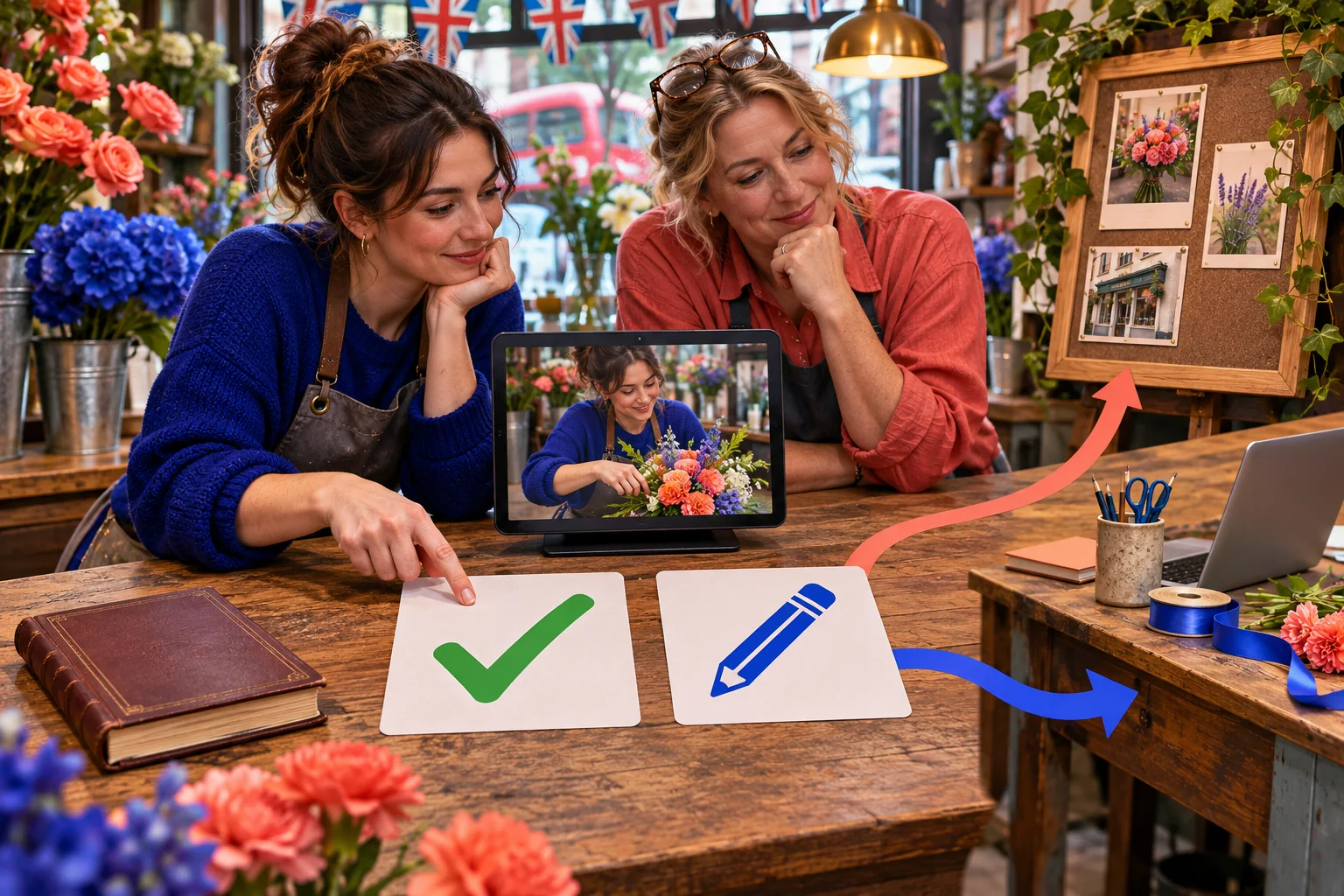
The review image shows three separate things: the filmed bouquet, two possible next actions and a closed notebook. A shop can choose to share the existing trial with everyone if the message is clear and current. It can leave the trial unshared and make a better future Reel when the first version creates confusion. Or it can stop if the product, footage or timing no longer makes the idea useful. Trial Reels provide a choice, not an obligation to promote a post that performed poorly or an automatic promise of bigger distribution.
Before sharing widely, check the final Reel again. Are the flowers still available? Does the caption send people to a current page? Is the audio still acceptable for this use? Meta says a Reel shared with everyone can appear on the profile grid and become eligible for follower distribution. That is a wider publication decision; it does not mean every follower will see it. If the automatic-share choice was enabled, check whether the Reel has already moved before making a second decision.
Record the reason for the outcome in one sentence. 'Share: the process was understood and stock is current' is more actionable than 'good numbers'. 'Revise: viewers asked whether delivery is available, but the Reel does not answer it' tells the next editor what to fix. If comments expose an incorrect statement, correct the relevant public information promptly. Do not delete or repost a weak trial merely to reset a counter; that erases learning without repairing the content.
- Share only after checking that the original facts and any linked page are still accurate.
- If the question remains unclear, revise the next piece of content instead of assuming a hidden algorithm failure.
- If the idea is no longer useful, leave the trial unshared and record why.
Keep business evidence separate from platform actions
A Trial Reel is not a local lead report. Instagram initially shows it to non-followers, and its available figures describe activity on that Reel. A view does not establish that someone is in the UK, visited the florist's website, sent an enquiry or ordered a bouquet. The shop should use its own records for those later steps: a dated enquiry, a confirmed booking or an order with a known source where that source is actually recorded. Do not fill a missing source field by assuming the Reel caused the sale.
The same separation applies if the shop considers a follower package. HitsBoost's UK Instagram follower page describes a separate service with its own quantity, destination and terms. A purchased count is not evidence that the Trial Reel reached local non-followers or that those people became customers. The decision to buy a package should be made on its own terms, without presenting it as a way to make an experimental Reel pass an undocumented threshold.
If the shop later pays to promote a different post, keep that paid distribution in a different row of its records. Organic trial exposure, a manual share to followers, a paid ad and a purchased follower count are different actions with different evidence. The UK organic-versus-paid guide helps compare those routes. A clean record prevents a lively video from being credited with sales it cannot demonstrate and gives the team a fairer basis for choosing its next useful video.
Make a modest follow-up plan for the next week
One trial is enough to start. The florist can write the creative question, approve the Reel, record the published settings, make one planned review and assign a final decision owner. If the first video reveals a customer question, the follow-up might be an ordinary Reel that answers it directly. If it reveals a missing product fact, update the shop's page before making more content. The point is to improve the information available to a real viewer, not to manufacture a stream of near-duplicate trials.
Use the worksheet as a small team handoff. An owner signs off the product details and permissions; an editor checks the video and captions; a staff member answers general comments and routes private order details to support. The same person can cover more than one role in a tiny shop, but the responsibilities still need names. Review only the measures available on this account, and leave blank fields blank instead of inventing conversion figures.
At the end of the week, compare the planned question with what the team actually learned. Decide whether the next task is a clearer opening, a different demonstration, a better destination or no further Trial Reel. Meta's in-app Best Practices resource can supply current account-specific creation guidance, but its suggestions do not override the shop's factual checks. Keep a flexible publishing calendar so the team can stop when there is no worthwhile customer question to answer.
Frequently asked questions
What is an Instagram Trial Reel?+
It is a Reel shared to non-followers first through Instagram's Trial setting. The owner can review the available response and choose to share it with everyone later. It remains published content, not a private draft or an ad test.
Can my existing followers see a Trial Reel?+
They should not see it in the normal follower feed or profile Reels grid while it remains a trial, according to Meta's feature explanation. Some may still encounter it through a direct share or a surface linked to the same audio, location or filter. Publish only a video you are willing to make public.
How do I turn on Trial for a shop Reel?+
Use the current Instagram app to create a Reel, then check the final sharing options for the Trial setting before posting. Confirm the account and the automatic-share choice as well. If the control is absent, consult current in-app help and use another suitable publishing route rather than assuming it is enabled.
Does Trial Reels work for every UK shop account?+
Meta announced broad availability in 2025, but that announcement does not verify the live controls or eligibility on your particular account today. Check the shop account directly and record what you find. A UK address alone does not prove that a menu option is available.
When should I look at a Trial Reel's numbers?+
Meta says key views, likes, comments and shares are available approximately 24 hours after posting. Look at the actual account's displayed period and definitions; record the time you checked. There is no official first-1,000-view pass mark for Trial Reels.
Will Instagram automatically share the trial with followers?+
It can if the creator chooses the optional automatic-sharing setting. Meta described an assessment based on views within the first 72 hours. Inspect the current setting before publishing and later check whether the Reel has moved to wider sharing; otherwise use the manual choice when available.
Should I share a trial that has more views than another one?+
Not on that fact alone. Check whether the two Reels had comparable topics and observation windows, whether the planned customer question was answered, and whether the product details remain true. A higher view count does not tell you which viewers are nearby or likely to buy.
Can Trial Reels or bought followers guarantee orders?+
No. A trial is a content-distribution feature and a follower package is a separate count service. Neither confirms local interest, website visits, enquiries or sales. Use the shop's own records for confirmed business actions and keep them separate from platform metrics.
Compare UK Instagram follower packages separately
If a visible profile count is a separate business goal, review the UK package quantity, public destination and current terms. A follower package does not improve a Trial Reel by rule or guarantee local buyers.
Review UK Instagram follower options