

A question-selection worksheet for an independent shop; check facts in the current shop record before publishing
| Customer question | What can be shown? | Who checks the fact? | Useful public destination | Decision |
|---|---|---|---|---|
| Does this pot have a drainage hole? | The base of the exact pot version | Buyer or stock owner checks the variant | Current product listing with the same version | Film if the answer and listing match |
| Can I collect it this Saturday? | A current collection notice, not an assumed promise | Shop manager checks hours and staffing | Current collection policy or contact route | Pause if availability is unsettled |
| Will it fit my private order? | No customer-specific answer in a public Reel | Customer-support colleague checks the order privately | Approved private support route | Answer privately; publish only a generalised question later |
| Is every colour identical? | Actual variants side by side if available | Stock owner checks each variant | Variant-specific product page | Split into separate answers if details differ |
Start with a question that a Reel can actually answer
A shop owner often hears the same small question at the counter and in messages. A potential customer may want to see the underside of a planter, the size of a notebook beside a pen, or the difference between two finishes. Video can help when an object, action or comparison explains more than another line of sales copy. The Manchester plant shop in this guide is fictional. Its repeated question is whether one particular pot has a drainage hole. Showing the base of that exact pot is the point of the Reel.
This is not a format for every enquiry. An order delay, a complaint, personal sizing advice or a sensitive question belongs in the shop's normal private support process. Nor does a Reel replace the product page. The short video can settle one visible uncertainty and then send the viewer to the current details they need before a decision. If the answer needs many conditions, a written guide or direct conversation may be clearer.
Meta's Instagram best-practices hub covers creation, engagement and reach, but it does not promise that a particular Reel will be recommended. Use this workflow because it helps a real customer answer a real question. The separate UK product-launch guide is for introducing a new offer; this guide is for recurring questions about existing products or services. A small shop can test a few honest answers without committing to a daily video quota.
Collect recurring questions without publishing customer data
Ask counter staff, customer-support colleagues and whoever packs orders which questions interrupt them most often. Look at questions that customers have already posted publicly only as leads to a theme; do not treat a person's message, handle or photograph as free material for a Reel. A staff note can say 'drainage-hole question came up again' without retaining the customer's identity. If a private message mentions an order, answer that customer privately through the authorised channel.
The shop can make a short candidate list from genuine themes rather than copying whole conversations. Separate a common public answer from an individual exception. 'Does this exact pot have a drainage hole?' could become a general demonstration. 'Does my parcel contain the blue pot I ordered?' needs a private account check. Anonymising the theme is also a way to write better content: the Reel can open with the plain question a new customer would ask, without a screenshot that only makes sense to the original sender.
GOV.UK's data-protection guidance for businesses is a useful starting point for keeping customer information accurate and secure and explaining how it is used. The shop's content planner does not need a dump of private chats. Give staff a safe route to flag a theme and assign one person to decide whether it is suitable for public explanation. If permission from a customer or employee is needed for anything visible or audible, arrange it before filming rather than trying to repair the problem after publication.
- Record the question theme in staff notes without a customer's name, handle or order details.
- Keep a count of repeated themes only if the team already has a lawful, suitable record.
- Ask a colleague whether the answer can be demonstrated with current stock.
- Send personal, urgent or order-specific questions to the normal private support route.
Choose the first three questions with a decision worksheet
A repeated question is only a good Reel subject when the answer is stable enough to stand publicly and can be shown clearly. Use the worksheet below as a filter, not as a claim that these example questions were measured in a real shop. For each candidate, write the exact question, the visual proof, the person who owns the fact and where the viewer can check the current details. If any column is blank, the answer is not ready to film.
The drainage-hole question passes because the staff member can show the base of the specified pot and match it with the current listing. 'Can I collect this Saturday?' may be useful, but only if hours, staffing and collection terms are confirmed. A fast-changing stock answer may age before the next customer watches it. In that case the Reel can explain how to check current availability, while the live stock page or support team gives the actual answer.
Choose three distinct candidate questions as a pilot, not thirty near-identical clips. A shop could test one product feature, one simple process and one comparison. Each should stand alone for someone who has never seen the account. Do not use the question selection sheet as a generic 30-day calendar; the purpose is to decide whether this particular answer deserves a short demonstration and can remain truthful when a customer finds it later.
Check the physical answer and the offer before filming
The close-up image shows a worker turning over a pot to inspect its base beside another upright pot and a blank tag. That is the fact-check step, not a marketing pose. The shop should pull the exact version it plans to name and inspect it under ordinary light. Do not assume all colours, sizes or new batches share the same feature. If two variants differ, show the difference plainly or make separate answers. A demonstration of the wrong version can mislead a customer even when the presenter sounds confident.
Ask the product owner or buyer to confirm any description that cannot be checked by sight, such as material, dimensions, included accessories or use limitations. If the pot is handmade and features vary, say so and point to the current product details rather than claiming every unit is identical. Match what the Reel says to the current listing. GOV.UK sets out pre-order information rules and exceptions for distance and online sales, including details about the item, price, payment and delivery where applicable. A Reel is a prompt to inspect the shop's actual transaction information; it should not become the only place it exists.
Mark the filming date in the shop's working note. Prices, stock and collection arrangements can change, so avoid putting a temporary amount or deadline into an evergreen answer unless the business is prepared to update it. If the listing and the physical product disagree, stop the Reel and correct the source record first. The practical standard is simple: a customer watching with no access to the staff member should see the same product feature and find the same current offer at the named destination.
- Match the filmed item to its exact variant or stock code.
- Check physical features, measurements and exclusions with the person responsible for the product.
- Check the public listing, price and fulfilment information on the day of posting.
- Name any uncertainty rather than turning an assumption into a claim.

Write a proof-first script for one short answer
Start with the question in the customer's words, then answer it immediately. For the fictional shop: 'Does this pot have a drainage hole? This version does; here is the base.' Turn the pot, hold still long enough for the hole to be visible, and show which version is being described. Close with the current place to check sizes and collection details. A second explanation about the entire range can wait for a different Reel. This keeps the clip useful even if someone encounters it outside a planned series.
A workable shot list is question, proof and next step. It is a production aid, not a platform rule or a promise about ideal seconds. The first shot should identify the subject; the middle shot should make the feature visible; the closing words should state what remains on the product page or support route. If a claim depends on a condition, include that condition in speech or the visible caption. Cut decorative footage before cutting the evidence a customer needs.
Meta describes tools for combining clips, audio, stickers and text in the Reels editor. The precise controls can change, so preview what the account's current app offers rather than writing a script around one button. The existing Reel-caption guide deals with editing controls in depth. Here the editorial decision is more basic: can a stranger understand the question and verify the answer after one watch, without a fake statistic or an unsupported hook about guaranteed reach?
Film so the answer works with and without sound
Use the shop's own product and a quiet, bright area. Place the camera vertically, keep hands out of the feature being shown and make a second take if a reflection hides the hole. Check the first and last frames at phone size. The viewer should still recognise the object when the video is cropped on a small screen. A close view of the actual feature matters more than a complicated transition. Keep labels outside the filmed product where they could be mistaken for its real packaging.
Say the answer clearly and add readable captions or equivalent visible explanation using the controls available to the account. RNID's current Instagram guidance notes that caption features can vary and gives steps for enabling or editing them. Review any automated transcript: a mistaken 'does' versus 'doesn't' would reverse the meaning of this example. Do not pile embedded captions over automatic captions so neither is readable. The separate caption guide explains the current editing route; the shop should still verify the final published result on a phone.
Keep music below the spoken answer or omit it. Use only material the business has permission to publish, including staff appearances, customer voices, music and background signage. A hands-only demonstration can be effective if nobody wants to appear on camera. The shop does not need to present a customer as a testimonial to explain a product feature. A quiet clip with a clear, accurate demonstration is more useful than a polished one whose proof disappears under visual effects.
- Watch once with sound off and once with sound on.
- Correct any automated caption errors before sharing where the feature is available.
- Keep the object and essential visual proof inside the safe central crop.
- Check permission for any person, music, customer material or other content used.
Publish with a current destination and a truthful caption
The Reel and its written caption should name the exact item or variant shown, in words a customer can recognise. Keep the main answer visible in the video, then use the caption for conditions and the next step. A viewer who wants to buy or collect should have a straightforward route to current product information, such as the public product page linked from the profile or another available account control. Do not tell viewers to tap a product tag or link sticker unless the account actually has that control and it opens the intended destination.
Before posting, test the route as a visitor: open the profile, find the named page and check that the item, variant, stock indication and terms agree with the Reel. If the route is a general shop homepage, tell people how to find the product there; if it is a direct listing, confirm it is publicly accessible. Keep essential price, delivery and returns information in the normal online selling flow. GOV.UK's distance-selling guide is a useful checklist for applicable pre-order information and exceptions; a short social video is not a substitute for the shop's full purchase context.
Use a cover frame that shows the pot and the relevant feature at small size. Avoid a cover that looks like an official Instagram notice or a screenshot of private customer information. If the account supports sharing the Reel elsewhere, recheck the destination and any platform-specific caption. The customer's path should end in a real, current shop action, not a vague 'DM us' when a working listing already answers the question.
Moderate follow-up questions and route private cases
After the Reel is public, assign a staff member to check responses at realistic intervals. A comment such as 'Does the smaller blue version also have a hole?' may expose a useful missing detail. Staff should inspect that variant before replying. If the answer is different, say which version was shown and direct the person to the correct listing. A reply is part of the public record; write it as carefully as the video. Do not guess about stock or promise same-day collection because it sounds helpful.
Order references, delivery problems, complaints and anything requiring a customer's personal details should move to the shop's approved private support path. Do not ask a customer to post an address, phone number or order number in comments. If a person shares such details publicly, follow the shop's moderation policy and platform controls rather than repeating them. The separate UK enquiry guide covers handoff and ownership. This Reel guide uses a simpler rule: public thread for general verified facts, private channel for an individual's case.
Not every question deserves another video. Keep a short list of genuinely new themes and update the original answer where it is merely unclear. A run of nearly identical clips can make the profile harder to use. For the plant shop, a follow-up about a different pot may deserve a clear comparison only after both products are checked. If a question points to a broken listing, fix the listing before using more content to send people there.
Correct or retire an answer when the facts change
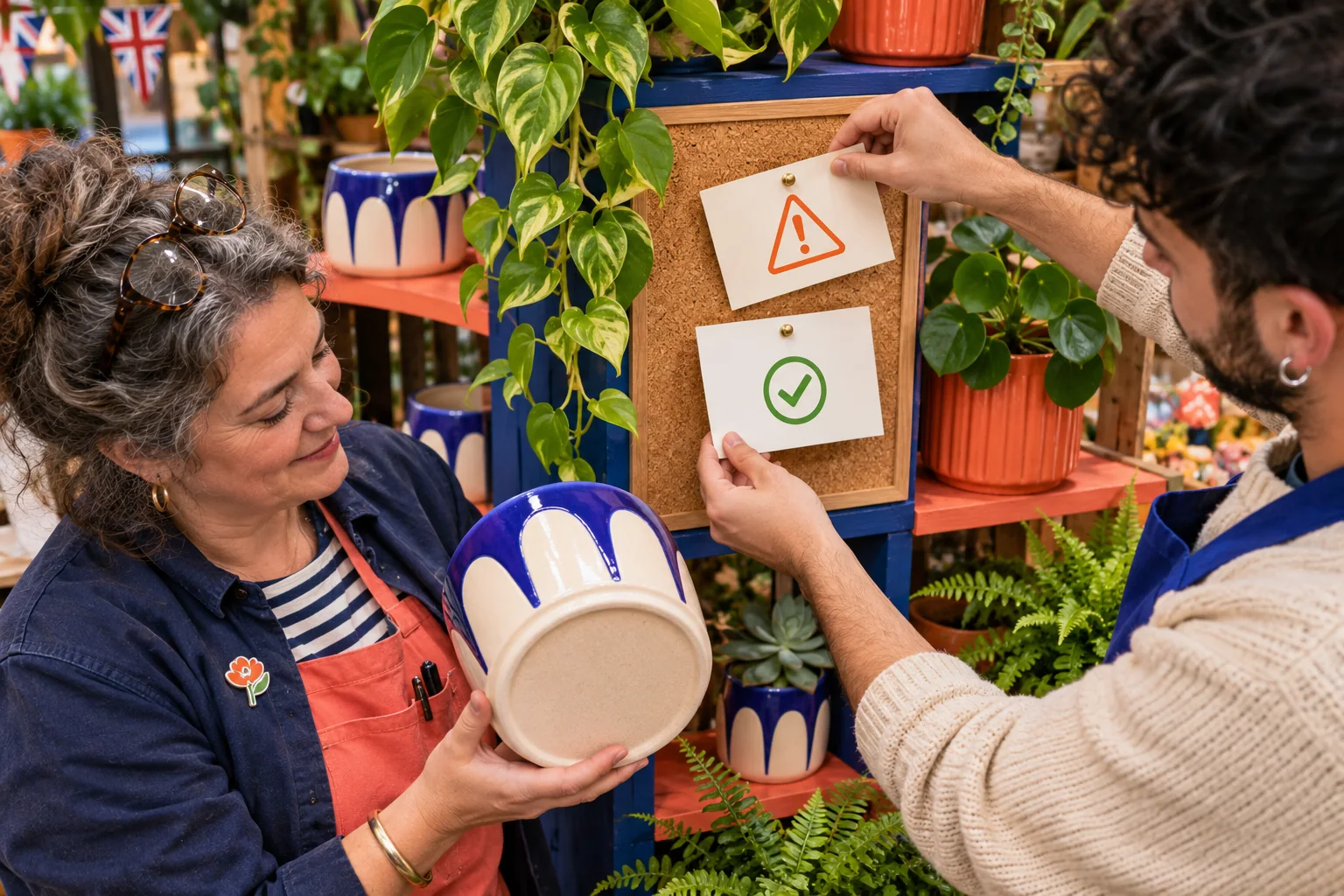
The second inline image shows staff with a solid-base pot beside warning and check cards. It illustrates a correction decision: a new batch or variant may no longer match the filmed answer. First establish exactly what changed. Is it the same listing with a different feature, a renamed variant, a discontinued item or only a temporary stock position? Check the product page and staff answer sheet so the business does not keep giving conflicting information.
Then find the published Reel, caption and any cross-posted copies that still state the old fact. Use the controls available now to clarify, edit where possible, replace or remove the affected version. A new Reel alone may not prevent someone finding the old one, so do not assume a fresh post has corrected the public record. Where a customer has already acted on inaccurate information, handle that case through the normal service process. Keep a short internal note of the change and the action taken.
A temporary availability question is often better answered by directing viewers to a current listing than by filming a time-bound claim. The drainage-hole demonstration can be evergreen only while the filmed version and listing remain aligned. If staff cannot verify that, pause promotion and give the viewer a live check route. This is also why the fact owner and destination appear in the worksheet: someone must be responsible for noticing when the answer stops being true.
- Identify what fact has changed and which published Reels state the old answer.
- Fix the product page or customer-service information first.
- Use the current platform controls to correct, clarify, replace or remove the affected content as appropriate.
- Record the correction so staff do not keep repeating the outdated version.
Review whether the answer helped, without inventing sales
Set a modest review question before posting: did this Reel reduce confusion about the specified pot, and did relevant people find the correct product information? Meta offers Instagram professional guidance and content insights, but the labels and availability can change. Record the Reel link, date, exact metric names and selected period if the account shows them. Views and interactions show activity on content; they are not proof that local customers bought pots. The separate UK Insights guide gives a fuller measurement method.
Read the follow-up questions. If people still ask whether the pot has a hole, inspect the opening, close-up and caption for ambiguity. If comments ask about a different variant, the original answer may be clear but too narrow; a comparison or listing revision may help. Check the shop's own product-page questions and customer-support notes for that theme. A customer may also arrive directly from search or a friend's recommendation, so treat any self-reported Reel source as a clue rather than a causal sales calculation.
An honest review can be qualitative. In a fictional worked example, the shop films the verified pot base, names the exact variant and tests the public listing. Later it sees several comments about the solid-base version, checks that version and adds a second explanation. That shows a content gap was found and resolved; it does not supply a fabricated conversion figure. If the shop measures orders, use its own confirmed order records and keep attribution uncertainty visible.
Run a small question-answer pilot and keep the service choice separate
Make a three-answer pilot only when three suitable questions exist. Give each answer a distinct purpose: a visible product feature, a simple buying or collection process, and a comparison between versions. Before each shoot, check the fact owner and current destination. After publication, note the question that each Reel was meant to settle, what staff learned from replies and whether the public information needs updating. A stable cadence is whatever the team can verify and maintain; there is no reason to publish a filler clip to keep a streak.
The next decision is editorial: continue the format if customers find useful answers, change the demonstration if they remain confused, or stop when the questions are exhausted. A broader content calendar can organise other formats, but this workflow is for a shop's repeat customer questions. Keep any product launch or paid promotion in its separate plan. If filming creates more support work than the team can cover, improve the product page and reply route before expanding the series.
HitsBoost's UK Instagram follower packages are a separate profile-count service under their current terms. They cannot verify a product claim, turn a Reel view into a UK buyer, or guarantee reach, enquiries, orders or sales. A shop interested in those options should review the live UK page separately from this question-answer pilot. The practical win to look for here is clearer public information and a better customer path, evidenced by the shop's own records rather than a promise about the algorithm.
Frequently asked questions
What customer questions suit an Instagram Reel for a UK shop?+
Choose a repeated question with a current answer that can be shown clearly, such as a feature of the exact product or a simple process. Keep private orders, complaints and complex exceptions in the normal support route.
Can I use a customer's DM as the opening of the Reel?+
Use the question theme in your own words without publishing the person's handle, message or order details. Get appropriate permission before showing or quoting a person. A private case still needs a private answer.
How long should a question-answer Reel be?+
Use enough time to state the question, show reliable proof and explain the next step without padding. There is no universal duration that guarantees distribution. Preview the finished Reel on a phone to check whether the feature remains visible.
Should every Reel in the series use the same script?+
A recognisable question, proof and next-step structure helps staff produce clear answers, but each Reel should stand alone and fit its own subject. Do not repeat a script when the facts or customer task differ.
Do I need to add captions to a spoken Reel?+
Make the essential answer understandable without sound and review the caption controls available to the account. Correct automatic transcription errors, especially words that reverse the answer. RNID and Instagram's current guidance can help with the available controls.
Where should the Reel send someone who wants to buy?+
Point to a public, current listing or another working route that contains the exact product and its purchase information. Test the path as a visitor; do not claim a product-tag or link feature exists on an account where it is unavailable.
What if a new product batch makes the answer wrong?+
Check the exact change, fix the product information and identify the old Reel and any copies. Clarify, edit, replace or remove affected content using the current controls, and make sure staff answer consistently.
Will these Reels or bought followers guarantee local orders?+
No. A useful Reel may clarify a product question, while views and followers do not prove purchases. Confirm actual enquiries and orders in the shop's records and keep any follower-service decision separate from the content pilot.
Compare Instagram Followers packages.
Prepare the public destination, then review the quantity and terms that fit your goal.
Review UK Instagram follower options separately