

Decision sheet for an ongoing UK shop offer, not a promised result
| Shop situation | Best next step | What to verify before changing course | Evidence to record |
|---|---|---|---|
| Offer or link is unclear | Fix the offer before promotion | Exact item, current stock, total price, delivery or collection and returns route | Broken or corrected destinations |
| A repeated buyer question needs an answer | Publish a useful organic explanation | Can staff keep the answer and link current? | Question themes and verified responses |
| A verified offer needs a defined new audience | Consider a capped Meta ad test | Objective, audience, placement, approved maximum spend and stop date | Spend and platform delivery plus shop outcomes |
| Ad activity rises but shop outcomes remain unclear | Pause, diagnose and revise | Destination, attribution limits, customer questions and fulfilment | Confirmed orders, qualified enquiries and costs |
Start with the customer action, not the channel
A shop owner often asks whether to post more or boost a Reel when the real problem is earlier in the journey: what should a nearby shopper understand or do? Write one customer action first. It might be to inspect an everyday mug range, check whether a colour is in stock, ask about collection, or complete an order for a particular item. If the team cannot describe the next action in a sentence, it cannot choose useful creative or judge a paid result. More distribution only multiplies whatever confusion already exists.
Imagine a fictional independent homewares shop in Sheffield with a continuing range of handmade-style ceramic mugs. The mugs are already on sale; this is neither a launch nor a one-date event. The owner wants local and online customers to find the right size and collection or delivery option. Her decision is whether an ordinary explanatory post is enough for the next period or whether a small, controlled Meta ad test could help people who do not already know the shop. The example describes a decision process, not a report of sales.
Keep the neighbouring guides in their own lanes. A new product needs the separate UK product-launch checks; a market evening needs the local-event guide; a multiweek Christmas range needs its changing seasonal truth sheet. This guide deals with a standing offer and one distribution decision. Its useful output is a documented reason to stay organic, run a limited test, or wait until the offer is ready. None of those choices promises an Instagram ranking, local footfall or a sale.
Check the offer before buying distribution
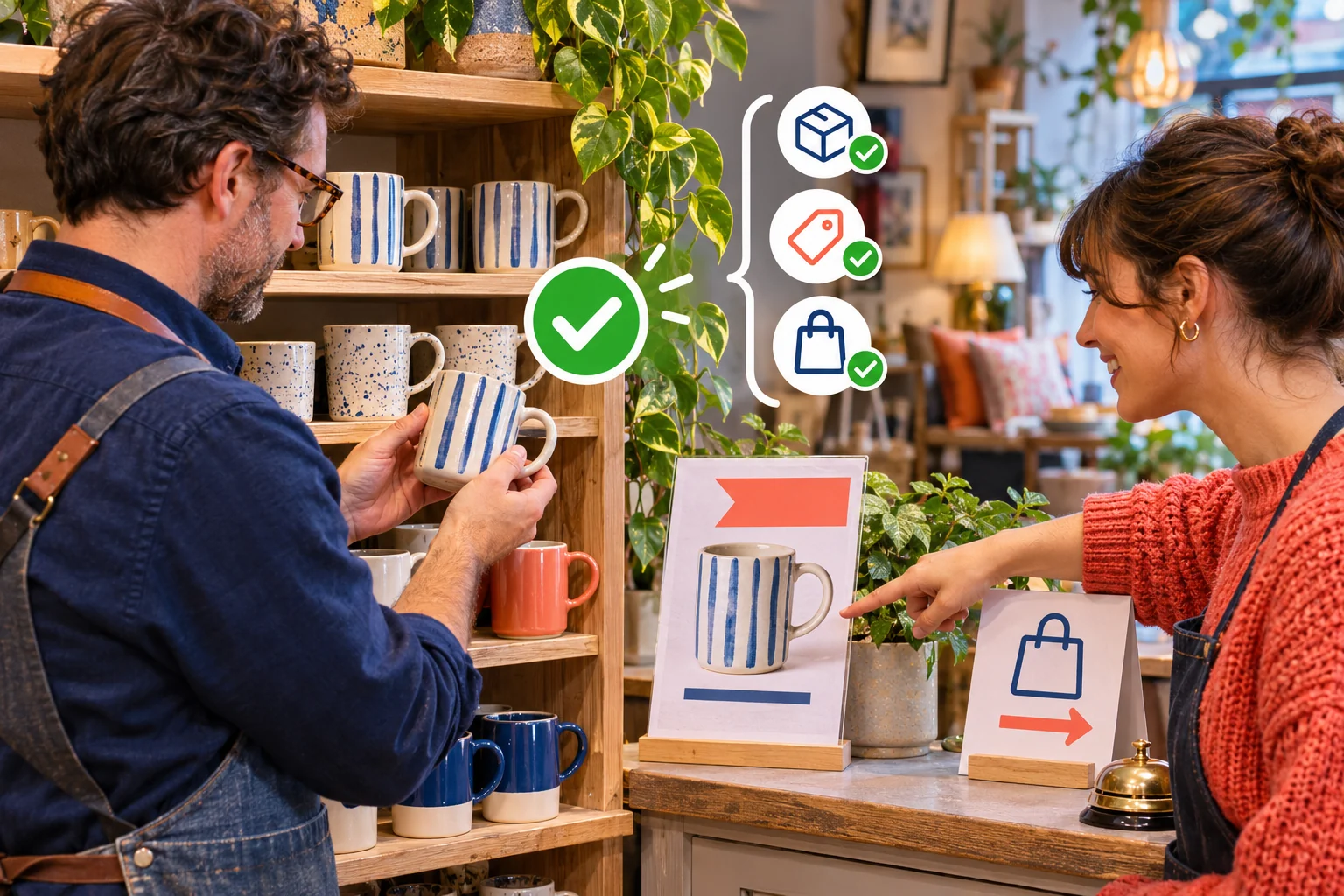
Put the pictured item beside the page and fulfilment plan a visitor will actually see. For the Sheffield shop, a blue striped mug in a photograph must be the version that can be ordered or collected, with its current price and any meaningful size or care details. A good photograph of a sold-out colour is not a sound paid invitation. Record stock ownership, the page link, delivery areas, collection hours, any material conditions and who can approve a correction. The second image shows the team checking these facts before promotion.
Open the destination as an ordinary phone visitor, logged out. Does the link lead to that mug, or a general homepage where it is hard to find? Can the buyer understand the total price, applicable delivery cost or collection arrangement before paying? Is there a clear route to current returns and support information? GOV.UK's distance-selling guidance explains information sellers need to give before an order. Instagram creative does not replace those obligations. If the offer requires a private message, staff must be able to answer without asking for sensitive order details in public comments.
Now test the operational side. If more people ask about mugs tomorrow, can someone answer and fulfil the orders the shop actually accepts? Who pauses an ad if a colour disappears, a collection slot closes or the listing changes? A destination can be technically live while the promise in the caption becomes false. Map each active caption, Story and ad to its destination so corrections reach both places. A shop with an unclear checkout or no response cover should fix that before spending to widen the audience.
- Match the exact photographed item to its current listing and stock.
- Test the public buying route on a phone while logged out.
- Name the person who can correct the post, page and ad if the offer changes.
Use organic posts to answer what shoppers already ask
Organic content is the shop's unpaid publication on its own account. It can explain the mug's size, show the glaze in ordinary light, compare the available colours, or clarify the difference between delivery and collection. A carousel might answer a recurring question with the exact item linked from the profile; a short Reel might demonstrate its actual scale in a person's hand. Choose the format that makes the product easier to judge. A daily posting quota does not make a weak answer stronger or keep stock information current.
An organic post is useful even when it is not being used as an ad test. It can give existing followers a reason to ask a better question, and it can be shown to someone who arrives from search or a shared link. Its distribution depends on Meta's systems and people's responses; the shop should not assume it reaches every follower or every local buyer. Meta's Instagram best-practices resource is an education tool, not evidence that one format will produce a particular business outcome for this shop. Read the actual account controls and insights available now.
Create a short record beside each useful post: the customer question, date, pictured item, public destination, the person responsible for factual accuracy and the next review point. If several buyers ask whether the mugs are microwave safe, answer only after checking the supplier's current information. If the same question returns, improve the product page as well as the post. This record is a better basis for considering paid distribution than a generic instruction to boost whatever collected the most likes.
Understand what a Meta ad can and cannot buy
Paid promotion is a separate Meta advertising purchase. A shop can consider promoting eligible existing content through the account's current tools or building an ad campaign in Meta Ads Manager. The choices and controls visible to one account can change. Meta Blueprint currently describes Ads Manager as a place to choose a business objective, audience, placements, budget and schedule, then review campaign results. Check the live setup rather than relying on a screenshot from an old tutorial or assuming every objective and placement is available to the shop.
The purchased thing is an opportunity for Meta to deliver the ad under the selected setup. It is not a guarantee that people will notice, click, visit the shop, complete an order or become followers. A profile visit or link click may be useful diagnostic information, but it is not a confirmed mug sale. If the shop's real task is an order on a working page, choose a campaign approach that can be evaluated against that task and the tools the business can legally and practically operate. Do not choose a vanity result merely because it is easy to display.
A boost of an existing post may be convenient when a clear post and destination are already approved; an Ads Manager campaign may suit a shop that needs more deliberate setup and review. That is a workflow distinction, not a promise that one option is cheaper or better. Read the budget and objective labels shown at the time of purchase. Check who owns the ad account and payment method. The person authorised to spend should approve the final maximum, end condition and preview before anything goes live.
Use a decision sheet before promoting a post
The table gives four practical routes. If the offer is inaccurate or the destination fails, fix it. If the question is one the shop's present audience keeps asking, publish an organic explanation and observe whether the answer reduces confusion. If a verified standing offer has a clear next action and the shop wants to test whether a defined new audience responds, paid promotion may be worth a bounded experiment. If the ad reports activity but business records remain unclear, pause and investigate rather than assuming a winning campaign.
The strongest candidate for a paid test is often a post that already helps a customer make a decision. For the Sheffield mug shop, that could be a short, accurate demonstration of capacity and available colour with an obvious route to the corresponding range. It does not become suitable just because it is attractive. Check whether the caption states the offer accurately, whether the linked page is mobile usable, and whether staff can deal with the likely questions. A post with many hearts but no meaningful next step is not automatically a good ad.
Write a one-line test hypothesis in the shop's own words: 'We will show this verified mug range to a defined audience and see whether qualified visits or confirmed orders justify the spend we can afford.' Then write a stop rule. If stock changes, the destination breaks, staff cannot answer, the full approved amount is spent, or the scheduled end arrives, stop or revise. These are controllable business rules. They are more useful than a promise that a particular view count will turn into revenue.
- Is there one truthful customer question the content answers?
- Is the desired next action available right now?
- Would a wider audience create a support or fulfilment problem?
Set an affordable cap and a review point
Begin with the shop's available marketing money after essentials, not a number suggested by a platform or another advertiser. Decide what the business can afford to spend on learning even if the test yields no confirmed order. Reserve any creative cost, staff time and fulfilment obligation separately. A simple planning formula is: maximum affordable ad test = approved marketing allowance minus other committed marketing and test preparation costs. This is an internal spending boundary, not an estimate of the amount required to make an ad succeed.
For a purely fictional worksheet, suppose the owner has approved £180 for all promotion in a period and has already committed £70 to photography and local printed material. The remaining £110 is a ceiling for a possible ad test, not an instruction to spend it all and not a forecast of return. If £110 would strain rent, stock or service capacity, choose a lower cap or no paid test. The owner might instead invest time in clearer product photographs and an organic explanation. The amount is intentionally illustrative; there is no universal minimum or recommended daily budget for a UK shop.
Before launching, record the approved maximum, the person who approves payment, the planned end date, the review date and exactly what would cause an early pause. Check the live Meta interface for how its chosen budget type, duration, taxes and billing conditions work in that setup. Meta Blueprint teaches budget and schedule selection, but the shop remains responsible for confirming its own final spend settings. Save the settings in the internal campaign note. A cost review after the campaign is too late to discover that the wrong amount or end condition was selected.
- Write down the maximum amount the shop can afford to lose as a test.
- Reserve money for creative work, fulfilment and other commitments before setting ad spend.
- Set an end date, review owner and stop rule in the shop record.
Keep UK ad claims and customer data in scope
ASA/CAP says paid social ads and brand-owned commercial content fall within its advertising rules. The shop's own identifiable account may make its commercial intent obvious, but that does not give it permission to mislead. Show the actual mug and substantiated availability; make material conditions clear before a customer acts. If the shop pays a creator or gives an incentive for a recommendation, that introduces a separate disclosure check covered by the UK creator-ad guide. The label and claim must make sense in the context where each person sees the content, including a post viewed away from the profile.
Audience selection also deserves care. The ICO's direct-marketing guidance discusses targeting people on social platforms, including using existing customer contact details to create an audience. Uploading a customer list is not merely a convenient switch in Ads Manager; the shop needs an appropriate lawful basis, transparent privacy information and a reasoned assessment of the particular use. If the owner cannot establish those conditions, do not upload customer details. A broad audience chosen inside Meta's offered controls is a different decision from handing over the shop's own contact list.
Do not ask staff to paste customer names, emails or private order information into ad copy or planning sheets. Keep any campaign record limited to the facts needed for approval and evaluation. If the shop collects leads or uses tracking technologies, check the current ICO guidance and its own privacy arrangements before launch; do not assume a platform setting makes the whole process compliant. Legal and platform duties can change. The point of this section is a practical pause for the owner, not a claim that one preset makes every ad lawful.
Check the live audience, placement and creative
Choose the ad objective only after naming the customer action. Meta Blueprint explicitly connects a business goal to an Ads Manager objective and to measurement. The options visible for a shop can vary with account, format, destination and current product changes. Before publishing, inspect the live audience and any location setting, available placements, creative preview, destination, budget and schedule. Do not infer that an Instagram placement is the only one selected merely because the original post began on Instagram. The approved screen, not a remembered tutorial, defines the purchase.
Make the message understandable without a long caption. Show the real mug, identify the relevant range or question, and give a next step the shop can fulfil. Check the crop and any text overlay at phone size. A beautiful frame that hides the product name or cuts off a significant condition will not help a buyer. Use accessible caption text and accurate image description where available. Avoid invented scarcity, claims about sales volume, or a 'local' promise if the product is not available through the stated local route.
Preview the destination from the ad itself before approval. Can a visitor see the same mug and choose the advertised variant? Does the shop's opening information agree with a collection invitation? Is the final payment route working? Assign someone to inspect the live version after launch and when stock or terms change. Pause if the ad keeps circulating a stale offer. The shop can make a careful paid test with ordinary tools, but careful operation is a series of checks rather than a magic audience setting.
- Check the objective and destination in the live ad setup.
- Check the audience and placements actually offered to this account.
- Review the final preview, total budget and end condition before publishing.
Measure ad activity and shop outcomes separately
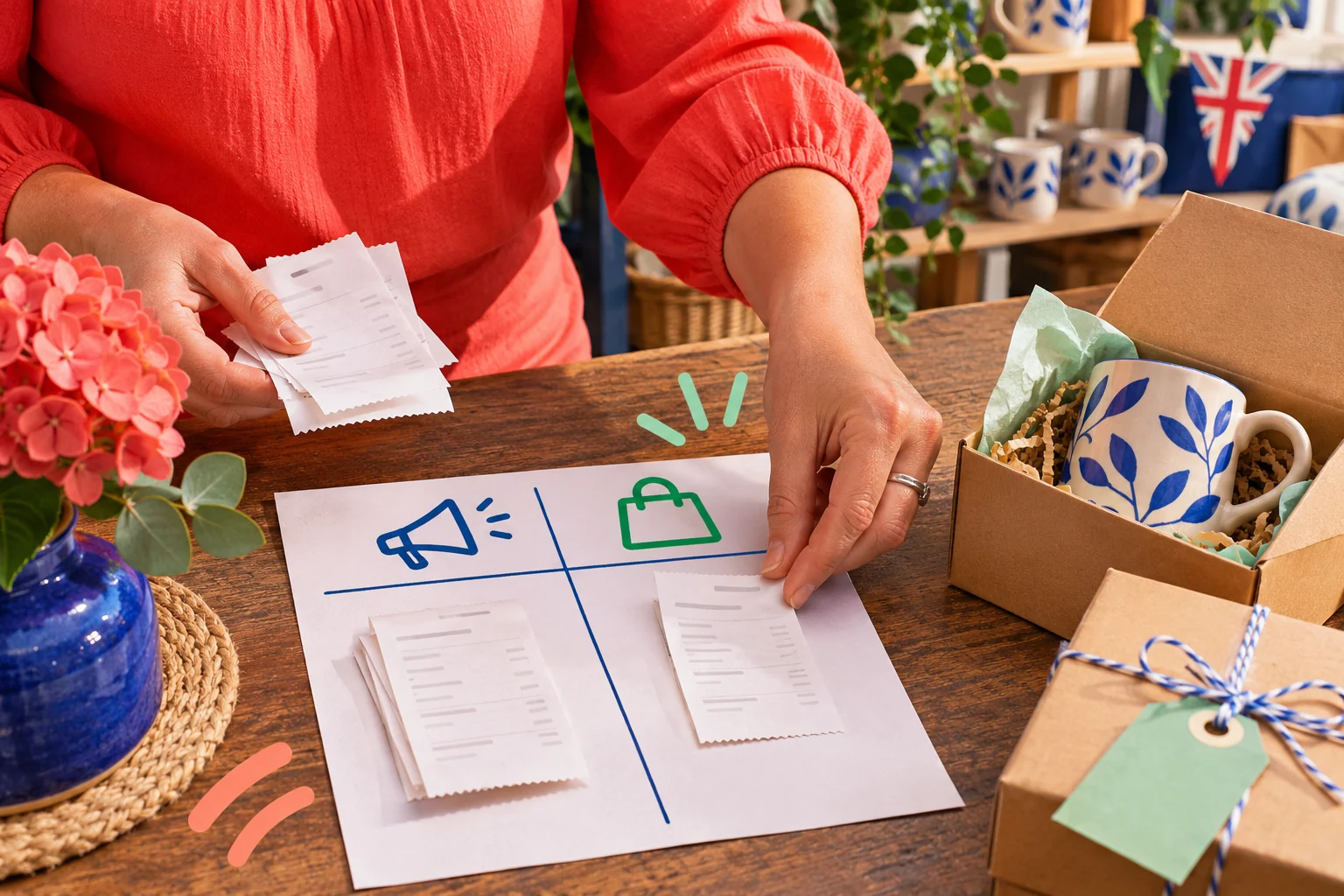
Create two columns before the test. In the Meta column, record the amount charged, delivery and the metrics relevant to the chosen objective that the account actually reports, such as link activity. In the shop column, record confirmed orders for the featured mugs, qualified enquiries, cancellations, returns and fulfilment costs. The third image shows a receipt being put on the confirmed-order side of a tally because a paid click and a sale are different events. Do not relabel a view, profile visit or follower change as a customer.
Set a review window that fits the shop's buying route and record it in advance. A customer may see an ad, later type the shop name into a browser, visit from a friend's share or buy at the till. Conversely, an order may have nothing to do with the ad. Platform attribution and tagged links can help describe some paths, but they do not prove every purchase was caused by the campaign. Keep notes on window displays, other posts, email, local mentions, stock changes and any offer changes during the same period.
A useful summary states what is known and unknown. For example: 'Meta reports spend and link activity; the shop recorded these confirmed orders during the period; we cannot identify every order's source.' If there are no usable order records, the paid test may reveal technical or message problems, but it cannot be honestly called profitable. Avoid invented return-on-ad-spend figures, multiplying an average basket by clicks, or using gross sales while ignoring product cost, delivery and returns. Where margins matter, calculate them from the shop's actual records.
- Meta record: spend, delivery, clicks and the chosen objective's available result.
- Shop record: confirmed orders, qualified enquiries, returns and fulfilment cost.
- Context record: other promotions, stock changes and customer questions.
Decide whether to stop, repair or run another test
At the planned review, compare the question the test was supposed to answer with the evidence collected. If spend occurred but the link was broken, the conclusion is to repair the route, not that Instagram shoppers dislike the mugs. If people ask a repeated size question, make the product information clearer. If an ad reaches people outside the shop's fulfilment area, review the live location and placement controls. If staff cannot keep up with enquiries or stock, pause distribution until the service can support the promise.
A campaign may also finish without enough reliable evidence to continue spending. That is a legitimate result. Do not keep it running to protect the effort already spent, or declare success from engagement alone. If the shop does revise and test again, change one important thing at a time where practical: perhaps the question answered, destination or approved audience. Record what changed and why. Do not present a simple before-and-after comparison as a controlled proof when the offer, timing and other promotions also changed.
Bring the lesson back to ordinary publishing. The best answer to a buyer question may deserve a permanent product-page improvement and a useful organic post, even if no further ad is bought. This guide's decision loop can be reused for another standing offer, but the budget, stock and response capacity must be checked again. The separate UK Christmas guide handles seasonal change; it should not be used as a fixed template for an everyday mug range. The goal is a clearer customer journey and a spend decision the shop can explain.
Keep profile-count services outside the ad budget
HitsBoost's UK Instagram follower service is a separate profile-count product with its own current package terms. It is not Meta advertising, does not choose a paid audience for a mug offer, and cannot guarantee reach, engagement, enquiries, purchases or local shoppers. If the owner is considering that service for profile presentation, review the live UK package page, what is currently available, the quantity, delivery terms and checkout total as its own decision. Never share an Instagram password with a provider. Do not put a follower order in the ad-spend column or treat it as a sales result.
The same separation applies to organic metrics. A larger profile count may be visible, but it does not prove that a particular post reached useful buyers or that a paid ad worked. The shop should keep verified orders, support demand and fulfilment quality as business records. If an owner wants to compare profile-count options, the UK HitsBoost page is the appropriate place to inspect the current service. If an owner wants to decide whether to pay Meta to promote a shop offer, use the offer, cap, audience and outcome framework in this guide.
Before the next decision, preserve a one-page note: the customer action, verified offer, organic content already tried, reasons for or against paid distribution, approved maximum, live setup checks, review date and what the shop actually learned. The note is useful even when the answer is 'do not buy an ad now'. It prevents a future team member from mistaking likes for orders or assuming last month's price, stock or ad controls still apply. Recheck facts each time, then make the smallest responsible choice that answers a real customer need.
Frequently asked questions
Should a UK shop boost every Instagram post that gets many likes?+
No. First check whether the post answers a useful buyer question, describes a current offer and leads to a working destination. Likes alone do not show that new distribution would help the shop or justify spend.
Is organic Instagram posting really free for a small business?+
The shop does not pay Meta to publish an ordinary post, but creating, checking and answering around that post takes staff time. Include that work when comparing options.
What is a sensible daily Instagram ad budget for a UK shop?+
There is no universal amount. Decide the maximum the business can afford to lose as a test after other commitments, then check the live budget type, duration and final approval in Meta's current setup.
Can I use a boosted post instead of Meta Ads Manager?+
An eligible existing post may be promotable through the account's current tools. Ads Manager offers a more deliberate campaign workflow. Choose based on the available objective, control and measurement the shop needs, and verify the live options before paying.
Do I need to label my own shop's Instagram ad as advertising?+
ASA/CAP says paid and brand-owned social content falls within its advertising rules and must be obviously identifiable. A clearly branded shop account often makes its own commercial purpose apparent, but any paid partnership or creator recommendation needs a separate context-specific check.
Can I upload my customer email list to target an ad?+
Only after assessing the particular use against current ICO direct-marketing and data-protection guidance, including lawful basis and clear privacy information. If you cannot establish those conditions, do not upload the list.
Do Meta link clicks prove an Instagram ad sold products?+
No. Link activity is an ad-platform measure. Compare it with confirmed shop orders and costs while recognising that attribution is incomplete and other routes may have contributed.
Will buying Instagram followers replace paid promotion for my shop?+
No. A HitsBoost follower package is a separate profile-count service under its current terms. It cannot guarantee delivery of a shop offer to relevant customers, nor orders or sales.
Compare Instagram Followers packages.
Prepare the public destination, then review the quantity and terms that fit your goal.
Compare UK Instagram follower options