

A visitor-path worksheet for a fictional Nottingham salon
| Step | What the visitor needs | Owner's evidence | Stop or correct if |
|---|---|---|---|
| Profile or Story | A named haircut service and a trustworthy next step | Public profile destination and published sticker checked on a phone | The invitation points to an old home page or a closed promotion |
| Service page | Who provides it, where, how long and the current full price | Approved service description, salon address and current price record | A treatment, location, duration or charge differs from the post |
| Slot selection | Real available times and any required deposit or consultation | Live diary and payment terms checked as an ordinary visitor | A slot appears selectable but cannot be held or completed |
| Confirmation | A clear record of whether the appointment is accepted | Customer confirmation and corresponding salon diary entry | The form merely says 'sent' while the post promises an instant booking |
| Later change | A usable reschedule or cancellation route | Published terms and staffed process for changes | The policy or contact route is missing or no longer works |
Start with the appointment the customer can actually book
A useful Instagram invitation begins with a service the team is ready to provide. Write down its name, location, typical duration, price owner and booking method before choosing an image or a call to action. If a stylist is available only on certain days, check the live diary rather than a printed schedule. If a service requires a prior consultation, the invitation should lead to that consultation instead of promising an immediately confirmed treatment. The word 'book' has an operational meaning, not just a marketing tone.
Consider a fictional independent hair salon in Nottingham offering a standard cut and finish. The owner wants visitors from Instagram to choose the right service and available time without being told to send an open-ended message. This is a teaching example; no client, price, conversion rate or result is being reported. The salon first decides whether the customer can book instantly, request approval or ask a question. Its public wording must describe the real state, because a message saying 'I want Tuesday' does not reserve Tuesday.
This task differs from promoting a dated workshop or handling every kind of incoming enquiry. A recurring salon appointment needs a persistent service page, current staff availability and a way to change a booking later. The existing UK event guide covers one date and venue; the enquiry guide covers replies and ownership. Here the central question is whether a visitor can travel from an ordinary Instagram surface to an accepted appointment and recognise the proof at the end.
Make the booking destination answer service and price questions
The destination should answer what the service includes, who provides it if that changes the offer, where it happens, how long to allow and what the visitor pays. A link to a generic home page can work only if the named service is straightforward to find from there. A page showing 'from £40' without explaining when another price applies may create a surprise at the final step. Compare the Instagram wording with the live public page and the current business price record, then correct the one that is stale.
For a UK service booked at a distance, review the current GOV.UK rules that apply to the particular service and sales route. Its distance-selling guidance describes pre-contract information such as the trader's identity, the main characteristics, full price and cancellation conditions. Separate GOV.UK guidance explains that contract terms and cancellation charges must be fair. The legal outcome can depend on the service and circumstances, so this guide does not prescribe a universal deposit or cancellation rule. Make the actual business terms visible before a customer commits.
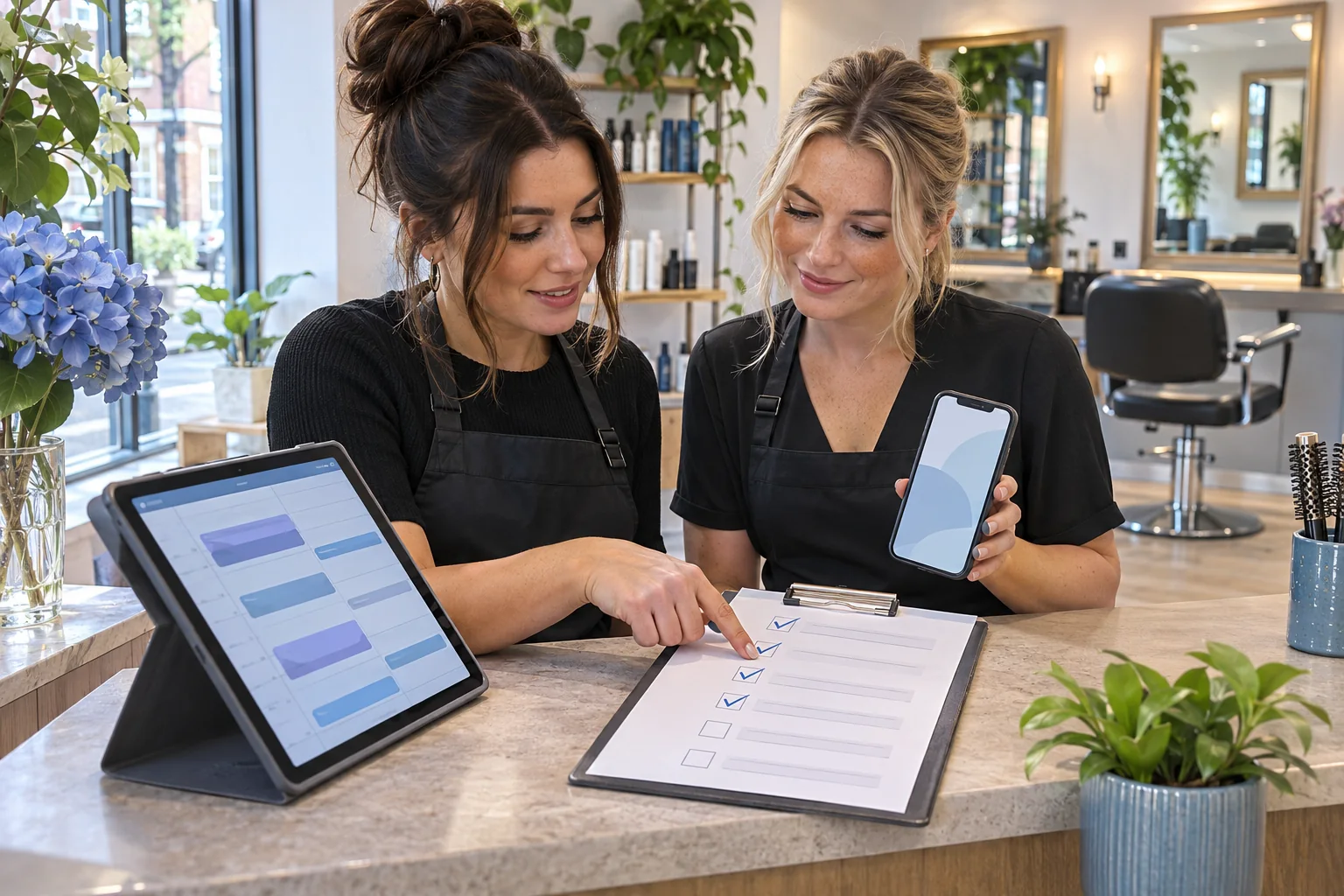
A salon can use the table above as a short truth sheet. Its service owner checks the duration and what is included; the diary owner checks available slots; the person responsible for terms checks the deposit and change policy; a second person follows the public route on a phone. If the diary is temporarily closed or a stylist leaves, pause invitations that promise their time. An attractive Reel cannot repair a booking page that offers a service the team cannot deliver.
- Confirm the actual service name, duration, location and current full price.
- Check whether a deposit, consultation or eligibility condition changes the next step.
- Make cancellation and rescheduling terms findable before someone commits.
Collect only the details needed for this appointment
An appointment form usually needs enough information to contact the customer and identify the service and time. Decide which fields are essential and why before asking for more. A haircut request should not automatically collect a home address, date of birth or unrelated preference profile. If the service genuinely needs sensitive details for safety or suitability, use an appropriate private process and specialist advice; do not invite customers to put that information in a public Instagram comment or an unstructured direct message.
The ICO specifically reminds small beauty and wellbeing businesses that appointment, payment and allergy information can be personal data. Its small-business guidance says such businesses are likely to be processing personal information and need to consider how they tell people what happens to it. Give visitors an accessible privacy notice at the booking point and use a booking provider only after checking its role and the business's process. This is operational guidance, not a claim that one form design satisfies every UK data duty.
Keep appointment communication separate from future promotion. A reminder about an agreed time may be a service message; a text about a new treatment is marketing and needs its own rules and preference handling. The ICO explains this distinction in its small-business direct-marketing guidance. A customer should not have to accept unrelated marketing to request an ordinary booking. Make the confirmation, change instructions and any promotional choice understandable on a small phone screen.
Test the complete mobile route before changing Instagram
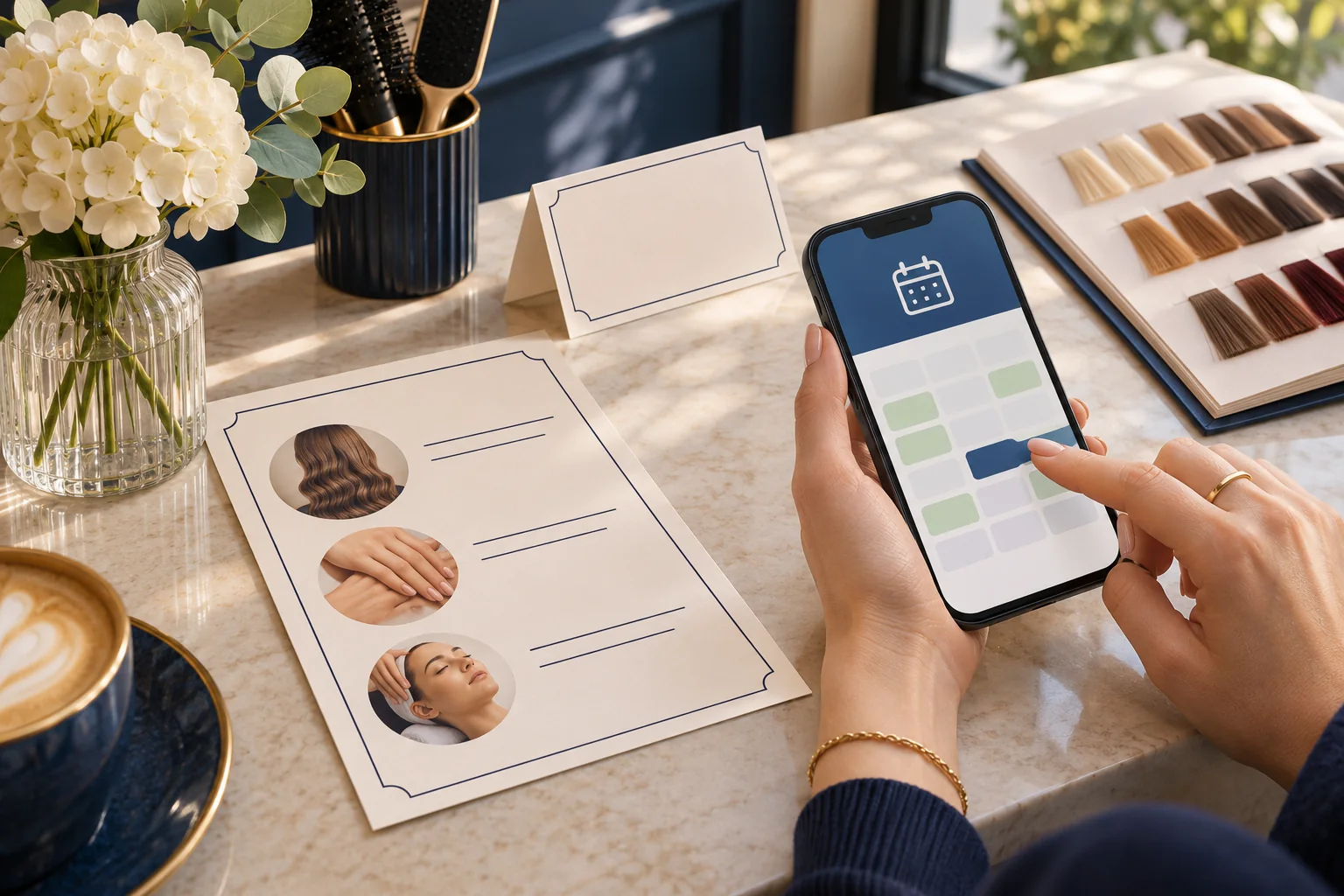
Open the public booking page on a phone in a normal visitor state. Find the named cut, read the current terms and reach the availability view. Pick an appropriate test slot or use the system's approved preview or test method, without making an accidental customer reservation or charge. Follow the route far enough to see the final commitment step and the confirmation wording. A successful page load is only the first check; a service page that loads but never lets a customer complete a supported action is not a working booking journey.
Check the states between selection and acceptance. Does the system hold a slot while someone enters details, or does it only request one? Does payment happen before or after approval? What does the customer see if the slot disappears? Test the exact words the salon plans to put in Instagram. If the page ends with 'we will contact you', use 'request an appointment' in the invitation; do not say 'instant booking'. If it ends with a true confirmation, check that the salon diary agrees.
Test failure as well as success. Try a narrow phone viewport, an ordinary mobile connection and a person who is not signed in as the salon owner. Confirm the form labels and tap targets can be understood, the button works, error text explains how to recover, and the route for changing a booking is visible. If the provider has an outage, name who can update Instagram and which alternative contact route is staffed. Avoid a generic 'DM us' fallback when the inbox cannot actually confirm a place.
- Open the public destination without a staff login.
- Choose the same service named in the profile, reach the real slot screen and inspect the final step.
- Check what the customer receives and what the business diary records.
Give the Instagram profile a durable next step
The profile is a persistent starting point for someone who arrives from a post, Reel, search result or recommendation. State the business type and location plainly in the bio, then point the relevant profile link to a current booking destination or a clear service-choice page. If there are multiple links, label the appointment one so a visitor does not have to guess whether a menu, map or old competition page is the right route. Check what your own account currently allows rather than relying on a screenshot from another year.
The Nottingham salon might use a concise instruction such as 'Cuts in Nottingham; choose a service and available time below'. The destination should identify the salon and service without forcing a visitor through several unrelated promotions. A link aggregator can be useful if it genuinely reduces confusion, but it adds another page and another point of failure. If the first screen lists ten offers, put the active booking option where it is easy to recognise and check that it still leads to current terms.
Review the public profile after a staffing change, relocation, pricing update or booking-system switch. A destination that used to work may redirect to a provider login, an expired campaign or a page showing a different branch. Save the profile link and the date it was last tested in a simple owner sheet. This maintenance matters because old posts can continue sending people to the profile after the post author has forgotten the booking promise.
Use a Story Link sticker for one clear invitation
A Story can make a specific current invitation, such as available consultation times this week, and its Link sticker can point to the matching destination when the control is available to the account. Instagram's own Story help describes creating a Story and adding stickers; its Link guidance tells publishers to preview the address. Use the current app control and read the actual audience choice before sharing. A Story's temporary nature makes it useful for a dated availability message, but it also means the team should not use it as the only durable booking route.
The sticker wording should describe what happens after the tap. 'See available cut appointments' fits a live slot page; 'Request a consultation' fits a form that needs approval. Avoid a vague 'BOOK NOW' sticker if the page first asks a person to choose a branch and then says no slots exist. Preview the destination before posting, then open the published Story as a viewer and follow the actual sticker. A draft preview cannot prove that the public sticker goes where the team intended.
Do not assume that a Story view is a sticker tap or that either is an appointment. If the account provides Story insights, record the specific measure and period shown; do not invent a platform-wide click rate. If a service slot fills during the Story's life, update the destination and consider correcting or retiring the still-visible invitation. The business should know who owns that decision, especially when the person who posts is not the person who controls the diary.
Make posts and Reels explain the service before asking for a booking
A feed photograph or short Reel should help a person decide whether the service fits. Show the salon, the relevant staff member or an approved example of the work, and explain what a standard cut includes. If a result depends on a customer's starting hair or an individual consultation, state that rather than promising a uniform outcome. Obtain appropriate permission before using a customer's image; the separate UK customer-photo guide covers reuse checks. One truthful example is more useful than a montage that implies every appointment delivers the same result.
Put essential information in readable caption text: location, service name, what the linked page will do and any important limitation. A Reel can demonstrate a process, but review spoken captions and visible details so it still makes sense without sound. Do not place the only price, deposit condition or access information in tiny text embedded in the image. If an Instagram caption's URL is not a usable link for the viewer, direct them to the verified profile destination or use an appropriate available Story control.
Meta's professional-dashboard education covers content creation, engagement and reach as separate topics, not a formula for bookings. The salon can choose a format that answers real customer questions and that its team can keep accurate. A post showing the exact service, place and next step is a useful invitation even if its visible count is small. The booking route and fulfilment are still owned by the business, and no content format or follower total can guarantee local appointments.
Verify the published journey and confirmation twice
After publication, check the public post or Story from a normal viewer account and follow the path it asks a customer to take. Test the profile link and any Story sticker separately; they may point to different pages. Check the phone crop, the readable service name and the final call to action. If the profile still points to last month's event, correct it before sending more people there. Save the public URL and a short note showing which destination was tested and when.
Use a test method the booking provider and salon permit. If the business can make and cancel a test appointment without displacing a real customer, confirm that the visitor receives the expected notice and that a matching entry appears in the staff diary. If it cannot, inspect the final confirmation flow with the provider and check an appropriate real booking with permission. Never submit another person's details merely to prove the form works. The important distinction is between a request that reached the business and a place the business actually accepted.
Give the duty manager a simple failure rule. When the public link fails, a slot is no longer available or confirmation emails stop arriving, stop or correct the invitation while the underlying process is fixed. A front-desk colleague should be able to identify the affected service, contact the customer through the approved channel and explain the next step. Keep the incident record separate from social metrics so a repaired link is not mistaken for a sales result.
- Follow the published profile link and Story sticker on a phone.
- Test the complete route with a non-chargeable method approved by the business.
- Save the public post URL and assign an owner for future link changes.
Handle changes and customer questions without losing the booking
A booking journey continues after the first confirmation. Put the correct route for rearranging or cancelling where customers can find it in the confirmation and service terms. Explain whether an appointment is cancelled immediately, awaits staff approval or needs another action. Fairness of deposits and cancellation charges depends on the circumstances; check GOV.UK's current fair-contract guidance and the business's actual policy rather than copying a blanket 'non-refundable' statement into Instagram.
Keep private details out of public replies. When someone comments 'Can I move Friday?', give the approved change route instead of asking for their phone number or booking reference beneath the post. A team member who receives a direct message should verify the relevant diary record before saying the time is changed. The UK customer-enquiry guide covers ownership and handoff when several people answer messages; this guide focuses on whether the appointment record and customer notification are both updated.
If a staff member becomes unavailable, check who owns the affected appointments, who contacts customers and what the business can genuinely offer. A social Story announcing a new gap is not a substitute for updating the booking system, and a confirmation from yesterday is not proof that today's new time has been accepted. A short, accurate service message can help a customer, while a promotional follow-up is a different use of their contact details under the ICO's guidance.
Review appointments with the right denominators
Use a small funnel only for records you genuinely have. A post impression, profile visit, link tap, booking-page visit, submitted request, accepted appointment and attended visit are different observations. Instagram may provide some account insights; the website and booking provider may provide others. Do not fill gaps with guesses or combine a Story-view number with a different period's booking total. Define a measure, date range and source before using it in a meeting.
For the fictional Nottingham salon, a practical review might count accepted appointments directly from the diary and attended appointments from its completed-service records. Link visits can help locate a broken route, but one person may tap several times or arrive via search, a recommendation, a shop-window code or another advert. Without a reliable source record, label attribution unknown. A rise in confirmed appointments after a post is a reason to investigate, not proof that the post alone caused it.
If the salon separately considers a HitsBoost UK Instagram follower package, assess its listed quantity, eligible public profile and current checkout total as a visible-count purchase. Keep that decision outside the appointment funnel. A purchased follower count cannot establish that people are local, that they tapped the link, that a booking exists or that a visitor attended. Do not use it as a replacement for a working service page, accurate availability or actual customer confirmations.
- Report platform visits or sticker taps only when the relevant insight is available.
- Count accepted appointments from the booking system, not from message or link activity.
- Review attended visits separately and note other discovery channels.
Keep the booking route current as the business changes
Assign a named person to the profile link, booking page, diary availability and published posts. Their review triggers should be specific: a new price, changed service duration, staff departure, branch move, system migration or revised cancellation terms. Each trigger can leave a different public promise behind. Change the source of truth first, then inspect every active invitation that sends a visitor there. A link can still return HTTP 200 while the information on it is wrong.
Use the table as a repeatable handoff rather than a demand to post every day. Before a new campaign, verify the service and terms; before publication, test the visitor route; after publication, check the actual link; after any material change, repeat those checks. If a colleague cannot tell whether the invitation is a request or an instant booking, rewrite it before increasing the audience. The aim is for a prospective customer to know what they can do now and how they will know when it is confirmed.
This process is useful even when Instagram changes a button or insight label. Follow the current controls on the business's own account, keep an alternative staffed contact route for genuine questions and use business records for the outcome. The salon's most durable improvement is a truthful service page connected to a dependable diary and a team that can correct mistakes. More followers, views or posts cannot make an unavailable slot available or turn an unconfirmed request into an appointment.
Frequently asked questions
Can I put an appointment booking link in my Instagram profile?+
Use a current profile link control available to your account and point it to a service or booking page that matches the bio. Follow the published link on a phone as a visitor before relying on it.
Should a Story Link sticker go directly to available appointments?+
Yes when the Story promises those appointments and the live page shows accurate service details, terms and availability. Preview the address before sharing and follow the published sticker afterwards.
Is an Instagram DM asking for Tuesday a confirmed appointment?+
No. It is a request until the business's actual process accepts the slot and communicates the confirmation. Check the diary and the notice the customer receives before using 'booked' in a reply.
What should a UK salon show before a customer books?+
Show the actual service, location, duration, current full price and applicable deposit, change and cancellation terms in the public journey. Review current GOV.UK rules for the particular service and sales route.
Can I require a non-refundable deposit for every service?+
Do not assume a blanket statement is fair. GOV.UK guidance says customer terms and cancellation charges must be fair and reflect the circumstances. Review the specific service and policy with appropriate advice before publishing it.
What customer data should an appointment form ask for?+
Ask only for details needed to arrange and support the appointment, explain their use and protect the record. For sensitive details, use an appropriate private process. The ICO has specific small-business and beauty-sector guidance.
Does a Story view prove someone tapped the booking link?+
No. A Story view, sticker tap, page visit, request and accepted appointment are separate observations. Use the actual account and booking records available for the same period rather than inferring one from another.
Will buying Instagram followers get my salon more appointments?+
No. A follower package concerns a defined visible profile count under its terms. It does not guarantee local people, link taps, bookings, recommendations, reach or sales. Keep any package record separate from the salon's confirmed appointments.
Compare Instagram Followers packages.
Prepare the public destination, then review the quantity and terms that fit your goal.
Review UK Instagram follower options