
This English guide is shared with our global site. Follow related UK service links for current packages. Other service links open the global catalog in its stated currency.

Which Instagram Story number answers your question? Use the exact labels available on your account.
| Measure | Question it helps answer | What it cannot establish alone |
|---|---|---|
| Views | How many plays or displays were counted for this Story? | How many different people watched to the end |
| Viewers | How many unique accounts saw this content at least once? | A sequence-wide unique total made by adding frame totals |
| Reach / accounts reached, where shown | How many accounts were reached under this report's definition? | An interchangeable value with every Views or Viewers report |
| Interactions | How many response actions did the report count? | How many different accounts took those actions |
| Accounts engaged | How many unique accounts interacted with the content? | That every viewer interacted or bought something |
| Profile activity | What reported profile actions followed the Story? | That a profile visit became a paying customer |
| Navigation, where shown | What movement actions were recorded around this frame? | The motive of every person who moved on |
| Viewer list | Which usernames are available in this Story's viewer information? | A permanent, complete attention record or ranking of interest |
What counts as a Story view: the direct answer
Instagram's Story Insights help page describes Views as a count of plays or displays. Its separate Viewers measure counts accounts that saw the content at least once. That distinction applies to both still-image and video Stories: a displayed photo can contribute a view without being a video play. Read the counter for the individual item you are examining, rather than assuming it describes the whole account.
Instagram's current viewer-information help also says Story replays are included in the view count. An account seeing a frame more than once can therefore contribute to a total that is higher than the number of names in the viewer list. A figure such as 600 does not automatically mean 600 different people. Nor does it demonstrate that the audience read every word, listened with sound, or reached the last frame.
Choose the question first. Record Views for exposure volume, Viewers for unique audience size, and the relevant action metric for a response. A small business should not treat a large display total as evidence that a booking offer worked when no booking or relevant enquiry has been recorded.
Views, viewers, reach and interactions are separate measures
The comparison table separates counts of activity from counts of accounts. One account can take several actions, so an interaction total and the number of accounts engaged need not match. Profile activity adds another perspective, such as visits or follows reported from the Story. None of these measures should be renamed engagement simply because they appear in the same dashboard.
You may also encounter reach or accounts reached in an older report, an advertising screen, or another reporting tool. Read that source's definition and scope before treating it as equivalent to a current Viewers figure. Instagram describes Viewers as a unique-account measure, but that does not make figures from different periods or reporting screens interchangeable. The current Help Center also labels some audience metrics estimated and in development.
For an appointment reminder, useful responses might be link taps or relevant replies. For a tutorial, the audience reaching a later frame may matter. The views total supplies context for those goals; it does not replace them. Use the exact label in a report, then explain its meaning in a short sentence so a colleague can understand the finding without learning analytics jargon.
Find the right number on your own account
Use the official Instagram app or website and open the Story information available to your account. Instagram's current help describes Insights for public personal or professional accounts; boosting content remains a separate professional-account feature. Avoid relying on an old instruction that says every form of Insights is available only to businesses. The menus and individual metrics you receive can still differ as features are introduced.
For an active Story, the app offers Story-specific information when you open the item and use its Insights or viewer controls. Instagram also provides computer instructions for Story Insights and a content library for reviewing past material. Follow the device-specific Help Center steps if your screen looks different. A viewer list and an Insights overview are related sources, but they do not answer every question in the same way.
Instagram says Views is being introduced gradually, so a missing metric does not prove your Story has no audience. Record an unavailable or incomplete screen as a limitation. Do not give a service your password merely to fill a blank cell, or invent a missing unique count from total views.
- Find the individual Story's Insights or viewer information in the official app or site.
- Save the metric name, frame identifier, publishing time and observation time.
- Note the chosen date range, audience and whether promotion is included.
- Keep missing or unavailable figures marked as unavailable rather than substituting another metric.
A frame count is not a unique total for the sequence
A Story sequence contains separate photos or videos. Give each one a simple identifier, such as frame one, frame two and frame three, and preserve that order in your record. A person may see several of them. Summing their Viewers figures counts that account once within each frame's figure; it does not identify how many different accounts saw any part of the complete sequence.
Suppose three hypothetical frames show 400, 350 and 300 unique viewers. Adding them produces 1,050 frame-level viewer counts. It does not prove that 1,050 distinct accounts saw the sequence. There may be substantial overlap, and the figures alone do not reveal how much. If Instagram supplies a relevant combined unique measure, use it with its stated definition. Otherwise label the sum as a sum of frame figures.
The same caution applies to continuation. Three hundred divided by 400 equals 75%, but without account-level overlap this is a last-frame-to-first-frame count ratio, not proof that precisely 75% of the original viewers completed everything. People can enter a sequence later. A clearly named ratio remains useful for comparing similar sequences while keeping the limits of the calculation visible.
Worked example: 600 views and 400 viewers
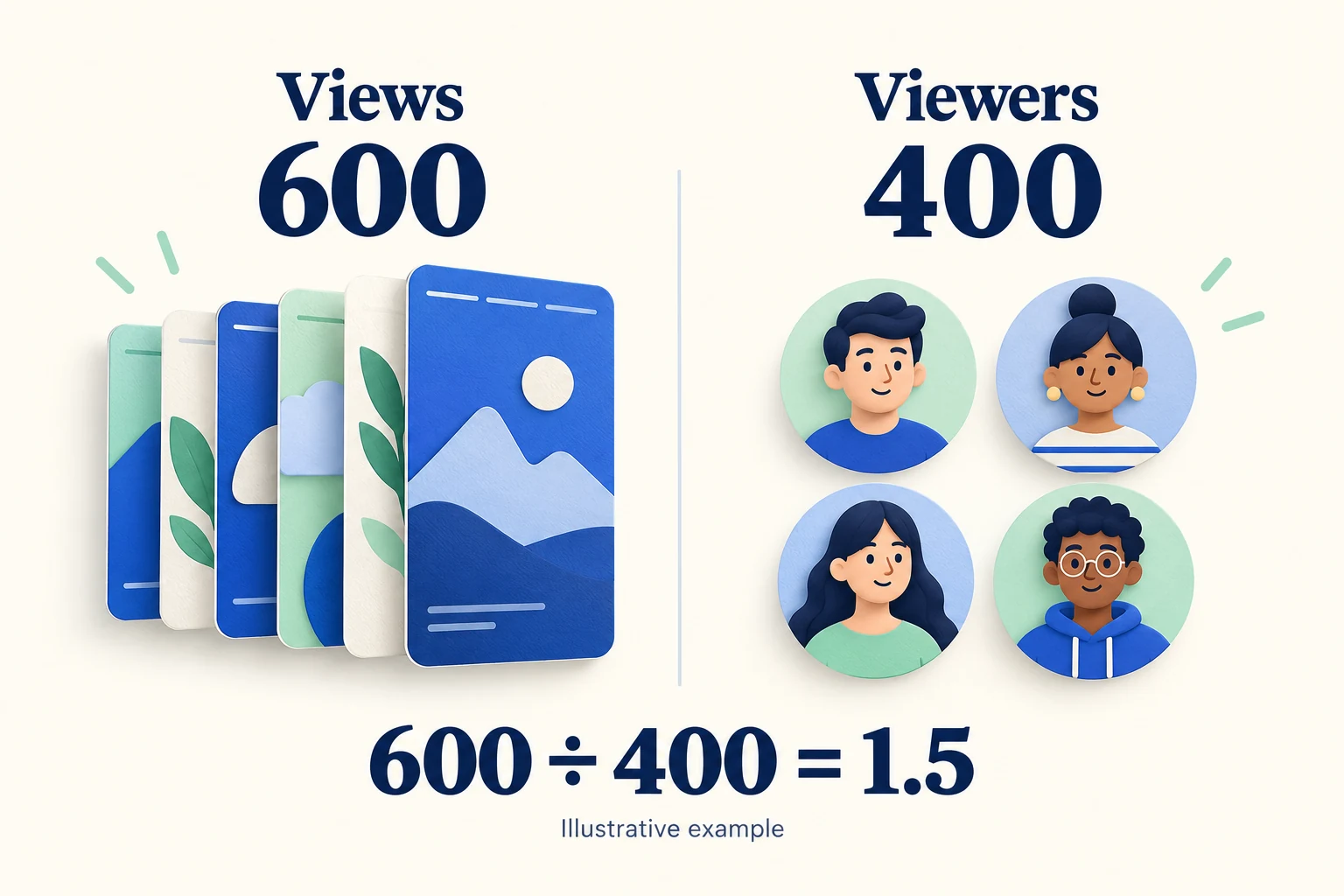
Imagine one Story frame recorded from the same Insights report at the same observation time. It shows 600 Views and 400 Viewers. These are illustrative teaching figures, not a HitsBoost customer result or an Instagram performance target. The total activity exceeds the unique audience measure, so describing the result as 600 unique viewers would be incorrect.
Dividing 600 by 400 gives 1.5 counted views per unique account in that report. This is an average relationship between two matching measures. It does not mean every account watched exactly one and a half times, or that you can identify which person returned. Some accounts could contribute more repeated activity than others. The ratio also does not establish that a video was watched to completion.
Now suppose the same frame shows 20 link taps. Twenty divided by 400, multiplied by 100, gives five link taps per 100 reported viewers. Calling that a 5% buyer conversion rate would be unsupported: taps are actions, the same person may take more than one action, and purchases are a separate outcome. Write the numerator, denominator and reporting scope beside any percentage you share.
Replays, minimum seconds and your own views
Replays are one point the current official viewer guidance answers directly: they contribute to Story views, so repeated viewing can make the total higher than the list of usernames. This is why older advice that every Story view is necessarily a new account is unreliable. Keep the total and unique-account figures separate rather than trying to make them equal by removing a number you cannot verify.
The official Story definitions reviewed for this guide do not specify a universal minimum number of seconds that you should apply to every Story. Do not import a video rule from another format, an advertising metric, or a third-party article. A still image and a video can both receive displays, and a view count alone does not establish duration. If a different report defines a timed measure, preserve its own label.
We also do not infer a universal self-view rule from the available definitions. Opening your Story repeatedly is not a reliable experiment for estimating how Instagram handles your own activity, because a changing display may include other activity or later updates. For reporting, use the official figures and disclose any deliberate test. Avoid promising that a particular refresh, replay or tap will produce an exact additional count.
What the viewer list can and cannot tell you
Instagram's iPhone guidance says you can open a Story and swipe up to see available viewer names for each photo or video. It gives a window of up to 48 hours after publication for checking who saw it, including through Archive after the active period. That is a viewer-information window, not a promise that the Story remains publicly available for the same length of time.
Names do not reveal attention, agreement, or the reason for their position in the list. Instagram also documents an Instagram Plus Story-preview exception on the viewer-information page. A missing name does not prove someone never encountered the content. Do not use the list to label people as buyers, loyal fans or secret admirers.
If you share a Story to Facebook, the official instructions describe separate Facebook viewer information. Preserve that platform distinction in your record rather than silently treating every displayed name as an Instagram account. For routine reporting, aggregate figures are usually sufficient. Keep unnecessary personal details out of shared spreadsheets, and do not expect an external viewer-tracking app to reconstruct an expired list accurately.
Keep Story availability and reporting history separate
Several clocks are involved. Standard Story help describes the usual 24-hour active period. Viewer information has its own up-to-48-hour guidance. Story Insights help describes access to historical insights for up to two years, while the general Insights overview has selectable windows within the past 90 days. Those are different capabilities; a historical aggregate is not a permanent list of viewer names.
There is also a current exception to treating every Story as a 24-hour item. Meta's June 2026 Instagram Plus announcement describes a Story Extend feature that can make a Story last 48 hours, along with rewatch insights and viewer-list search. Availability and the options on your account should be checked directly. The announcement does not justify assuming every Story receives an extension or identical reporting features.
Record the actual publishing time and any extension when comparing results. A Story observed after six hours has had a different opportunity to collect activity from one observed after its full active period. Saving a frame in a Highlight or finding it in Archive also changes the question you are asking. State whether the report concerns its original active period or another available context instead of treating every later figure as the same snapshot.
Read navigation beside views without guessing motives
Where your report provides movement or navigation figures, they can add context to the views total. Use the action names and definitions actually displayed on that screen. Do not assume every account offers the same collection of taps, movement or exit measures, and do not treat the absence of a navigation breakdown as a missing views count.
A movement action describes something that happened around the frame. It does not explain the person's motive. Moving onward may reflect scanning, familiarity or a distraction; returning to a frame may reflect interest or a need to read a detail again. These are possible interpretations, not facts established by the counter. Look at the frame itself and the intended task before assigning a positive or negative meaning.
For a three-part coffee tutorial, compare each frame's available audience and response figures beside the three actual images. If the final frame invites a reply, use relevant replies as a separate result. You can then report that the audience size changed and the call to action received certain responses. Whether the sequence needs a creative change is a later diagnosis, rather than part of the definition of a view.
Make fair comparisons between Story reports
A fair comparison starts with the same measure and level of reporting. Compare a frame's Views with another frame's Views, not with an account-level audience figure from a different period. Preserve the observation age as well. Comparing a fresh Story with a finished one is a comparison of both content and time, even when the two pictures look similar.
Audience settings and distribution matter to the record. Note whether the Story was public or shared with a restricted audience, whether it was also shared to Facebook, and whether it was boosted or received other paid activity. Instagram's Help Center distinguishes organic and boosted Story insights. Read the scope of the figure you are using rather than assuming that every dashboard includes the same sources.
When the app and a downloaded or third-party report disagree, check their metric definitions, selected dates and capture times. Keep the original values rather than averaging them into an invented result. A missing figure, estimate or reporting change should remain annotated. If a comparable set really shows a decline, use the separate Story-views diagnosis guide; this article's job is establishing what the measures mean first.
- Match the exact metric and the level of reporting: frame, content group or account.
- Compare content at the same elapsed age and note any extension or removal.
- Use the same reporting source and audience settings.
- Identify Facebook sharing, boosts and other paid activity rather than silently combining them.
A simple record you can use for your next Story
Create one row per frame with its purpose, publication time, observation time, exact metric labels and available figures. Add a short context note for audience choice, sharing, promotion and any extension. This can be a notebook or ordinary spreadsheet. The important part is keeping the definition and the number together, not purchasing a more complicated reporting tool.
Write a finding that stays inside the evidence: frame two recorded 600 Views and 400 Viewers at the stated time, with 20 link taps in the same report. Then write a separate question, such as whether the destination answered the offer clearly. That makes it possible for a colleague to review both the arithmetic and the next decision without mistaking a display count for a commercial result.
Choose the response measure before publishing. Useful replies may suit a customer question; link actions may suit a resource recommendation. Keep a small set of repeatable measures and retain screenshots privately. That produces a clearer history than a weekly slide that replaces every figure with the word engagement.
- Record: account, Story/frame, purpose, publication time, observation time and source.
- Copy: Views, Viewers and the response metric relevant to the Story's purpose, where available.
- Annotate: audience choice, sharing, promotion, extensions and missing figures.
- Conclude: one supported observation and one next question; keep speculation out of the result.

What a Story views package does not prove
If you compare a paid Story views service, read its actual destination requirements, quantity, timing and terms. A packaged view count is a different question from how many interested customers understood the Story. Do not present purchased activity as evidence that Instagram recommended the content, that an organic experiment worked, or that an audience took actions not included in the offer.
Password-free ordering protects your login from being shared with that provider; it does not establish Instagram approval or eliminate platform-policy risk. Meta has publicly described enforcement against fake engagement. Keep credentials and authentication codes private, preserve the order confirmation, and ask support about ambiguous destination or availability requirements before relying on a time-sensitive Story.
Review HitsBoost's Story views packages and their stated terms if this service fits your purpose. For an existing order, use its record for support and annotate related activity in your report. Views, unique viewers, replies, profile visits and sales remain separate measures; report only the outcome you actually observed.
Frequently asked questions
What counts as an Instagram Story view?+
Instagram's current Story Insights definition counts a play or display. This includes displayed photo Stories as well as video Stories. It is not automatically a unique account, a completed watch or an interaction. Check the individual item's metric label and reporting scope.
Are Instagram Story views the same as unique viewers?+
No. Views measure counted plays or displays, while Viewers measure unique accounts that saw the content at least once. Use matching reports and dates when comparing them. Do not add separate frames' unique figures and call the sum unique people across the sequence.
Do replays count toward Instagram Story views?+
Instagram's current iPhone viewer-information help says Story replays are included in the view count. That can make the total higher than the list of usernames. A ratio of views to viewers is an average; it does not identify which person replayed the frame or how long they watched.
How many seconds make an Instagram Story view?+
The official Story definitions reviewed for this guide do not state a universal minimum-seconds rule. Do not apply a threshold from a Reel, advertisement or another platform to every Story. A views figure alone does not establish watch duration or completion.
Does viewing my own Story count?+
The reviewed official definitions do not settle a universal self-view rule. Repeatedly opening your Story is not a reliable way to infer how your own activity is handled. Use Instagram's reported figures, disclose deliberate tests and avoid expecting an exact increase from each refresh.
How long can I see who viewed my Story?+
Instagram's current iPhone help gives up to 48 hours after publication for viewer information and describes checking Archive after the active period. This differs from the Story's availability and the history available in Insights. Check the current instructions for your device and account.
Can every Instagram account see the same Story metrics?+
No. Current help describes Insights for public accounts and notes gradual introduction of Views. Menus, available breakdowns and reporting windows can differ. Copy the labels actually provided to your account and leave an unavailable figure marked unavailable rather than estimating it.
Will more Story views guarantee replies, followers or sales?+
No. Plays or displays, unique viewers, interactions and business outcomes answer different questions. Record each relevant outcome separately. If a paid views package is involved, check its stated terms and annotate it; a purchased total is not evidence of organic recommendations or customer demand.
Compare Instagram Story Views packages.
Prepare the public destination, then review the quantity and terms that fit your goal.
Compare Instagram Story views packages