
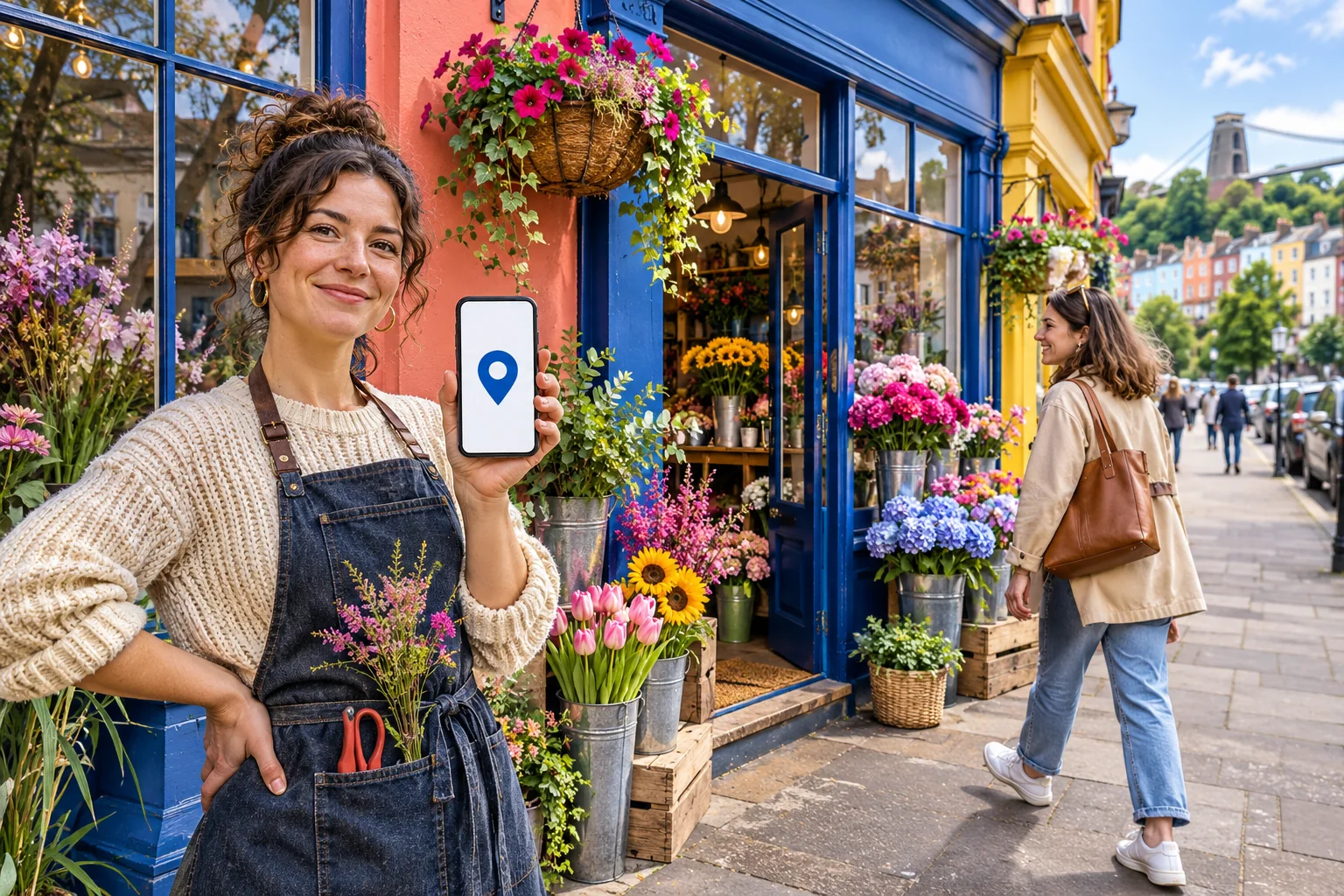
A place-and-visitor worksheet for a fictional Bristol florist
| Surface | Visitor question | Evidence the owner checks | Correct when |
|---|---|---|---|
| Public profile | Is this the florist I mean to visit? | Shop name, Bristol area and working public destination | The bio names an old branch or the link opens a closed page |
| Post or Reel tag | Does this tag refer to the real venue? | Available place label compared with the public shop entrance | It points to a different business, postcode or shopping area |
| Photo and caption | Can I recognise the door and visit time? | Current exterior, opening information and accessible route | The image shows a former entrance or an out-of-date opening claim |
| Published visitor route | Can I get from post to usable directions? | Second phone follows tag or profile link to the current route | It ends on an unrelated map result or a broken link |
| Business outcome | Did the visit or enquiry actually happen? | Staff enquiry log or other business record with a defined period | Only impressions, likes or a follower count are available |
Start with the place a visitor actually needs to find
A location tag is useful when it reduces a visitor's uncertainty. Someone searching for a florist may need to know whether the shop is in Bristol rather than Bath, whether a pictured counter is a permanent shop or a temporary stall, and which entrance is open today. Write down the real public venue, who controls it and the next visitor action before choosing a tag. A popular place label that sends people somewhere else is a poor answer even if it looks more discoverable.
Imagine an independent florist on a Bristol high street. The business also sells at a seasonal market and sometimes delivers flowers around the city. This is a fictional planning example, not a reported business or campaign result. For ordinary shop posts, the primary place is the permanent shop. A market stall post can name the market and date, while a delivery photograph need not pretend the bouquet was made at the customer's address. The place signal should describe the particular content truthfully.
Make the public business identity consistent
Start from a public visitor view of the account. Does its name identify the actual florist, and does the bio tell a person the city or neighbourhood it serves? If the shop uses a trading name on its storefront and a different legal name on invoices, choose public wording that does not make the visitor guess whether the account belongs to the shop. State what the business offers in plain language, then check that its website or profile destination confirms the same venue and current way to contact it.
There is no need to cram a complete address into every caption. The important point is that a visitor can reach reliable directions from an obvious public route and tell whether the business has one branch or several. If the florist takes orders online but welcomes shop visitors only at certain times, say so where it matters. A profile that says 'open today' while the public website says 'collection by appointment' creates more friction than a missing hashtag. Keep the source of truth agreed within the team.
- Write down the public venue name, real entrance, neighbourhood and current website destination.
- Check how the profile appears to someone who is not signed in as the business.
- Assign an owner for changes to hours, branch details and links.
Understand what Instagram may show and what it does not promise
Meta's current Instagram Search explanation describes an inventory that can include profiles, posts, Reels, hashtags, places and audio. It then describes relevance scoring and filtering; the order can depend on several signals that change over time. That is a reason to make the shop and its content understandable to people, not a reason to assume that a place tag is a guaranteed ranking lever. A visitor can also arrive through a shared post, the account's existing audience or an external link rather than Search.
A location tag is an item of context attached to a post, Reel or Story when the relevant control is offered. It can help someone interpret where content was made or which venue it describes. Meta has said location-tagged content may appear in its Map experience, but the Map's controls and regional rollout have changed since launch. Treat that as a possible surface to inspect, not an entitlement to appear on a map, a promise of exposure to everyone nearby or proof that a UK customer will see the florist.
Open the app version and account that staff actually use. Note whether the composer offers a location choice for the selected format, what label it shows before publication and what a different viewer can see afterwards. If an older help article shows a Places tab that your account no longer has, do not teach staff to hunt for it indefinitely. The observable public route is the useful evidence. Screenshot dates and device versions in a small internal note when a control changes, rather than making a permanent claim from one phone.
Choose the real venue, not the nearest attractive pin
When a location control presents several choices, compare the exact label and the destination it opens. A place with the same shop name in another city, an old branch, the wider shopping precinct and the shop's own doorway are different things. Select the most accurate available place for the actual content. For the fictional florist, a permanent-shop tour should not tag a busy tourist attraction around the corner just because more people browse it. That would mislead the visitor and would not make the florist's address more trustworthy.
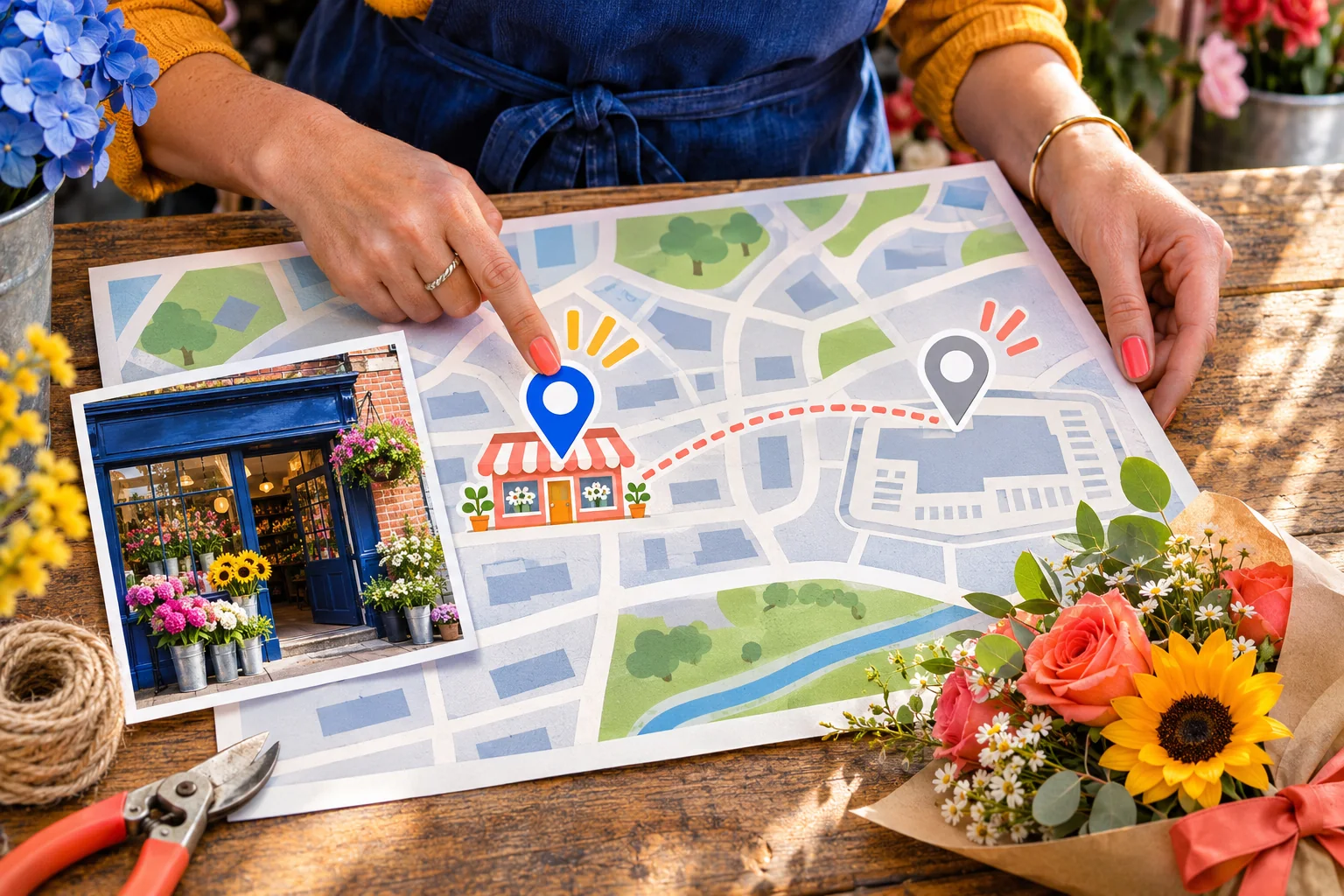
The accompanying map illustration models a common mistake: a blue pin sits at the florist's real door, while a similarly plausible grey pin belongs to another site. Staff can compare a place result with the public shop address, street view or the physical frontage they know. If the app shows no precise shop result, a truthful neighbourhood or city label can be better than a wrong business label. Put the exact address and directions in a verified public destination or readable caption where appropriate; do not invent a geotag just to fill a field.
The same rule applies to format and timing. A Reel filmed at a local market should name the market if the stall really operated there, and explain the date or limited availability. A later shop post should return to the permanent venue. A delivery image from a customer's home need not reveal that private place. Check the preview before posting and then tap the live tag as a visitor. Meta's Map update specifically discusses a preview for how tagged content can look on the Map, but that control may not appear on every UK account.
- In the current post, Reel or Story composer, look for an available location control before sharing.
- Compare the visible place label with the real venue, not just the same street or city.
- Preview the tagged post on the business's own app before publishing.
- If the exact venue is unavailable, use an honest broader area and give the address through a verified public route.
Keep a tagged place separate from live location sharing
A tagged post says something about the content's place; it does not by itself mean the account holder has opted to show their last active position to friends. Meta introduced Instagram Map with location sharing off unless a person chooses to turn it on. Its later explanation explicitly addressed confusion between tagged content and a person's location. A business owner should review both controls separately instead of assuming that adding a shop tag switches on personal sharing or that turning off personal sharing removes every tagged post.
Use the business's public venue location only for content where it is relevant. Avoid revealing staff home addresses, a customer's doorstep, a private appointment location or a predictable personal routine for the sake of a tag. Before showing a visitor or employee in an identifiable photograph, check the business's permission and data-protection process. The ICO's small-business marketing guidance notes that reusing customer or staff photographs for marketing can be a new use of personal data that needs its own assessment. A public shopfront photograph may answer the wayfinding question without showing anybody else.
For a team account, decide who is allowed to change account-level location-sharing preferences and who can add post tags. Check what the current app actually displays on the account's Map or privacy controls, if available, and document the choice. A post's accurate shop tag and a person's private whereabouts are different records. Where a venue is a home-based business with no public visiting address, say the service area or collection arrangement without exposing a residence or promising walk-in access that does not exist.
Publish a place story that answers a real local question
Location is useful context, but the post still needs a subject. A photograph of a doorway can help first-time visitors recognise a shop; a short video can show which side of a shopping arcade has the entrance; a caption can explain when orders are ready for collection. The florist might show the current window display and a simple route from a familiar street corner. These are practical editorial choices, not claims that a particular content format or amount of local wording earns an algorithmic boost.
Match each tag to the content. A bouquet arrangement filmed behind the counter can use the shop venue if that is where the work happened. A Reel about a pop-up stall can use the genuine market place and its correct date. A collaboration with a nearby café should not label both businesses as one venue; identify the partner in the caption or account tag as appropriate. Use readable captions for the address, time or access detail. A symbol hidden in a photograph may be impossible to read on a small phone.
Do not borrow customer photographs or publish recognisable visitors merely because they make a scene feel local. Obtain appropriate permission and review the specific reuse plan. The separate UK customer-photo guide covers that process. For the florist, a staff-made image of the shopfront, bouquet or route is often enough. Meta's creator best-practices material covers creation and engagement as distinct questions; it does not promise that a local tag converts into a local sale. Judge a post first by whether a visitor could use its information.
Show the way from a landmark to the right door
A place result can stop at a street or block rather than the entrance someone needs. Walk the route as a first-time visitor: from the bus stop or familiar corner, can they see the florist's sign, blue frontage and open doorway? If the main door is inside a courtyard or behind a shared lobby, make that clear. A short sequence of exterior shots can communicate the route more reliably than a decorative map sticker.
Keep wayfinding current. If a construction barrier changes the approach or the shop uses a rear collection entrance on certain days, update the public directions and the affected invitation. A photograph from last winter may still appear in an old Reel, so label or correct it if it no longer describes today's route. For a visitor with mobility needs, do not claim an accessible entrance from a photo alone; verify the available route, step, ramp or other relevant detail with the people responsible for the site.
The next action should match the place. A walk-in shop can provide current opening information and a directions route. A collection-only florist should explain how someone knows an order is ready. An appointment-only studio should send visitors to an actual booking route, as the separate UK booking guide explains. A tag can help identify a place; it cannot establish opening hours, availability, an accepted order or the customer's arrival. Put those facts in the business's maintained destination.
Test the published visitor path on another phone
Before a post goes out, ask someone who did not make it to identify the business and route from the draft. After publication, ask them to start from the public post, tap the place label where available, return to the profile and follow the main destination. Can they find the exact shop, current opening information and a staffed question route? Record which step was unclear. A preview is useful, but the published experience is the final check because crops, links and tag destinations can change.
Use the worksheet above as a small audit, not as a report of measured demand. For the fictional florist, a second team member tests one ordinary feed post, one Reel and the account profile. If the location tag opens the shopping precinct rather than the flower shop, the owner corrects future posts and checks whether the live post can be edited appropriately. If the profile destination opens a dead checkout or old market date, the team fixes the destination before inviting more visits.
Do not simulate a purchase or send a real customer message merely to test the route. Ask staff to use an approved non-chargeable test path if they need to check ordering; otherwise stop at the last safe public step. Where the route fails, give the person responsible a specific symptom and URL rather than saying 'the algorithm is broken'. The UK customer-enquiry guide covers how the shop should own and answer genuine questions once they arrive.
- Open the published post and profile on another phone.
- Follow each public tag and link to the current venue or directions.
- Check the route after a move, changed entrance or amended hours.
Diagnose missing or wrong place results without inventing a fix
If the expected shop label is absent, first separate three questions: Is the control present on this account and format? Does the label exist but refer to another venue? Does the published tag work for a visitor but not show in the surface staff expected? Those situations need different responses. A missing Map view on one phone is not proof that the shop was penalised; Meta's own announcements describe staged rollout and changed Map behaviour. Record the app version, account, format and exact public observation.
Next compare the business's own facts. Is the shop trading under a changed name? Did it move? Is there a duplicate or similarly named place nearby? If the correct label cannot be selected, use a truthful broader area if available and give the exact visitor route through the maintained public profile or site. Do not create a fake venue, tag a competitor or place a private residence on a public post. A staff member can revisit the platform's current help and reporting controls when a genuine place error persists, but should not promise a guaranteed repair time.
Measure a useful action, not a promised local reach figure
If the account provides insights, use their exact names and periods. An impression says the content was displayed under a platform definition; it does not identify a person who visited the shop. A profile visit is not a directions tap, a directions tap is not an arrival and a follower count is not a count of Bristol customers. Staff can keep a short log of practical questions such as 'Which entrance?' or 'Are you open on Sunday?' to see whether public information needs improving. Count only what the business can actually observe.
For the fictional florist, one review meeting could compare current public details with questions staff answered during a defined week. If several visitors ask where the blue door is, the shop can make a clearer exterior image and check the profile route. That is a hypothetical decision rule, not a claim that a new post will produce a particular number of visits. A staff member may ask willing customers how they found the shop, while acknowledging that people often see multiple sources and recall them imperfectly.
The florist may separately consider a HitsBoost UK Instagram follower package for a visible profile-count goal. Compare the current quantity, eligibility and checkout total on the relevant UK service page if that is a distinct need. A purchased count cannot establish that followers live nearby, saw a location tag, reached the shop, enquired or bought flowers. Keep the package record separate from visitor-route checks and actual business outcomes. The Global followers-versus-engagement guide explains why these measures answer different questions.
- Name the measure, source and date range before comparing results.
- Keep a direct question log for genuine wayfinding problems.
- Do not infer visits or local customers from impressions or bought follower counts.
Maintain the venue record when real life changes
Assign owners for the shop's profile, linked destination, public opening details and location-tag choices. A branch move, renamed market, changed entrance, seasonal hours or staff handover can make an old invitation misleading. Update the maintained source of truth first, then inspect pinned posts, Highlights and current campaign material that still direct a visitor to the former place. A link can continue loading while its directions are stale. Save a date on the internal place record so staff know what was last checked.
Use a compact pre-publication routine: identify the actual venue for this content, verify the public place label, inspect any people or private details in frame, show one useful arrival fact, and test the post after it goes live. Repeat the route check after a material venue change. This workflow will remain useful even as Instagram moves a button or renames a feature. Check current Meta and Instagram help for the control your account actually has rather than carrying an old screenshot into every new campaign.
Frequently asked questions
Will a location tag make my UK shop appear in Instagram Search?+
It may add relevant place context, but Meta does not promise placement or a particular ranking. Check the public result on your account and make the shop's identity and visitor route clear regardless of where a post appears.
Is Instagram Map available to every UK business?+
Do not assume so. Meta has described a staged rollout and changes to Map. Check the current app and account; the profile, published tag and public directions should still make sense if a Map control is absent.
Does tagging my shop turn on live location sharing?+
No. Meta distinguishes location-tagged content from optional sharing of a person's last active position. Review the account's Map and privacy settings separately.
What if Instagram shows the wrong shop with a similar name?+
Do not select it. Compare the public place result with the real entrance and address. Use a truthful broader area and maintained directions if the exact venue is unavailable, then check current platform help for reporting an error.
Should I tag a popular landmark near my shop?+
Only if that landmark is genuinely the place the content is about. A nearby tourist site should not be labelled as your business. Explain the route from a landmark in the caption or video instead.
Can I tag a customer's home where I delivered an order?+
A private customer address is usually unnecessary for a florist's marketing post. Show the bouquet or service without revealing their home, and assess permission before using identifiable people or details.
How do I tell whether the location work helped?+
Check the public route and log genuine wayfinding questions, enquiries or visits using the business's own records. Platform impressions and profile visits are different observations and do not prove a shop visit.
Will buying Instagram followers bring nearby customers?+
No. A follower package concerns a defined visible count under its terms. It cannot guarantee that people are local, see a tag, visit the shop, recommend the account or buy anything.
Compare Instagram Followers packages.
Prepare the public destination, then review the quantity and terms that fit your goal.
Review UK Instagram follower options