
Instagram Story views diagnostic matrix
| Observed pattern | Check first | Next controlled test | Avoid concluding |
|---|---|---|---|
| Every frame is lower than usual | Date range, metric definition, account status, audience activity, outside promotion | Repeat a proven topic and format at a comparable time | The account has been permanently penalized |
| Frame one is normal, then a sharp exit | Transition before the drop, visual load, message continuity, accidental tap target | Rewrite only that transition and keep the sequence length similar | All Story content is failing |
| Long sequences fade gradually | Number of frames, repetition, pacing, placement of the promised value | Deliver the key value earlier in a shorter sequence | Viewers dislike the whole topic |
| Replies or taps rise while views fall | Audience size versus response quality | Repeat the interaction for a comparable audience | Lower volume always means worse performance |
| One day or topic performs poorly | Timing, competing events, subject demand, first-frame clarity | Retest the topic with one deliberate change | One post proves a platform-wide algorithm change |
First confirm that Instagram Story views really dropped
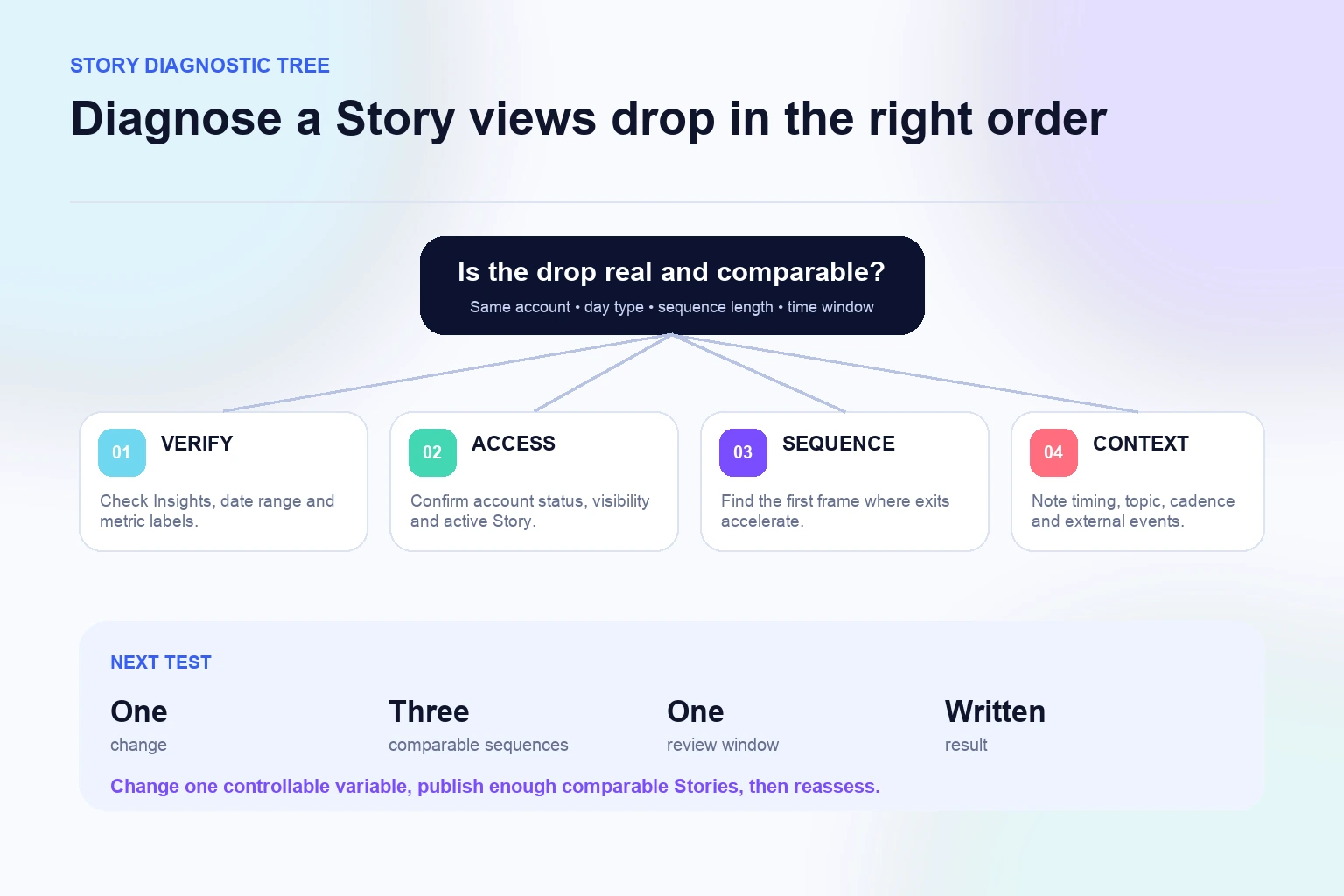
Start with the exact number, screen, and time window. ‘Story views are down’ can mean fewer accounts saw the first frame, later frames retained fewer people, replies declined, or a dashboard uses a different label than the person reporting it. Capture the metric name as Instagram displays it, the date, account, sequence, number of frames, and elapsed time since publication. Without that record, the team may compare different measures and solve a problem that is not real.
Compare several normal sequences with several recent sequences. Match the day type, general publishing time, topic category, sequence length, and how long each Story had been available when recorded. Do not compare yesterday's six-hour result with a previous Story's final total, or a routine update with a launch promoted through email and collaborators. A fair baseline is typically the recent median or range for genuinely similar Stories, not the largest audience the account has ever reached.
If an Instagram Story views package or paid promotion ran during either period, label it separately. The visible total may include activity from several sources, and the service has its own destination, quantity, and timing. A useful diagnosis keeps that campaign record beside—rather than blended into—the organic comparison. Only after the decline survives these basic checks should you begin asking why it happened.
- Record the exact metric label and reporting screen.
- Compare the same number of frames and similar time after publishing.
- Note topic, time, day, and any outside promotion.
- Use a multi-sequence baseline instead of your best-ever Story.
Use the right Story metrics and definitions
Instagram's available Insights can vary by account type, region, product version, and content age. Professional accounts may see account and content insights, but the names and availability can change. Use the labels in the current interface and consult Instagram's Help Center when a definition is unclear. Avoid carrying an old screenshot or third-party dashboard definition into a current report without verifying it.
Keep exposure and response measures separate. An account-level reach figure, a Story's viewers or views, navigation actions, sticker taps, link taps, replies, profile activity, and follows answer different questions. A sequence can reach fewer people while producing a higher proportion of useful replies. It can also reach many people but lose them before the promised information appears. Calling every measure ‘engagement’ removes the detail needed to improve the work.
Where a rate helps, save both numerator and denominator. A reply rate based on viewers answers a different question from replies divided by followers. A frame-to-frame continuation calculation requires comparable frame counts at comparable elapsed times. If a metric disappears from the product or its definition changes, mark the break in your reporting series rather than pretending the old and new numbers are identical.
Build a comparison set that removes obvious noise
Select six to twelve recent Story sequences from the same editorial category. Tag each with day, time, number of frames, first-frame format, topic, use of video or stills, interaction sticker, link, mention, collaborator, and outside promotion. This does not make the analysis scientific, but it stops major differences from hiding inside a single average. A product launch, personal announcement, tutorial, and repost serve different audience needs.
Compare the recent group with a previous group using the median and range, not only the mean. One unusually successful Story can raise an average enough to make normal performance look like a collapse. Also check whether follower count, posting frequency, or audience geography changed between periods. A different audience composition can move the time when viewers are active without indicating a penalty.
Add context notes for holidays, large news events, platform outages, account collaborations, and promotions. These notes do not prove causation. They remind the reviewer that content competes for attention in a changing environment. Use your hashtag research and audience questions to classify topic demand, but do not assume the presence or absence of one tag explains a broad shift across every frame.
Check account, access, and reporting conditions
Before rewriting creative, open Instagram's Account Status and review any current notices or recommendation eligibility information available to the account. Meta explains that some content may be allowed on its services while not being eligible for recommendation in the same way. If Instagram shows a specific issue, follow the platform's stated review or correction path. Do not diagnose a hidden restriction from a low number alone.
Confirm that the intended audience can see the account and active Story. Review privacy changes, Close Friends selection, age or regional restrictions where relevant, blocked accounts, and any shift between personal, creator, or business settings. If a teammate published from the wrong account or audience, that operational mistake can look exactly like a distribution problem in a summary spreadsheet.
Check for incomplete uploads, missing audio, unreadable text, broken links, deleted frames, or an app issue reported by multiple team members. Then verify whether the Insights screen is fully populated. If reporting appears delayed, record that uncertainty and recheck later. Changing five creative elements while the data is incomplete destroys the clean baseline you need for a diagnosis.
- Open Account Status and review any current notices.
- Confirm the Story and profile are available to the intended audience.
- Check whether the account, privacy setting, or audience changed.
- Document app or reporting issues before changing content.
Separate audience conditions from creative quality
Audience attention changes by time, day, location, season, and what else is happening. Start with your own account's history rather than a universal ‘best time to post.’ Compare when current followers are active if that information is available, then test two realistic publishing windows. A global audience may need different timing for different regions; a local business may care more about the hours surrounding a real appointment or event.
Topic familiarity also matters. A continuing series may bring dependable viewers because people know what to expect. A new subject can begin lower while attracting a more relevant niche. A promotional sequence often behaves differently from an educational answer or behind-the-scenes update. Record the intended job of the Story before grading it. If the job is qualified replies, raw views are context rather than the sole outcome.
Profile changes affect the journey after the Story. A clear bio, current highlights, recognizable profile image, and related recent posts help a new viewer understand the account. If exposure is stable but profile actions or follows fall, the sequence may be doing its job while the destination has become less clear. Diagnose the full path instead of asking the Story to solve every profile problem.
Find the first break in the Story sequence
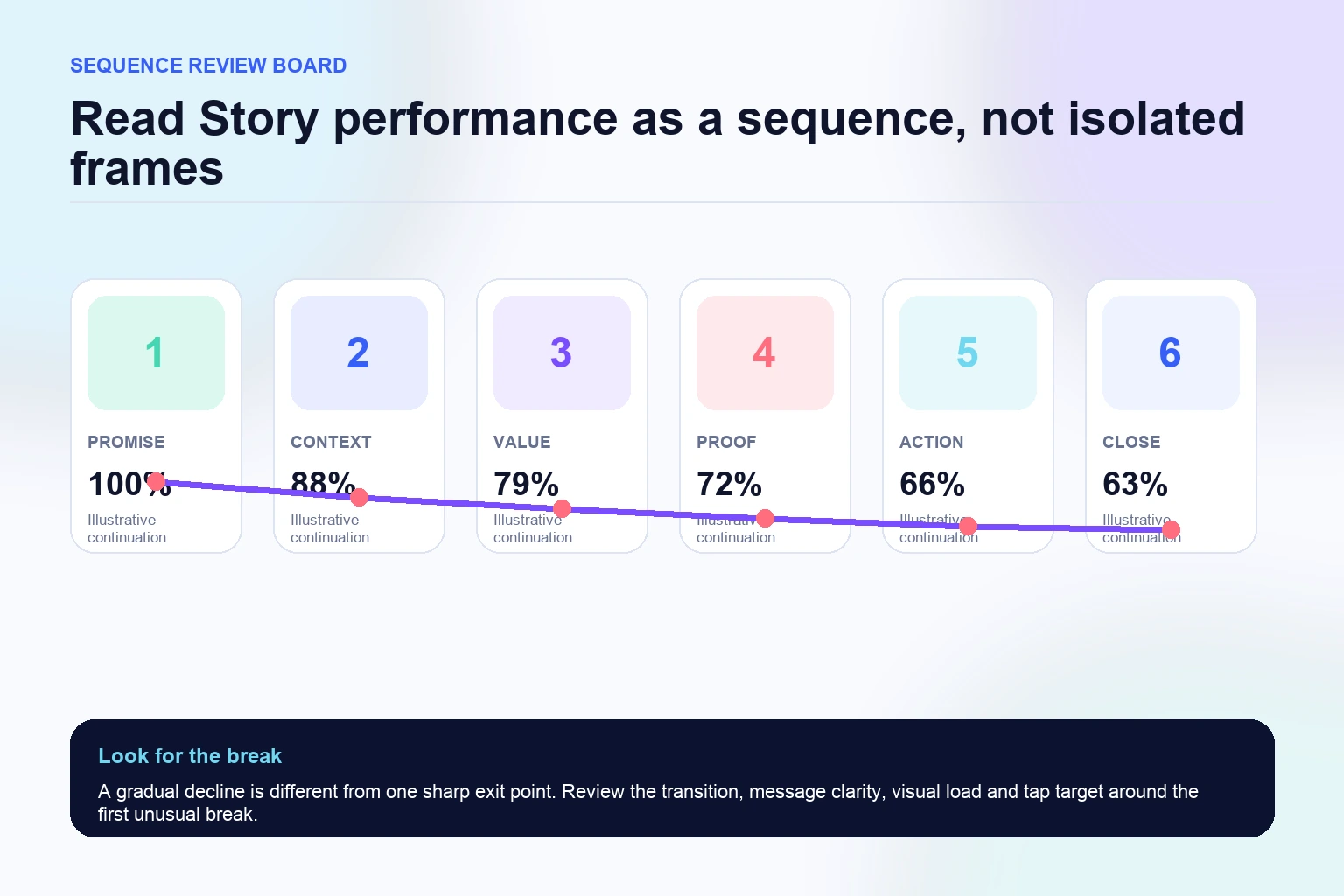
Lay the frames in order and label the job of each one: promise, context, value, proof, interaction, action, or close. Then compare continuation through the sequence with the normal pattern for similar Stories. Some decline is expected as people move through multiple frames. The useful signal is a break that is unusually sharp or occurs earlier than your baseline.
Review the transition immediately before that break. Did the sequence change topic, repeat the same point, introduce a dense paragraph, use low-contrast text, delay the promised answer, play audio without captions, or place a confusing tap target? A weak frame can affect the next frame's audience because people leave before reaching it. Editing the later frame cannot repair a promise that was broken earlier.
Do not remove every frame with a lower count. The final call to action naturally has fewer viewers than the opening because it comes later. Evaluate whether the people who remain take a useful action. A concise sequence that reaches a smaller but more relevant audience can be more valuable than a long sequence with a high opening number and no response.
- Label each frame by job: promise, context, value, proof, action, or close.
- Find the first break that differs from normal sequence decay.
- Review the transition immediately before that break.
- Keep strong response signals even when raw audience size is smaller.
Improve the opening without using clickbait
The first frame should tell the viewer what the sequence offers and why it matters now. Show the subject quickly, use readable contrast, and write for a phone screen. A strong opening can be a clear question, result to be explained, demonstration in progress, or specific promise. It should not withhold the basic topic or make a dramatic claim the sequence never supports.
Deliver part of the value immediately. If a five-frame tutorial promises three checks, name the first check on frame two rather than using three setup slides. Orient people joining from a reshare or mention; they may not have seen the account's earlier context. For video, add accurate captions and avoid placing essential words under interface elements.
Test one opening variable across comparable sequences: direct statement versus question, creator on camera versus object demonstration, or still versus short motion. Keep the rest of the sequence as similar as practical. A result is useful when the team can explain what changed, not when a redesign includes a new topic, time, length, visual identity, sticker, and offer at once.
Use interaction tools for a real editorial purpose
Polls, questions, links, mentions, and other current Story tools can turn passive viewing into participation, but each should have a job. Ask a poll when the answer will shape the next post. Use a question sticker when the team can review and answer submissions. Add a link when the destination fulfills the frame's promise. Decorative interactions can create taps without giving the audience or creator useful information.
Make the action specific and low-friction. ‘Which example should we break down tomorrow: A or B?’ is easier to answer than ‘Thoughts?’ Explain what will happen with the response and protect sensitive information. Do not invite customers to post private order details publicly. Route account or payment problems to the appropriate support channel.
Comments and direct replies can reveal whether the Story reached the right people. If you are evaluating optional Instagram comments or other packaged activity elsewhere in a campaign, keep that source clearly documented. Organic responses to a Story test should not be combined with purchased interactions and then presented as evidence that one creative idea caused the total.
Run a seven-day recovery test
Choose one editorial category that has enough recent history for comparison. Plan three or four sequences of similar length across realistic publishing windows. Keep the visual system and core promise consistent. Test one variable at a time: the first-frame approach, value placement, sequence length, interaction prompt, or time window. Write the hypothesis before publishing.
Capture the opening audience, frame-by-frame pattern, useful interactions, profile actions, and any available discovery information at consistent elapsed times. Add notes about reposts, mentions, paid activity, outages, and external events. If you also run a Live during the week, treat its promotion and results as a separate campaign even when Stories support it.
At the end of the week, classify the result as keep, revise, retest, or stop. Keep a change when it improves the intended outcome across more than one comparable sequence. Revise when the break is clear but the fix was weak. Retest when context made the result ambiguous. Stop when the format consistently loses the audience before delivering value. One week provides direction, not a permanent law about the account.
- Publish three or four comparable sequences over seven days.
- Change one major variable in each planned test.
- Capture results at consistent elapsed times.
- Choose keep, revise, retest, or stop at the end of the week.
Understand what an Instagram Story views package measures
A Story views package applies to the eligible public destination, quantity, and terms shown for that service. It does not prove that viewers understood the message, visited the profile, replied, followed, or purchased. Those are separate outcomes. Check the destination, current package description, price, delivery information, and public-access requirements before ordering.
Save the selected package, checkout record, Story URL or destination information supported by the service, start time, and the Story's availability window. Stories are time-sensitive, so submit the correct active destination and do not assume an expired or restricted Story can be processed. Never provide an Instagram password, authentication code, or recovery key for a public-destination order.
Keep packaged views separate in the analysis. They can support a stated visible metric, but they should not be reported as organic hashtag discovery or evidence that Instagram recommended the Story. Compare delivery against the package record, and evaluate editorial quality with the Story's own response signals and your controlled creative tests.
Turn the diagnosis into a repeatable Story system
Create three templates based on jobs rather than decoration: a quick answer, a short sequence that teaches a process, and an interactive follow-up. For each, define the promise, ideal length range based on your tests, visual hierarchy, accessibility check, interaction purpose, and measurement. Templates reduce production friction while leaving room for new subjects and creative execution.
Hold a weekly review with the frames visible beside the numbers. Ask where the first unusual break appeared, what audience action mattered, what changed outside the creative, and what single variable to test next. Keep examples of strong openings and transitions, but do not copy them into unrelated topics. The principle should travel; the exact words and images should remain specific.
A recovery is a stable improvement across several comparable sequences, not one high total. If the account remains materially below its own baseline after access, reporting, audience, and creative checks, use Instagram's official support resources and keep the documented evidence. The most credible conclusion may be that the cause is not yet known. That honesty protects the next decision from being built on a convenient guess.
Frequently asked questions
Why did my Instagram Story views suddenly drop?+
Possible explanations include a mismatched comparison window, different sequence length or topic, audience timing, access or account-status changes, reporting delay, creative exits, and outside events. The number alone cannot identify the cause, so check these in a fixed order.
Does a Story views drop mean I was shadowbanned?+
A low number is not proof of a hidden penalty. Review Account Status and any recommendation information Instagram provides, confirm access and metrics, then compare several similar sequences. Use the platform's stated review path when it shows a specific issue.
How many Stories should I post per day?+
There is no universal daily number that works for every account. Test sequence length against your own continuation and response patterns. Publish enough frames to deliver the promise clearly, then remove repetition that causes people to leave before the useful part.
Should I delete a Story that starts poorly?+
Usually, first check whether it contains an error, policy issue, sensitive information, or broken destination. Deleting only because the opening number is low removes evidence and may interrupt the sequence. Record the result and improve the next controlled test.
Do polls and question stickers increase Story views?+
They can invite useful participation, but no sticker guarantees more views. Use one when the response serves a clear editorial purpose, make the prompt easy to understand, and measure the quality of responses as well as exposure.
What is a normal frame-to-frame drop?+
There is no universal benchmark. Build a baseline from similar sequences on the same account, measured at comparable elapsed times. Look for a break that is unusual relative to that baseline rather than applying a percentage borrowed from another industry.
Can buying Instagram Story views restore organic reach?+
A Story views package addresses the eligible destination and quantity described by the provider. It does not establish that Instagram will recommend future Stories or that viewers will reply, follow, or buy. Track the package separately from organic creative tests.
How long should I test before changing the whole strategy?+
Run at least several comparable sequences with one major variable changed at a time. A focused seven-day test can show direction, while a broader decision should use more than one week when seasonality, launches, or unusual events affected the account.
Compare Instagram Story Views packages.
Prepare the public destination, then review the quantity and terms that fit your goal.
View Instagram Story views packages