
Hashtag candidate evaluation sheet
| Check | Question to answer | Keep when | Reject when |
|---|---|---|---|
| Meaning | Does the tag describe the post in ordinary language? | A viewer would understand the connection immediately | The connection requires an explanation or depends on a trend you did not join |
| Audience | Would the intended viewer plausibly search or follow this topic? | The wording matches the community's real vocabulary | The tag attracts a broad but unrelated crowd |
| Context | Does it fit the format, place, event, or moment? | The context is visible in the post | The tag borrows attention from an unrelated event |
| Search review | What appears when you inspect the current tag results? | Recent results share a meaningful topic and quality level | Results are dominated by another meaning, spam, or unsuitable content |
| Measurement | What result would justify using the set again? | Comparable posts show useful discovery or audience actions | Only raw impressions rise while relevance and actions weaken |
What makes an Instagram hashtag useful in 2026
A hashtag is a label attached to a post, Reel, or other eligible Instagram content. It can give people and Instagram an additional clue about the subject, but it cannot rescue unclear media, an unrelated caption, or a profile that offers no reason to continue. Instagram's own Help Center still documents hashtag pages and search behavior, while Meta's creator guidance places hashtags inside a wider system of creation, engagement, reach, and account guidelines. That is the right scale: useful context, not a guaranteed distribution switch.
The best Instagram hashtags are therefore the ones that are true, specific enough to set an expectation, and familiar to the audience you want to reach. A bakery tutorial might use a bread-making term, a technique, its city, and a seasonal event when each is genuinely visible in the post. A huge generic tag may describe the category loosely, yet place the post beside millions of unrelated items and teach the team very little about who found it.
Treat hashtags as one part of a complete discovery path. The first frame or image must earn attention, the caption should clarify the value, and the profile should confirm who created it. If discovery brings a relevant visitor, a clear bio, consistent recent posts, and an understandable next step determine whether that visit continues. Before increasing exposure, prepare the profile for the audience you want to keep.
Start with the post brief, not a hashtag list
Begin research by writing one sentence: ‘This post helps [audience] understand or do [specific thing] through [format].’ That sentence gives you more usable vocabulary than a list titled ‘100 viral hashtags.’ Underline the audience, subject, method, result, format, place, and occasion. Those words become research seeds; they are not automatically the final tags.
Next, inspect the actual media and caption. If the post promises a beginner sourdough scoring demonstration, tags about artisan bread, sourdough technique, baking tutorials, and the relevant location may fit. A tag about restaurant reviews does not become relevant just because both subjects involve food. Accuracy matters for the reader and protects the account from building a discovery history around people who never wanted the post.
This brief also makes collaboration easier. A strategist can propose candidates, the creator can check whether each term matches the work, and the person reporting results knows which audience action matters. Without the brief, teams often keep adding tags until the caption looks busy. With it, every label has to earn a place by describing the content or the context honestly.
- Write the post's one-sentence promise.
- Name the person the post is meant to help or entertain.
- List the concrete subject, format, place, and occasion.
- Remove any tag the media and caption do not support.
Research four layers of relevance
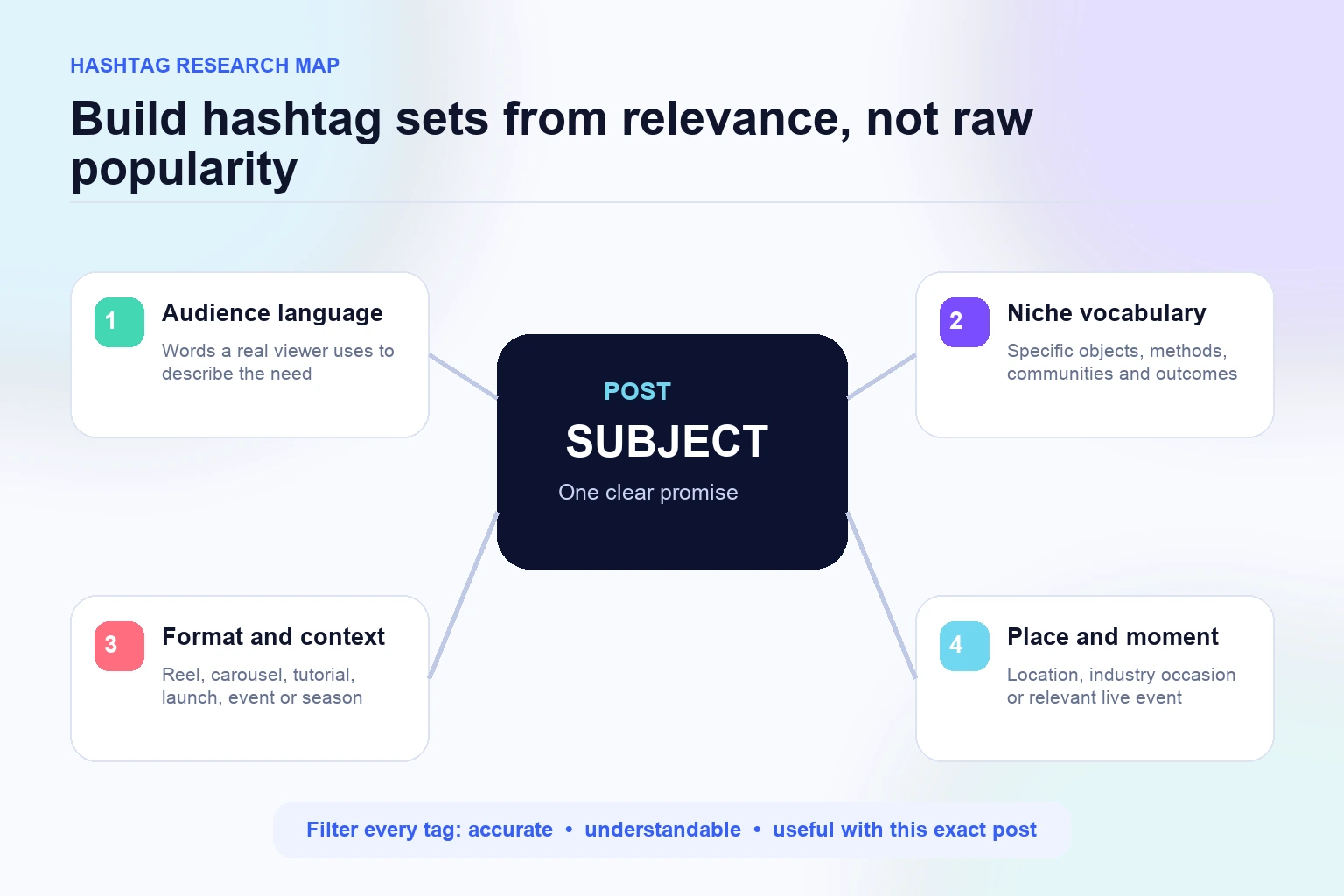
The first layer is audience language: the words a likely viewer uses for the problem, interest, or desired outcome. Collect phrases from customer questions, relevant comments, site search, community discussions, and your own messages. Preserve the audience's wording before translating everything into brand language. A creator may call a video a ‘mobility flow’ while beginners search for ‘stretches before running’; the post can support both only if both are accurate.
The second layer is niche vocabulary. Add the objects, methods, disciplines, professions, and communities that make the subject precise. The third layer is format and context: tutorial, before-and-after explanation, interview, carousel, Reel, launch, challenge, conference, or season. The fourth is place and moment, used only where location or timing contributes real meaning. A local studio can name its city; an online guide should not borrow city tags it does not serve.
Combine the layers into several small candidate sets rather than one permanent block. One set may emphasize the audience problem, another the niche method, and a third a legitimate event or location. Keep a short note beside every candidate explaining its role. That note is a useful quality gate: if nobody can explain why a hashtag belongs, the post probably does not need it.
Inspect every candidate before you publish
Open Instagram and examine the current search or hashtag results for each serious candidate. Look at the dominant meaning, the type of accounts appearing, how recent the visible content is, and whether the material is suitable for your brand. Language changes quickly. A phrase that appeared harmless in an old spreadsheet may now belong to a different community, a temporary meme, or content you would never want a visitor to associate with the post.
Check the spelling and word boundaries carefully. Hashtags remove spaces, so several words can create an unintended reading when joined. Also review whether the tag represents a protected identity, health claim, event, location, or social cause. Do not use a community's label merely because it has attention. Relevance includes the right to participate and the ability to contribute something truthful.
Meta publishes Recommendation Guidelines because content can be allowed on its services without being eligible for recommendation in the same way. Hashtags do not override those standards. Review the account's status and Instagram's current guidance if discovery changes suddenly. If a tag cannot be searched or its result page has changed, replace it based on fresh research rather than trying to evade a platform restriction.
- Open the current hashtag or search result before publishing.
- Check whether the meaning matches your intended topic.
- Avoid misleading event, identity, location, or community labels.
- Keep account privacy and recommendation eligibility in mind.
Ignore the myth of one perfect hashtag count
Advice about the ‘correct’ number of Instagram hashtags often presents a precise rule without a source, date, account type, or test design. Interface limits and creator recommendations can change, and performance depends on far more than count. A useful set may be compact because the subject is narrow. Another post may legitimately need more labels to describe a place, event, profession, method, and audience. Count should follow meaning, not the other way around.
The common popularity pyramid—some large tags, some medium tags, and some small tags—can help organize research, but popularity is not relevance. A smaller tag can still be wrong, and a broad tag can still be accurate. Instead of classifying candidates only by volume, label each one by role: subject, audience, niche, context, location, or brand. Then remove duplicates that point to the same idea without adding a new discovery cue.
Do not promise that a particular mix will increase likes, followers, or sales. Test whether a set helps the right people encounter and understand the post. If you also use an Instagram likes campaign, track that order separately from organic discovery so paid or packaged activity does not contaminate your hashtag conclusion. One report can contain both, but each needs its own source and label.
Build a small hashtag library your team understands
A useful library is a table, not a wall of copied tags. Give each entry the hashtag, plain-language meaning, relevance layer, suitable post types, accounts or regions it serves, date checked, and a short caution where necessary. Add the link or screen note from the latest search review. The library becomes a research memory, while the individual post brief still decides what gets used.
Create topic groups around recurring editorial pillars rather than departments or campaigns alone. A fitness brand might have mobility, strength technique, recovery education, coach interviews, and local classes. Within each group, separate evergreen terms from seasonal or event-specific options. A branded hashtag can organize a series or community contribution, but it should be easy to read, unique enough to identify, and supported consistently across the profile.
Do not paste the complete group into every post. Select only the labels that match that piece of content, then record the final set beside the post URL and brief. This provides a clear test history and avoids accidental repetition. It also helps a new team member understand why two posts in the same pillar may use different terms because their audience question, format, or location differs.
Run a four-post hashtag experiment
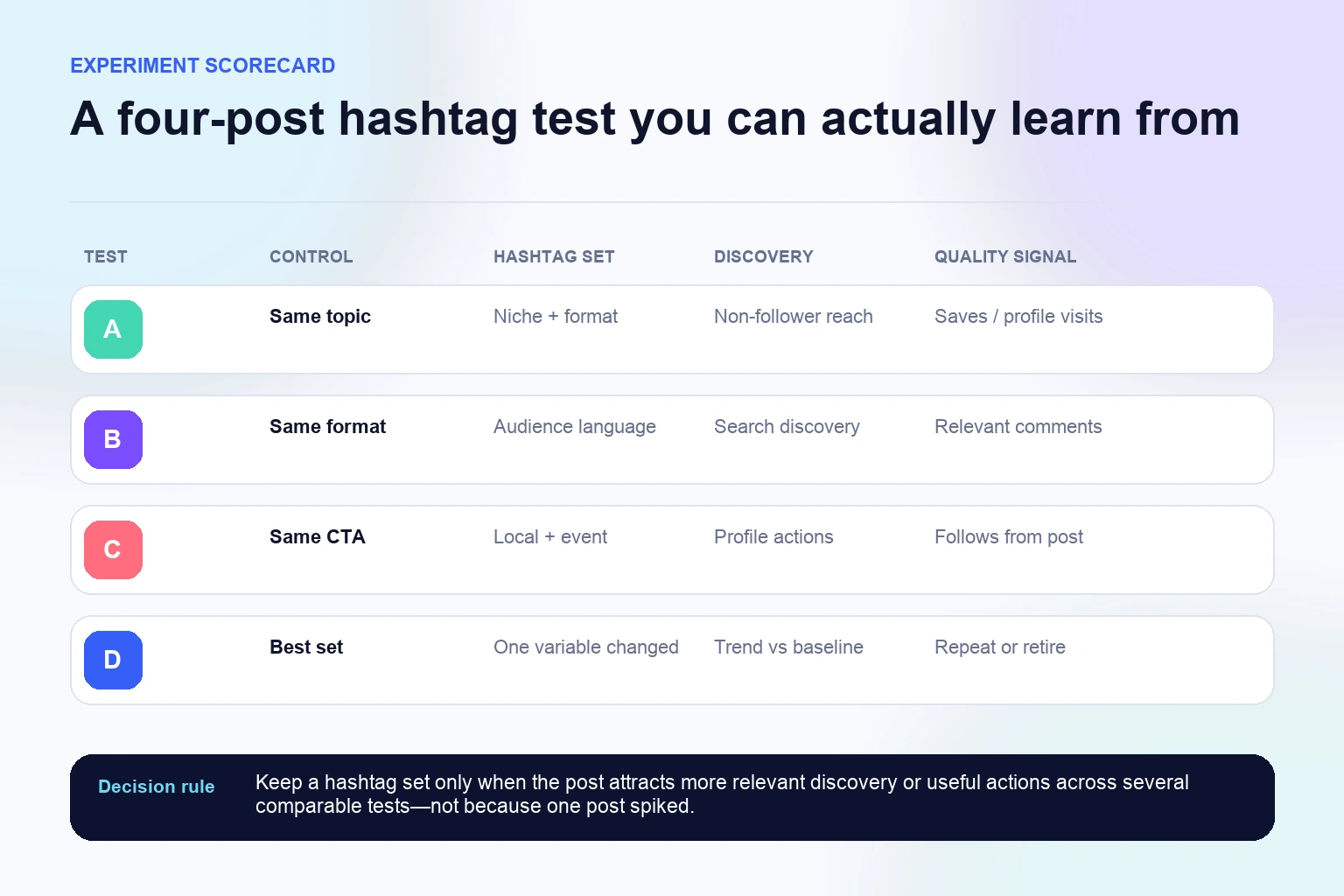
Choose four posts that are genuinely comparable: the same content pillar, similar production quality, related format, and normal publishing conditions. Perfect laboratory control is impossible on a live platform, but obvious differences can be reduced. Do not compare a major collaboration posted during a product launch with an ordinary solo tutorial and attribute the difference to hashtags.
Use the first post as a documented baseline. In the second, change the emphasis from broad category labels to audience-language labels. In the third, test a precise niche or legitimate local set. For the fourth, keep the strongest set and alter one smaller variable. Record the post, date, creative format, opening, caption, collaborators, distribution outside Instagram, final hashtag set, and any unusual event that could affect attention.
Decide the rule before seeing the result. For example: retain a set when several comparable posts show stronger non-follower discovery plus at least one relevant action such as saves, profile visits, qualified comments, or follows. The rule prevents the team from celebrating the largest impression number after the fact. It also makes an inconclusive result useful: repeat the test, improve comparability, or stop spending time on a variable that has not shown practical value.
- Use four comparable posts rather than four unrelated creative ideas.
- Hold topic, format, and publishing conditions as steady as practical.
- Change one main hashtag variable in each round.
- Write the result and next decision before starting another test.
Measure discovery without inventing causation
Use the metrics currently available to your account and content type, and copy their labels exactly. Account type, region, product changes, and the age of the content can affect which Insights are available. Compare reach, views, or discovery indicators only when their definitions and date windows match. Keep follower and non-follower figures separate when Instagram provides that breakdown.
Pair exposure with quality signals. Saves may indicate reference value, shares may indicate usefulness or identity, profile visits show curiosity, and relevant comments reveal whether the intended audience understood the topic. None proves that the hashtag alone caused the action. A better result statement is: ‘This set appeared on three comparable posts that produced more non-follower discovery and more profile visits than our four-post baseline.’
Look for patterns across several posts, not a single winner. Creative quality, the opening frame, topic demand, collaborator distribution, seasonality, and external promotion can all move results. Write those factors beside the numbers. An honest scorecard helps the next creator make a better choice; a confident causal story built from one post does not.
Place hashtags where they remain readable and accurate
The caption should make sense to a person before it serves a classification system. Lead with the post's useful context, write a clear next step where one is needed, and place hashtags without burying important information in a dense block. Teams can adopt a consistent style—grouped after the caption, integrated sparingly in natural language, or handled according to current Instagram options—then test readability on a phone.
Do not convert every keyword into a hashtag. Search-friendly writing and accessible description still require ordinary words. Name the subject in the spoken audio, on-screen text where appropriate, caption, and accurate alt text instead of assuming a tag can carry the entire meaning. Hashtags should support that coherent description rather than contradict it.
For Stories and Live promotion, use relevant stickers, reminders, captions, and clear creative context according to the features currently available to the account. A hashtag is only one possible cue. If Story reach weakens, diagnose the sequence and audience conditions rather than responding by adding more tags. If a Live needs more viewers, the event promise and promotion plan deserve attention before the hashtag count.
Examples for different Instagram accounts
A local ceramics studio posting a wheel-throwing tutorial could research its technique, clay type, beginner audience, city, and workshop series. The city tag belongs because people can attend locally; a global travel tag does not. A business-to-business software team sharing a carousel about invoice reconciliation might research the accounting task, job role, business size, and carousel's educational format while avoiding generic entrepreneurship labels that attract an unfocused audience.
A fashion creator covering a real event can combine garment details, styling method, audience interest, and the official event label after verifying it. A nonprofit explaining a community program should prioritize the issue, service, region, and people it legitimately serves. Social-cause tags require more care than ordinary product categories: the post must contribute accurate information and respect the community rather than borrowing visibility.
Service packages also need correct context. Instagram Story views apply to an eligible Story destination, while Instagram Live views concern an eligible active broadcast. Neither should be mixed into a hashtag experiment and reported as organic search discovery. If those options are part of a broader campaign, preserve the public destination, order timing, and package record in separate rows so the editorial test remains interpretable.
Maintain the library and turn tests into decisions
Review high-use hashtags monthly and event-specific tags before every campaign. Reopen the current results, confirm the meaning, and check whether your recent posts attracted the intended audience. Retire a tag when the surrounding content no longer fits, the term has taken on a different meaning, Instagram restricts it, or repeated comparable tests produce no useful signal.
Store a one-line decision with each experiment: keep, narrow, retest, or retire. Include the evidence and date. A result such as ‘retest because the collaborator drove most distribution’ is more valuable than declaring the set successful. The aim is a learning system in which each publishing cycle reduces uncertainty instead of creating another spreadsheet of unexplained numbers.
Finally, revisit the profile and content itself. If relevant people discover the post but do not explore, the issue may be the bio, recent grid, offer, or mismatch between the post and profile promise. If discovery is weak but existing followers respond strongly, consider the topic packaging and distribution path. Hashtag research works best when it points toward the next useful editorial decision rather than becoming an end in itself.
- Assign an owner and a monthly review date.
- Record why each tag belongs in the library.
- Retire tags whose meaning or result set no longer fits.
- Keep a dated test log so the team does not repeat failed experiments.
Frequently asked questions
How many hashtags should I use on Instagram in 2026?+
There is no universal count that guarantees reach. Use only the hashtags that accurately describe the post, audience, context, or location, then test comparable posts. Check Instagram's current in-app guidance and interface limits because product advice can change.
Should I put Instagram hashtags in the caption or comments?+
Choose a placement that remains readable and is supported by Instagram's current product behavior, then keep it consistent during a test. The larger issue is relevance: placement cannot make an unrelated hashtag useful.
Do popular hashtags always bring more views?+
No. A popular tag may place the post in a broad, competitive, or unrelated context. Review the current results and measure whether the post earns relevant discovery and useful audience actions rather than assuming a large tag produces a qualified audience.
Should I use the same hashtags on every post?+
Usually no. A reusable library can save research time, but the final set should match the individual post. Repeating one complete block makes it harder to learn which audience, subject, format, or location labels were appropriate.
Can hashtags fix a drop in Instagram reach?+
A hashtag change is only one test. First confirm the metric and date range, review account status, content quality, topic demand, timing, collaborators, and outside promotion. Change one important variable at a time so the result remains useful.
Are branded hashtags worth creating?+
They can organize a series, campaign, event, or community contribution when the phrase is readable and used consistently. A branded hashtag still needs explanation and moderation; creating it does not guarantee that people will adopt it.
How often should I update my hashtag library?+
Review frequently used tags at least monthly and time-sensitive tags before each campaign. Recheck meaning and search results whenever a community, event, platform feature, or business focus changes.
Can I prove that hashtags caused a follower increase?+
A simple before-and-after comparison cannot isolate causation. Report the hashtag set, comparable posts, discovery metrics, profile actions, other promotion, and timing. Describe the association you observed and repeat the test before making a stronger conclusion.
Compare Instagram Followers packages.
Prepare the public destination, then review the quantity and terms that fit your goal.
Compare Instagram followers packages