
First 1,000 Reel views review sheet
| Layer | Record at the checkpoint | Question it helps answer |
|---|---|---|
| Exposure | Views and accounts reached when available | How much counted viewing occurred, and how broad was the audience? |
| Attention | Total watch time, average watch time, and Reel length | Did the opening and pacing hold attention long enough to deliver the idea? |
| Depth | Retention or completion information available in the account | Where did interest weaken, and which moment deserves a new edit? |
| Response | Likes, comments, saves, shares, and follows | What did people do beyond starting the Reel? |
| Distribution | Publishing time, shares, ads, collaborations, and package activity | Which promotion occurred before the review? |
| Outcome | Profile actions, link activity, enquiries, or sales tied to the campaign | Did the Reel support the purpose defined before publishing? |
| Next test | One hook, pacing, topic, caption, or distribution change | What single change will make the next comparison useful? |
The short answer: 1,000 is a checkpoint, not a secret threshold
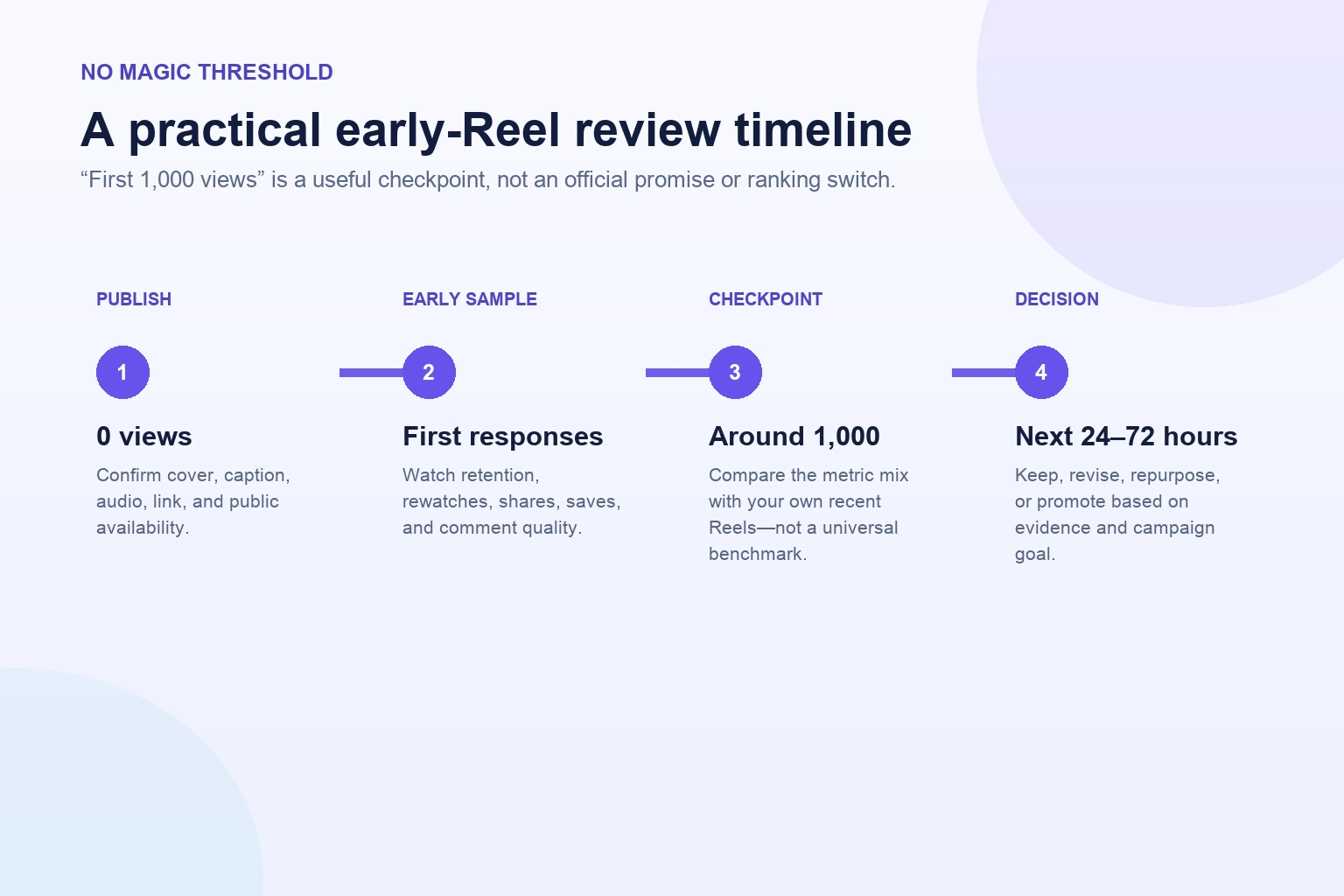
The first 1,000 Instagram Reel views matter when you use them as a consistent point for analysis. A four-digit count is large enough for many small and developing accounts to stop judging performance from the first few friends or followers, yet early enough to influence the next creative decision. It gives a team a shared moment to collect the Reel's metrics, note its distribution, and decide what to test next.
Instagram has not publicly identified 1,000 views as a universal switch that releases a Reel to a wider audience. Meta describes recommendation and ranking systems that use many signals, models, rules, and personalized predictions. Those systems change over time and respond to each person's interests and behavior. A round public number can be useful to your workflow without being a platform milestone that guarantees further reach.
That distinction protects the analysis. If views continue growing after 1,000, do not assume the number itself caused the growth. If they slow down, do not conclude that the Reel failed a hidden test. Review the audience, source, watch pattern, topic, opening, shares, saves, comments, and profile actions. The checkpoint matters because it organizes evidence, not because Instagram owes the Reel a second distribution wave.
Know what a Reel view does and does not tell you
A view is a counted play under Instagram's current measurement rules. It is not automatically a unique person, a complete watch, an attentive viewer, a profile visit, or a customer. Replays and the way a platform defines a view can affect the relationship between total views and individual accounts reached. Use the labels shown in your own Insights rather than substituting one metric for another.
Accounts reached is useful when available because it describes unique accounts that saw the content, while views or plays describe counted viewing activity. Dividing views by accounts reached can suggest that some repeat viewing occurred, but it does not explain why. A tutorial may be replayed for a useful step, a short visual may loop naturally, and an unclear moment may also cause a replay. Interpret the pattern beside watch time and content structure.
Do not use the public view count as a complete performance report. A creator with authorized Insights may see more detail than a visitor. Preserve the public count when it matters to the campaign, but use the account's own analytics for decisions. If several people manage the profile, agree on the reporting source and timezone so screenshots from different interfaces do not become false disagreements.
Why an early sample is useful
Early data can reveal a structural problem before a creator repeats it across a series. If comparable Reels lose attention immediately, the opening may be too slow or unclear. If viewers stay but take no other action, the content may answer the question without giving a reason to save, share, comment, or visit the profile. If profile activity rises but link actions remain flat, the profile promise or destination may need work.
The first 1,000 views can also expose distribution differences. A collaboration, newsletter, ad, profile share, or third-party views package changes the mix of exposure around a Reel. Record those inputs before reading the results. A view from one source should not be assumed to have the same intent as a view from another, and the public counter does not label every source for you.
Smaller accounts may need days or weeks to reach this checkpoint, while larger accounts may pass it quickly. That does not make the method invalid. Use the same review point across a defined set of comparable Reels, then add time-based checks such as 24 hours and seven days. The combination separates speed from eventual performance and prevents a fast start from becoming the only definition of success.
Measure attention before celebrating exposure
Meta introduced total watch time and average watch time in Reels Insights to help creators understand where people stay engaged and where a stronger hook may be needed. Total watch time accumulates the time spent playing the Reel, including replays. Average watch time divides watch time by total plays. Read both beside Reel length; an average of seven seconds means something different on an eight-second demonstration and a sixty-second explanation.
Retention or completion information, when available to the account, adds shape to the average. A strong opening followed by a steep drop may signal that the promise was clear but the middle did not deliver. A gentle decline with saves and shares may indicate useful depth even if not everyone reaches the final frame. Avoid a universal completion benchmark detached from topic, length, audience, and creative style.
Use attention metrics to choose an edit. Move the outcome earlier, remove a repeated sentence, show the finished result before the process, make on-screen text easier to read, or shorten a pause. Change one major element in the next Reel and preserve the rest when possible. Otherwise, a new hook, topic, length, audio choice, caption, posting time, and promotion plan all change together, leaving no clear lesson.
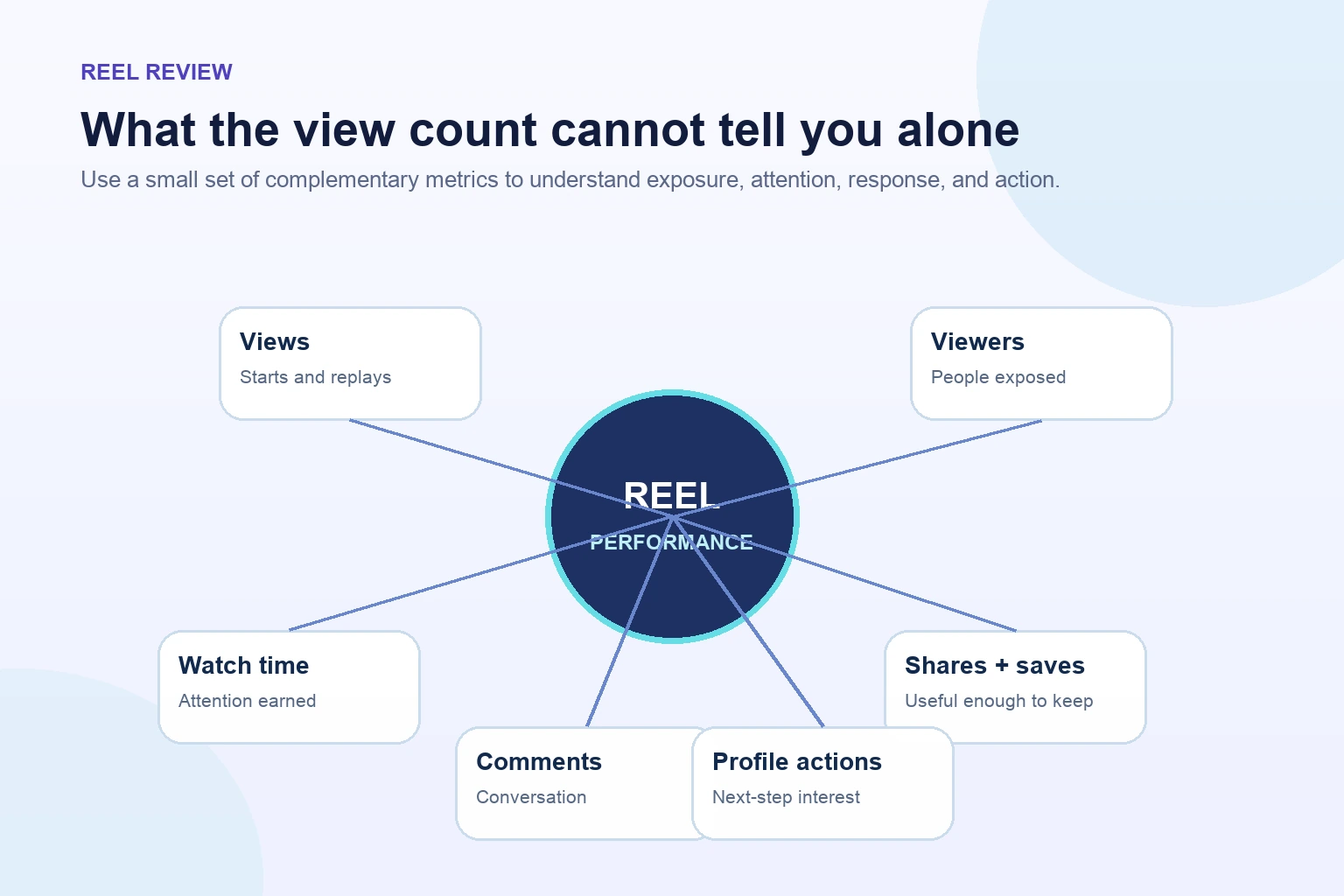
- Exposure: views and accounts reached answer different questions.
- Attention: total and average watch time reveal more than the counter alone.
- Depth: retention or completion patterns show where the story loses momentum.
- Response: likes, comments, saves, shares, and follows describe different actions.
- Outcome: profile activity, clicks, enquiries, or sales connect the Reel to its purpose.
Compare the Reel with its own fair baseline
Choose three to five earlier Reels from the same account with similar topics, lengths, and objectives. Compare their performance at the same view checkpoint and at the same elapsed-time checkpoint where possible. A product tutorial should not be judged only against a comedy clip, and a paid launch Reel should not be treated as equivalent to an unpromoted behind-the-scenes post.
Use rates as well as totals. Comments per 1,000 views, shares per 1,000 views, saves per 1,000 views, and profile actions per 1,000 views can make differently sized samples easier to compare. A rate does not remove audience or source differences, but it stops the largest view total from winning every comparison automatically. Keep the raw counts beside the rates so small-sample volatility remains visible.
Write the baseline before interpreting the new Reel. If the team chooses comparison posts only after seeing the result, it may select examples that support the preferred story. Note anomalies such as a giveaway, influencer tag, paid placement, press mention, or seasonal event. The goal is a useful reference range, not a claim that social content can be turned into a perfectly controlled laboratory experiment.
Diagnose the opening, pacing, and payoff
The opening should answer why this Reel deserves the next few seconds. Show the result, tension, question, or useful object early enough for a viewer to orient. Generic greetings, long logos, and context that only makes sense to existing followers can delay the promise. A strong hook is accurate and connected to the payoff; misleading curiosity may increase initial attention while weakening trust and meaningful response.
Pacing is not the same as speed. A complex tutorial may need time for labels and examples, while a visual transformation can move quickly. Remove dead space, repeated setup, and text that cannot be read before it disappears. Use cuts, motion, audio, captions, and framing to clarify the story rather than adding stimulation to every second. Accessibility choices can also help people understand the Reel without sound.
Deliver the payoff promised by the opening. If the Reel begins with 'three fixes,' make all three identifiable. If it promises a result, show the method and limits rather than only an after image. The final action should fit the content: save a checklist, share a useful comparison, comment with a specific experience, or visit the profile for a related resource. One clear next step usually reads better than four competing requests.
Read shares, saves, comments, and profile actions in context
Shares can indicate that a viewer thought another person would value or enjoy the Reel. Saves may indicate future utility, inspiration, or reference value. Comments can contain questions, disagreement, jokes, personal examples, or low-value repetition. Likes provide another visible response. None of these actions has one fixed meaning, so read the words and content context as well as the total.
Profile activity shows whether the Reel encouraged people to learn who made it. Follows, profile visits, and link actions answer different questions, and availability can vary by account and interface. A Reel may attract significant viewing without creating profile interest because it resolves the viewer's need completely. That can still be useful when the objective is awareness or education rather than follower growth.
Respond to genuine comments while the context is current. Ask a relevant follow-up, clarify a step, and save recurring questions for the next Reel. This turns the comment section into research rather than a score. The comments guide in this launch cluster explains how to design prompts and replies that create substance without relying on engagement bait or repetitive one-word requests.
Separate organic response from added distribution
List every meaningful source of exposure before the checkpoint: follower Feed, profile visits, Explore or Reels recommendations shown in Insights, collaborator audiences, Story reshares, direct messages, email, embeds, ads, and third-party packages. You may not have perfect attribution, but an honest source log stops the team from labeling all views organic when distribution was deliberately added.
If you use an Instagram views package, evaluate it against its stated view quantity, destination, timing, and support terms. It does not include watch time, unique reach, likes, comments, followers, saves, recommendations, or sales unless the live offer explicitly states another scope. Keep the Reel public, use its direct URL, protect account credentials, and avoid treating a completed view count as evidence that the content itself improved.
Paid or packaged exposure can coexist with content analysis only when the report keeps the layers separate. Note when each activity started and take a baseline first. If the team needs a clean read on the opening, consider testing the creative with a small relevant audience before large distribution. A larger mixed sample may be useful for campaign visibility while being less useful for diagnosing how a specific organic audience responded.
Explore Instagram ViewsRun a structured first-1,000 review
At the checkpoint, save the direct Reel URL, date, time, timezone, view count, accounts reached if available, total watch time, average watch time, Reel length, and the interaction counts available to the account. Add a screenshot or export for the internal record. Mark any metric that is unavailable instead of estimating it from a public screen.
Next, write one sentence for each layer: how people encountered the Reel, how long they stayed, what they did, whether they explored the profile, and what business or audience action followed. Then list every promotion source that was active. This prevents a meeting from focusing only on the most flattering number and gives writers, editors, media buyers, and account managers the same evidence.
Finish with three decisions: keep one element, change one element, and investigate one question. For example, keep the demonstration format, move the result into the opening two seconds, and investigate why shares were strong while profile visits were low. Schedule a later review so the first 1,000 views do not become the final verdict on a Reel that may continue circulating.
- Freeze the checkpoint with a date, time, Reel URL, and screenshot or export.
- Write down every promotion source active before the checkpoint.
- Compare with three to five similar Reels from the same account.
- Identify one strength, one weak point, and one change for the next Reel.
- Schedule the later review before leaving the dashboard.
Interpret common metric patterns without overclaiming
High views with low average watch time can point toward weak early retention, an audience mismatch, passive autoplay, or a short looping format. Review the retention pattern and source before choosing an explanation. High watch time with few shares may mean the content held attention but lacked portable value, or simply addressed a private need people did not want to share publicly.
Strong saves with modest likes can be a useful result for a tutorial. Active comments with low completion may mean the opening sparked debate before viewers watched the full point. Profile visits without follows may reveal a mismatch between the Reel and profile promise. Each pattern offers a hypothesis, not a diagnosis. Read actual comments and inspect the content before turning a ratio into a confident story.
If every metric is weak, avoid changing everything at once. Start with the clearest constraint: topic demand, opening clarity, visual quality, length, caption, destination, or distribution. If views are low but the people who watch stay and act, the content may need more relevant exposure. If views are high but attention is weak, improving the creative may matter more than buying additional reach.
Turn the checkpoint into the next Reel
The review is complete only when it changes the content plan. Convert the strongest audience signal into a follow-up: answer the most useful comment, expand a saved checklist, demonstrate a step people replayed, or create a shorter version of a topic with strong attention. Keep the next Reel close enough to the original that the comparison answers a question rather than starting an unrelated experiment.
Build a four-Reel sequence instead of chasing one viral outcome. Reel one establishes the problem, Reel two demonstrates a method, Reel three answers objections or comments, and Reel four shows an example or case. Review each at the same checkpoint and after the same number of days. A sequence creates more learning and more reasons for a viewer to explore the profile than a collection of disconnected trend attempts.
Keep expectations proportional. One thousand views can inform a creative decision, but it cannot prove product-market fit, audience loyalty, or future revenue. Continue improving profile clarity, publishing consistency, community replies, and the offer behind the content. Use the views service page only when a defined campaign needs additional count-based exposure, and keep that activity clearly labeled in the measurement record.
Frequently asked questions
Does Instagram boost every Reel after 1,000 views?+
Instagram has not disclosed a universal 1,000-view boost. Meta describes personalized ranking and recommendation systems that use many signals and rules. Treat 1,000 as your own consistent analysis checkpoint, not a guaranteed distribution trigger.
What should I measure besides Instagram Reel views?+
Review accounts reached where available, total and average watch time, retention or completion information, likes, comments, saves, shares, follows, profile activity, link actions, and the business outcome connected to the Reel.
What is the difference between views and accounts reached?+
Views or plays are counted viewing activity under Instagram's current definitions. Accounts reached generally refers to unique accounts that saw content. One person may create more than one view, so the two figures answer different questions.
Is average watch time more important than views?+
They describe different layers. Views show exposure; average watch time helps describe attention. Read average watch time beside Reel length, total watch time, retention information, response, and the campaign purpose rather than using one universal winning metric.
How long should I wait before reviewing a Reel?+
Use both a view checkpoint and time checkpoints. Capture the first 1,000 views whenever they occur, then compare the Reel at consistent elapsed times such as 24 hours and seven days. Smaller accounts may need longer to reach the view checkpoint.
Will buying Instagram views improve watch time or reach?+
A views package addresses the eligible view count described in the live offer. It does not guarantee unique reach, average watch time, completion, likes, comments, followers, recommendations, or sales. Measure each outcome separately.
How do I choose the next Reel test?+
Identify the clearest weak point or strongest signal, then change one major element: hook, pacing, length, topic, caption, or distribution. Keep the other important conditions similar enough that the next comparison can answer a useful question.
Compare Instagram Views packages.
Prepare the public destination, then review the quantity and terms that fit your goal.
Review Instagram views packages