
A simple Instagram growth service scoring model
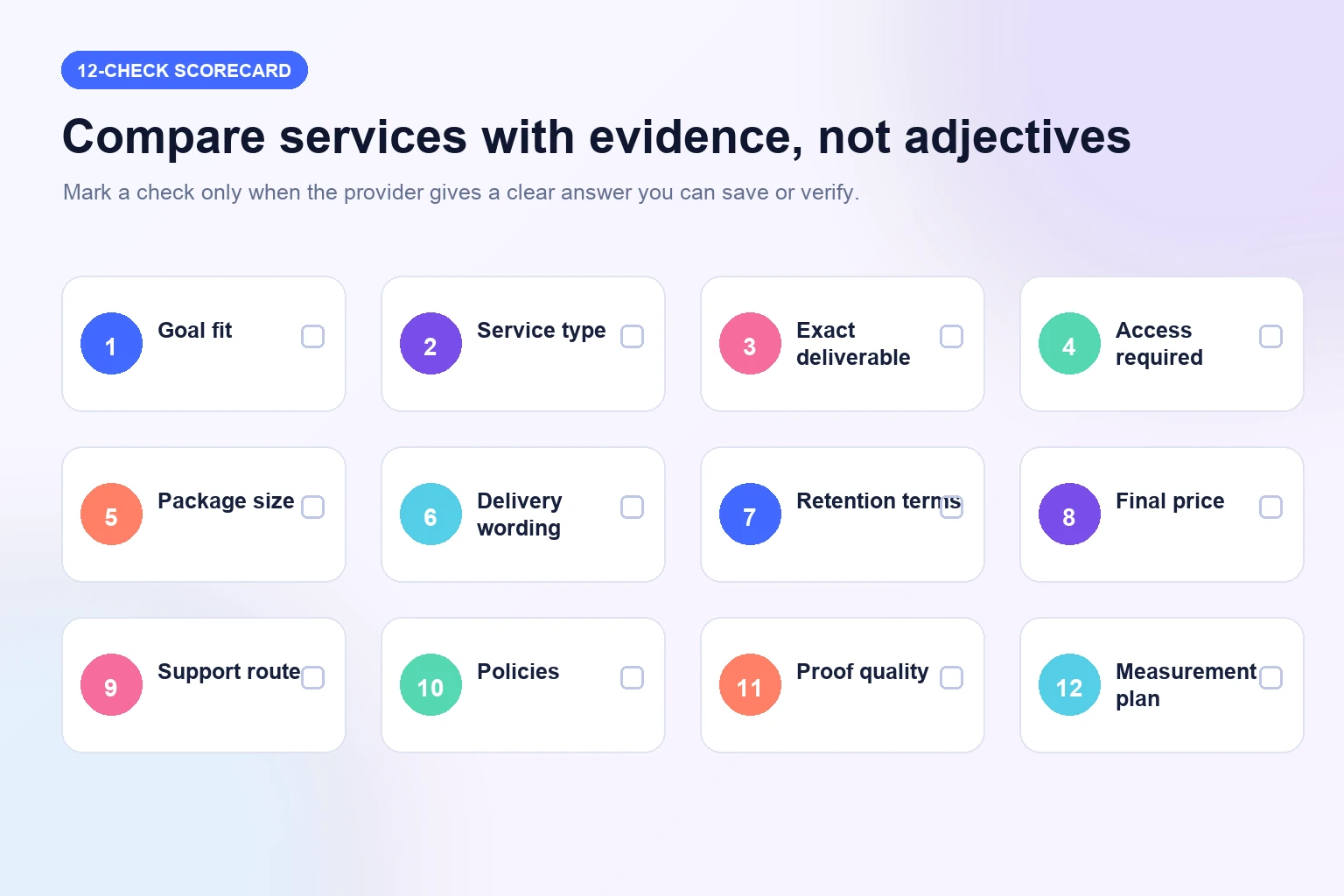
| Review area | 2 points: clear evidence | 1 point: incomplete | 0 points: stop or resolve |
|---|---|---|---|
| Goal and service fit | Offer directly matches one defined objective | Partial match or mixed deliverables | Service type cannot achieve the named goal |
| Account access | Only the minimum necessary access | Reason for access needs clarification | Password, code, cookie, or unnecessary admin access requested |
| Package and timing | Quantity, destination, tier, and timing are written | One term is vague | Deliverable changes between page and checkout |
| Policies and support | Specific terms and a tested support route | Policies exist but leave a key question open | No useful policy, identity, or support path |
| Price and billing | Final total, currency, fees, and billing type are clear | A fee or renewal detail needs confirmation | Unexpected charge or hidden recurring billing |
| Evidence and claims | Specific process evidence with realistic limits | Mostly testimonials or general claims | Guaranteed reach, revenue, virality, or platform approval |
| Measurement | Baseline, success metric, period, and owner are defined | Some metrics exist without method | No way to evaluate the purchased scope |
Check 1: define the outcome before comparing services
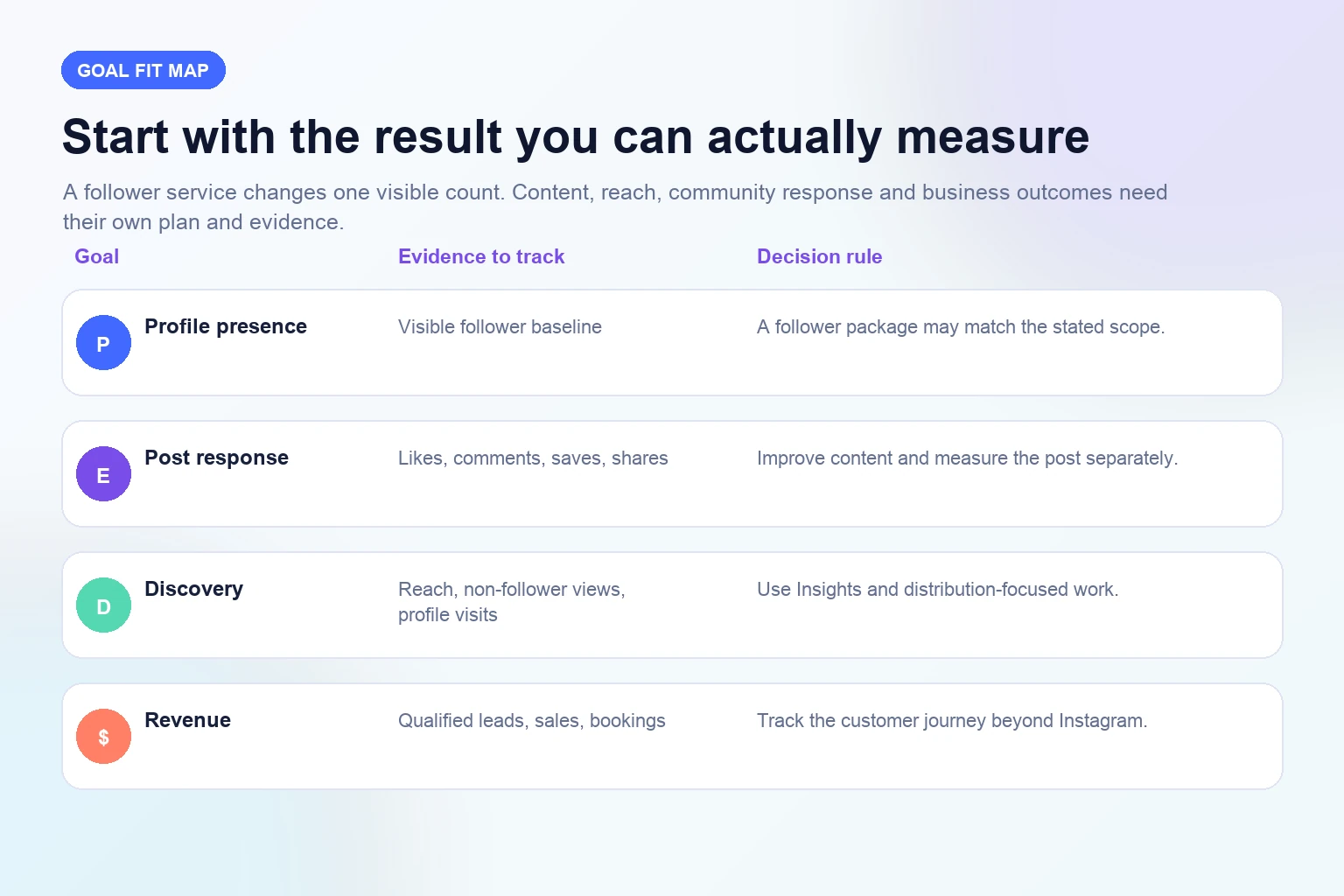
Begin with a measurable problem, not the word growth. Examples include improving the first impression of a new profile, increasing responses to one launch post, reaching more non-followers with video, publishing consistently, or generating qualified enquiries. Each needs a different plan. If the objective is vague, almost any sales page can appear relevant and success becomes impossible to evaluate.
Choose one primary outcome and one supporting measure. A profile-presence campaign might use visible follower count as the primary measure and profile visits as context. A content campaign might use qualified comments or saves on selected posts. A business campaign should use leads or sales from a documented journey. Do not allow the provider to replace your objective with whichever number is easiest to sell.
Write the budget, campaign period, account owner, and limits beside the goal. State what the service is allowed to do and what it is not. This brief makes provider comparisons faster and gives your team a common answer when a package includes attractive extras that do not help the original problem.
- Profile presence: a follower count and complete profile.
- Content response: likes, comments, saves, and shares on specific posts.
- Distribution: reach, impressions, plays, and non-follower discovery.
- Business outcome: qualified messages, leads, bookings, or sales.
Check 2: identify the service model
Instagram growth service is an umbrella phrase. A delivery service supplies a stated quantity such as followers, likes, views, or comments to a public destination. A content studio produces creative work. A community manager publishes and replies. An advertising specialist manages campaigns. Coaching provides guidance, while software may schedule, analyze, or organize. These models have different prices, inputs, timelines, and risks.
Ask the provider to describe what its team or system does in plain language. If the answer mixes several models, request separate deliverables. A monthly management retainer should not be compared with a one-time follower package simply because both pages mention growth. Separating the components also reveals which part requires access and which part can work from public information.
Check who remains responsible for strategy, creative approval, publishing, moderation, reporting, and compliance. An agency may provide all of those, or only one. A self-serve package may deliver a single metric and leave the rest to you. Neither model is automatically better; the correct model is the one that fits the brief and your available team.
- Delivery service supplies a defined count to a public destination.
- Agency or freelancer creates, publishes, moderates, or reports.
- Advertising service manages paid media through Meta tools.
- Software organizes workflows, analytics, scheduling, or listening.
Check 3: demand an exact written deliverable
The offer should name the destination, unit, quantity, tier, price, timing description, and conditions. A follower package should identify one public profile. A likes package should identify one eligible post or Reel. Views, Story views, comments, and live views each have their own destinations and constraints. A generic promise to boost an account leaves too much open to interpretation.
Read the selected card and the checkout together. Confirm that the product identifier, quantity, currency, and tier remain the same. Ask whether the deliverable is one-time or recurring and whether a dashboard status is informational or changes the contractual scope. If an optional extra is preselected, remove it unless it belongs in the brief.
Save the offer that you actually purchase, including the relevant policy wording. A homepage headline is not enough. When a provider changes its packages later, your team should still be able to show what was agreed for this order. Specific documentation improves support and prevents the largest number on the page from being mistaken for the selected quantity.
Check 4: give the least account access necessary
Access should follow the work. A public follower delivery should need a username or profile URL, not a password. A content manager may need a role-based publishing permission. An advertising specialist may need documented access through Meta business tools. An analyst may only need exported reports or read-only views. Ask why each permission is required and remove it when the engagement ends.
Never share a personal Instagram password, two-factor code, recovery key, session cookie, or device approval in chat, email, a form, or a team document. Role-based permissions are safer than shared credentials because they can be limited and revoked. Keep ownership, primary email, and recovery methods under the client's or business's control.
Review connected apps, active sessions, team roles, and recovery details before onboarding and after offboarding. If a provider tells you to install an unfamiliar extension, bypass a security prompt, or disable two-factor authentication, stop. Convenience does not justify giving a growth vendor the ability to take over the account.
- Public delivery: username or content URL only.
- Publishing: role-based permission with the narrowest useful scope.
- Advertising: documented Business Portfolio access, not a shared password.
- Analytics: read-only access where available and sufficient.
Check 5: match the package to the account and campaign
Package size should reflect the account's current audience, normal movement, publishing cadence, and reason for buying. A small account testing a new positioning does not need the same quantity as an established brand preparing a broad launch. Choose the smallest option that can answer the campaign question within budget rather than defaulting to the lowest price per unit.
Look at the destination itself. Is the bio complete? Are the links current? Do pinned posts introduce the account? Has the profile published recently? Does one content series explain what a visitor should expect? A larger visible number cannot repair an unclear profile. Complete these basics before bringing more attention to it.
If the service offers several tiers, read how the provider distinguishes them. Terms such as active, premium, or VIP are not industry standards. Compare the actual description, conditions, support, and price. If the differences cannot be explained without repeating the labels, there may be no useful basis for paying more.
Explore Instagram FollowersCheck 6: translate delivery language into a timeline
Delivery wording should tell you when processing can start, whether the quantity is expected all at once or over a period, what eligibility the destination needs, and what events can pause the order. Terms such as instant, gradual, or fast are not precise by themselves. Ask for the applicable window for the exact package and save the answer.
Build a timeline with a baseline, checkout time, stated window, sensible observation points, and review date. Add major campaign events such as ads, collaborations, viral posts, or username changes. These events provide context, but they do not prove cause. The visible follower total is a net figure that can move while delivery and ordinary follows or unfollows occur together.
Avoid ordering overlapping services for the same metric without a measurement plan. Two providers working on one profile during the same period make attribution and support difficult. If the organization runs several campaigns, give each one a named owner, destination, start date, and separate record.
Check 7: read retention, refill, cancellation, and refund terms
Do not assume a refill is included because the page uses words such as quality or stable. Look for the time period, eligible decline, excluded events, evidence required, and request process. A retention statement should explain what the provider will review, not promise that an independent platform count can never change.
Read cancellation and refund conditions before payment. Ask what happens if the username is wrong, the destination becomes private, the order has started, or the platform cannot locate the profile. Policies may differ by product or stage. Save the version that applies to the selected package rather than relying on a general support answer.
A clear policy can still be unsuitable for your campaign. Score both clarity and fit. If a client requires cancellation until creative approval, a one-time automated order may be the wrong model even when its policy is easy to read. Choose a service whose operating process matches the team's decision process.
Check 8: inspect the full price and billing structure
Compare the final payable amount, currency, taxes, processing fees, optional extras, and renewal terms. Unit price helps compare package sizes inside the same tier, but it does not capture support, policy fit, access risk, or unused quantity. A larger discount is only valuable when the larger package belongs in the brief.
For recurring management, ask what is included each month, how unused work is handled, and what notice ends the agreement. For advertising, separate service fees from media spend and identify who owns the ad account and data. For one-time delivery, confirm that no subscription is being created. Put every cost in the same monthly or campaign view before comparing providers.
Use a checkout that shows the order and produces a receipt. Confirm the merchant and total before authorization. If pricing changes after the provider sees your account, request a revised written scope instead of accepting a new figure in an informal message. Budget control is part of service quality.
Check 9: test support before there is a problem
Send one meaningful pre-purchase question through the advertised channel. Ask about the accepted destination, tier difference, billing type, or policy condition. A useful answer addresses the question, refers to the applicable offer, and explains what record you will receive. Speed is helpful, but speed without substance is not proof of support quality.
Confirm the hours, expected response window, and escalation path for a paid order. Ask how the team identifies the case. A ticket or order reference makes a conversation easier to continue across agents. If the only support channel is an anonymous direct message that loses history, include that weakness in the score.
Notice how the provider handles limits. A trustworthy representative can say that a result is outside scope or uncertain. Be cautious when every question receives a guarantee, especially about reach, revenue, virality, or platform approval. Honest boundaries are more useful than a confident promise no provider can control.
- Ask one relevant question before paying.
- Save the answer and note the channel and response time.
- Confirm how the provider identifies an order or support case.
Check 10: verify identity, policies, and data handling
Look for consistent business information across the site, checkout, receipt, and support response. Read the Privacy Policy to see what data is collected, why it is used, how long it is kept, and which processors or regions may be involved. The provider should not ask for more personal information than the service needs.
Read the Terms of Service, refund wording, and any product-specific conditions. Search for conflicts: one page may say a username is enough while another asks for login access; a package may say one-time while checkout enables renewal. Resolve material contradictions in writing before payment.
Review Instagram's current Terms and Community Guidelines independently. A vendor agreement does not replace platform rules. If a provider claims a private partnership, certification, or permission from Instagram, verify it through an official source rather than a badge on the provider's page.
Check 11: evaluate evidence and marketing claims
Separate evidence of process from evidence of outcomes. A public package catalog, documented checkout, order tracker, and support record show how the service operates. Testimonials describe selected customer experiences. Case studies may offer more context, but they still need dates, starting conditions, service scope, and a clear measurement method.
Watch for screenshots with cropped labels, follower graphs with no time range, percentages without a baseline, or claims that combine several campaigns. Ask whether paid ads, creator collaborations, organic content, and service delivery ran together. A before-and-after image can be accurate while still failing to show which activity caused the change.
Prefer modest, falsifiable claims. The provider should be able to say what it supplies, what the customer must provide, how support works, and what it cannot guarantee. Claims that promise automatic customers or algorithm preference are less credible because they skip the independent decisions between a count and a business outcome.
Check 12: design the test and measurement plan
Before payment, record the destination, baseline, primary metric, contextual metrics, campaign period, data source, and person responsible for reporting. Define the first review date and the condition for contacting support. A small test should answer a question, such as whether the provider handles destination, checkout, communication, and the stated package reliably.
Evaluate the purchased scope first. For a follower package, compare the order record and follower observations with the written terms. Then review content response, distribution, and business outcomes as separate layers. Do not credit or blame the service for every movement during the period, especially when publishing, advertising, and collaborations continue.
After the test, write a short decision note: continue, change package, change provider, or stop. Include the evidence, unresolved risks, and the next budget limit. A disciplined stop can be a successful test result. The purpose of a provider scorecard is to support a better decision, not to produce a high score for every service the team wants to buy.
- Record the baseline before work begins.
- Define the metric, reporting window, source, and owner.
- Evaluate the purchased scope before broader marketing outcomes.
Frequently asked questions
What is an Instagram growth service?+
It is a broad label for services that may deliver followers or engagement, create content, manage an account, run advertising, provide coaching, or supply software. Ask the provider to name its model and deliverables so you can compare like with like.
What is the most important first check?+
Define the result you need. Profile followers, post response, distribution, publishing consistency, and business outcomes are different goals. A provider cannot be evaluated until the goal and evidence are clear.
Should an Instagram growth service ask for my password?+
A public follower, likes, views, or comments order should use the public destination, not your password or authentication code. Management or advertising work should use the narrowest role-based permission available rather than shared credentials.
How can I compare two services fairly?+
Give both the same written brief and score goal fit, access, deliverable, timing, policies, billing, support, evidence, and measurement. Resolve any zero-point safety or scope issue before comparing totals.
Are reviews enough to choose a provider?+
No. Reviews can add context, but they should sit beside an exact offer, clear policies, identifiable support, documented checkout, realistic claims, and your own limited test. A testimonial does not establish how a different account will perform.
What package size should I start with?+
Use the smallest package that can answer your campaign question within the account's context and budget. Consider current audience size, normal movement, content readiness, and the purpose of the test rather than choosing only by unit price.
How do I evaluate a service after purchase?+
Compare the purchased scope with the order record and written terms, then review content, reach, and business metrics separately. Keep dates and concurrent campaign events so correlation is not presented as proof of cause.
When should I reject a provider?+
Stop when it requests unnecessary credentials, hides billing, cannot define the deliverable, lacks a workable support route, contradicts its own policies, or guarantees outcomes such as virality, revenue, or platform approval that it cannot control.
Compare Instagram Followers packages.
Prepare the public destination, then review the quantity and terms that fit your goal.
Review Instagram follower options