

Choose a Story sequence that fits the reader's task. These are planning suggestions, not Instagram ranking rules.
| Sequence purpose | Useful ending | Response to review separately |
|---|---|---|
| Teach a small task | Show the completed step and explain the key detail | Relevant questions or feedback about trying it |
| Explain a product | Answer a buying question and show the next place to learn | Product enquiries or available destination actions |
| Announce an event | State date, location, access and a clear next step | Relevant attendance questions or registration records |
| Answer a customer FAQ | Give the answer without requiring a message to uncover it | Whether replies reveal a remaining misunderstanding |
| Share behind the scenes | Explain why the process matters to the customer | Relevant responses about the work or product |
What an Instagram Story completion rate can tell a business
A sequence should take someone somewhere useful. A ceramic shop might explain how to care for a handmade mug; a trainer might demonstrate a movement; an event organiser might explain where to arrive. Looking at the first and last frames helps you ask whether the ending received a similar-sized audience to the opening. That is a useful planning question even when you cannot follow each person's journey.
This guide calls the last-frame-to-first-frame viewer ratio a completion proxy. Separate frame totals do not show whether their audiences contain exactly the same accounts. They also do not show whether everyone read a photo, heard a spoken explanation, or watched a video to the end. Confirming that the same people completed the sequence would require matching the starting accounts with those finishing every frame.
Use the proxy as a prompt for a decision, such as whether a tutorial needs a clearer ending. Keep the business purpose beside it. A sequence with fewer late-frame viewers could still answer an important customer question or receive useful enquiries. A polished percentage is insufficient evidence for changing a campaign on its own.
Choose the job of the sequence before choosing its length
Start with one reader task rather than a pile of content you need to publish. The planning table offers several different jobs and endings. A product announcement needs enough information to understand the offer; a care tutorial needs usable instructions. Forcing both into the same number of frames makes the plan serve the template rather than the reader.
Write a short brief using the four prompts below. For example: this sequence helps new mug owners understand safe everyday care; it ends with a complete care instruction and an invitation to ask a relevant question. That promise is specific enough for a colleague to check before publishing. A vague goal such as more engagement gives them much less direction.
Choose one main action that fits the task. If the Story is supposed to answer a common question, a clear answer may be the entire payoff; it does not need a purchase request. If you invite an enquiry, make the topic understandable. Several competing requests at the end make it harder to tell which response you hoped to receive.
- Reader: who should find this sequence useful?
- Promise: what will they understand or be able to do by the end?
- Ending: what information or appropriate next action completes the promise?
- Evidence: which available response or business record will help you review that goal?
Choose matching audience figures and a separate response measure
Instagram defines Story Views as plays or displays and Viewers as unique accounts. Use matching Viewers figures for this proxy. Read any alternative report's definition before substituting its figures. Mixing one frame's total views with another frame's unique audience would answer a different question.
Official Story guidance identifies response and profile-action measures. Choose one that suits your goal: a booking question differs from an unrelated reaction. Review useful enquiries separately and keep private messages out of team reports.
The first/last calculation and the response record answer separate questions. One compares frame audience sizes; the other describes actions or business conversations. Keep both labels visible. An action count is not automatically a count of different customers, and an enquiry is not a confirmed booking. Use actual booking or sales records when that is the result you need to assess.
Calculate the completion proxy: a worked example
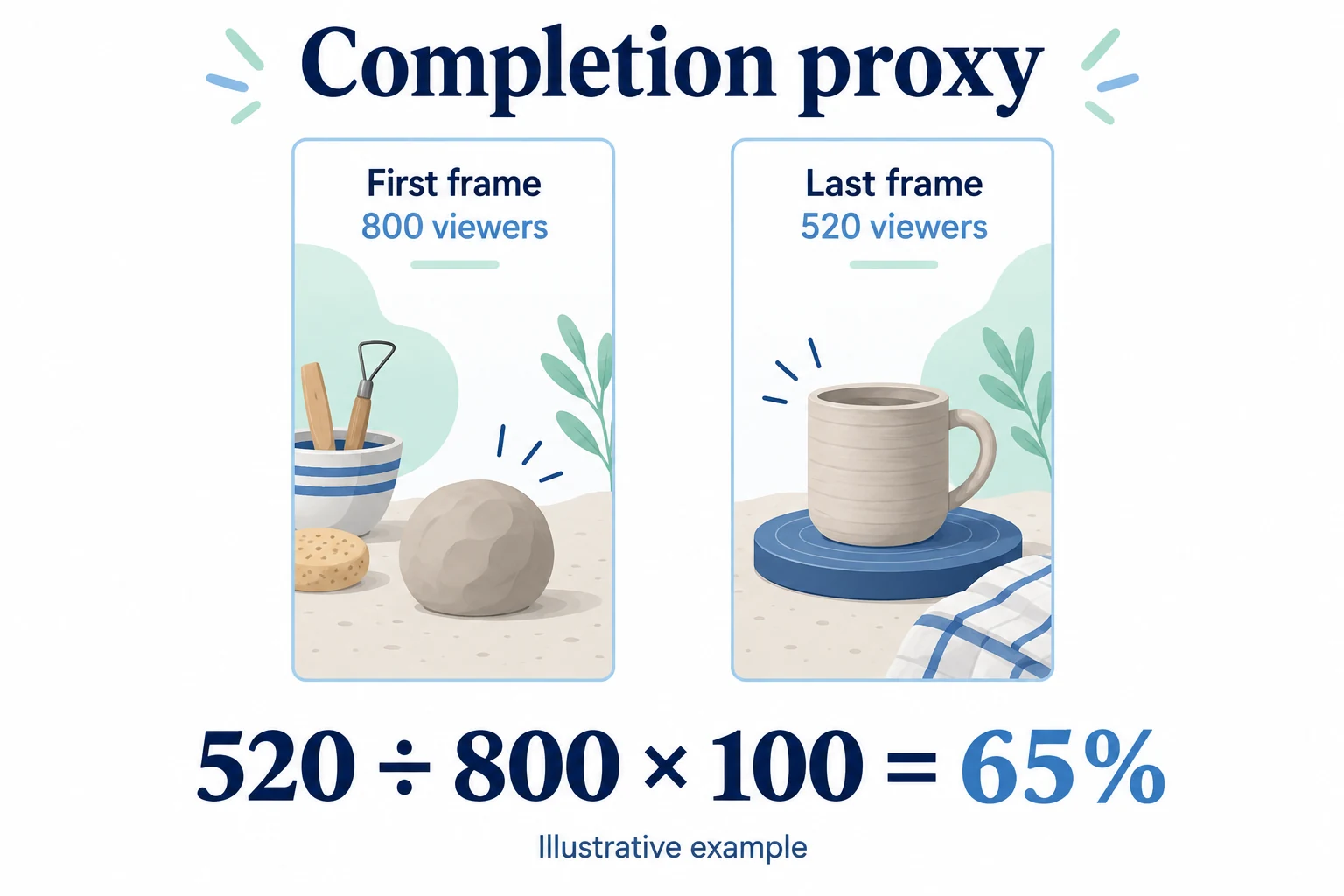
Use this formula: last-frame Viewers ÷ first-frame Viewers × 100. Suppose a hypothetical four-frame care tutorial records 800 Viewers on its first frame and 520 on its final frame under the stated recording conditions. Divide 520 by 800 to get 0.65, then multiply by 100. The completion proxy is 65%. These teaching figures are not a customer result or a suggested performance target.
Write the finding precisely: the final frame's reported unique-account count was 65% of the first frame's count. Avoid saying that 65% of the original audience completed the tutorial. You have compared two totals, without establishing their account-level overlap. Subtracting 520 from 800 gives a difference of 280 between the counts; it does not identify 280 people who abandoned the sequence.
If the first-frame figure is zero, the ratio is undefined. If either figure is missing, estimated in an incompatible way, or unavailable, record the proxy as unavailable rather than zero. Preserve the original counts and your reason. Rounding a valid result sensibly is fine, but extra decimal places cannot repair uncertain recording conditions or reveal how much attention people gave the content.
Why a later frame can have more viewers than the first
Separate frames do not necessarily contain one fixed audience moving through in order. People may encounter a later item without appearing in the opening frame's count. Publishing frames at different times also gives them different opportunities to be seen. Audience settings, sharing and the moment at which you recorded a report can further complicate the comparison. Consider these possibilities without claiming the counter proves a particular cause.
Imagine another hypothetical record with 400 first-frame Viewers and 460 last-frame Viewers. The arithmetic gives 115%. Keep that result as a count ratio and check the record. Do not cap it at 100%, report negative audience loss, or celebrate it as more than perfect completion. A result above 100% makes the proxy's limitation especially visible: it is not a verified percentage of the starting group.
You can still learn that the final item attracted a larger reported audience. Look at its content and context separately: did it contain a shareable answer, was it posted much later, or were the recording conditions different? Those are questions to investigate. If the frames are not comparable, leave them out of your usual benchmark and keep the observation as a separate note.
Set a recording approach your team can repeat
Choose the observation approach before looking at the result. One practical option is to publish a compact sequence within a short planned period and record all frames together at a stated point. That snapshot still leaves small age differences, so save each publishing time. For widely spaced frames, comparing each at a consistent elapsed age answers a different question; keep those records separate from single-time snapshots.
Current Story help describes Insights for public personal or professional accounts. Check your own screen. Leave missing values unavailable; replacing them with unrelated numbers can distort the comparison.
Record any actual extension or other change in availability, instead of assuming every item has identical exposure time. Preserve the audience and promotion context too. Keep organic-only records separate from records containing paid activity where the report allows that distinction. A simple consistent note is more useful than mixing incompatible sequences into one reassuring average.
- Save the first and last frame identifiers, publishing times and observation times.
- Copy the exact audience metric from the same reporting source for both frames.
- Note restricted audiences, sharing, promotion, extensions and material edits or removals.
- Keep incomplete or incomparable records out of your usual sequence comparison.
Build a clear opening, useful middle and complete ending
A practical starting structure is promise, explanation, useful detail and ending. For the mug tutorial, show what care question you will answer, demonstrate the relevant step, clarify an easy misunderstanding, and finish with the full recommendation. Four frames are an example, not an optimum Instagram length. Combine or add frames when the material genuinely needs it.
Keep the main meaning understandable on a phone. Use readable contrast, avoid squeezing several unrelated ideas into one frame, and provide text for essential spoken details. Check the actual preview so decorative elements do not obscure the instruction or action. These are usability choices, not claims that a certain font size or word count receives an algorithm reward.
Deliver useful information as the sequence progresses. A long series of teasers can leave the reader doing extra work before reaching the promised answer. Conversely, a detailed demonstration may need several steps. Judge each frame by whether it contributes to the reader's task. Where available, Instagram's Best Practices area offers account-specific creation and engagement guidance that you can review alongside your own plan.
Use Story features when they help the reader participate
Choose an interaction because the answer will be useful, rather than decorating every frame with a different request. A suitable question can invite a customer to explain what they need; an available response feature can help you collect feedback. Verify which stickers and options your account actually offers, and preview the wording. Participation should be easy to understand without requiring the audience to guess your intention.
Meta's official sticker announcement describes tools including Add Yours Music, Frames, Reveal and Cutouts. They serve different creative purposes. Reveal, for example, requires a direct message to uncover the hidden Story. That extra step may fit a deliberate interactive idea; it is a poor default for essential event details, care instructions or an offer the reader should be able to understand immediately.
Review the substance of responses as well as their number. Ten messages asking where an event is may show that the address was unclear, while two relevant enquiries may meet the sequence's purpose. Sticker interactions alone do not establish satisfaction or completion. Use feedback to improve the information, and avoid promising that adding a particular feature will guarantee a higher ratio.
Compare business responses beside the percentage
Consider two hypothetical product-care sequences. Sequence A has 800 first-frame Viewers, 520 last-frame Viewers and 12 relevant enquiries recorded by the business: a 65% proxy. Sequence B has 500 first-frame Viewers, 400 last-frame Viewers and three relevant enquiries: an 80% proxy. The higher proxy belongs to B, while A has more recorded enquiries and a larger starting audience.
These figures do not identify a winner without a goal and context. If you wanted to answer an existing customer's question, examine whether the explanation worked. If you wanted enquiries, review their relevance and what happened next. Different products, audiences, availability or timing could explain the difference. Neither example proves that changing the sequence caused a business outcome.
Do not turn the figures into sales claims. Twelve enquiries divided by 800 first-frame Viewers would be an enquiry-count-to-viewer ratio under that stated scope, not a buyer conversion rate or proof those enquiries came from the same 800 accounts. In many small-business reviews, writing the two audience counts, the proxy and the relevant enquiry count separately is clearer than adding another percentage.

Decide whether to keep, shorten, reorder or split the sequence
Keep a sequence when it delivers its promise clearly and its relevant responses support the intended job. Shorten it when a frame repeats information without adding understanding. Reorder it when a necessary detail appears too late to make the next step understandable. Split it when two different reader tasks compete, such as a care tutorial and a separate discount announcement.
Use the content itself and feedback to explain your choice. A lower last-frame count cannot tell you which sentence caused someone to move on. Available movement figures may add context, but they do not reveal every person's motive. If you change a frame, state a testable reason such as making the booking instructions clearer, rather than claiming you have found a universal retention trick.
Compare the next similar sequence under your usual recording approach. Keep major differences visible and change one important creative choice at a time where practical. You do not need to repeatedly redesign a useful tutorial to chase small fluctuations. If the problem is a sustained decline across otherwise comparable Stories, use a dedicated diagnosis process; that is a different task from planning the next sequence.
Give the team a short brief and a useful review record
Use the checklist below as a one-page planning and review record. Before publishing, a colleague should be able to explain the promise and ending from that brief. After publishing, they should be able to reproduce the arithmetic from the original figures. Save only the information the team needs; customer messages and unnecessary account names do not belong in a widely shared performance report.
For repeated subjects, build a small library of useful sequence types rather than copying the same wording into every Story. A care explanation, event reminder and customer FAQ can each have a familiar structure while their substance changes. Keep the instruction or offer current. A neat ending that points to an outdated page can undermine the reader's task even if the audience ratio looks healthy.
End the review with a concrete next decision: keep the explanation, move the address earlier, separate the offer, or ask a clearer question. Assign someone to complete that change. This connects measurement with a useful action and prevents the reporting habit from becoming a weekly exercise in displaying percentages without improving what readers receive.
- Sequence name and reader task, followed by one sentence describing its promise.
- Frame order and the useful job of each frame, including the intended ending.
- Owner, planned publishing period and the recording approach used for review.
- First/last audience figures, calculated proxy, relevant response and context notes.
- One decision for the next comparable sequence and the reason for that decision.
Keep purchased Story views separate from completion claims
A Story views package concerns a defined delivery service. It does not establish that real customers watched every frame, understood the explanation, or became buyers. If paid activity is involved, annotate your record and review its effect on comparability before using the proxy as a content benchmark. Increasing a displayed count cannot by itself demonstrate a better sequence.
If you consider a package, check the eligible Story destination, its active availability, current timing terms and support route before ordering. Keep credentials private and read the service's policies. Meta has described enforcement against fake engagement; purchasing activity therefore needs an informed review of platform rules and service limits. Password-free ordering does not remove those considerations.
HitsBoost's Instagram Story views page provides its current packages and ordering information. Use it for that specific service and contact support when an order needs clarification. Continue evaluating content with the labelled audience proxy and relevant business responses. Neither a package nor a high percentage guarantees completion, recommendations, reach, enquiries or sales.
Frequently asked questions
What is an Instagram Story completion rate?+
People commonly use the term for a comparison between a sequence's first and last frame counts. In this guide, last-frame Viewers divided by first-frame Viewers is a completion proxy. Separate totals cannot prove that the same starting audience completed every frame.
How do I calculate the Story completion proxy?+
Divide the final frame's Viewers by the first frame's Viewers and multiply by 100. For example, 520 ÷ 800 × 100 is 65%. Use matching metric labels and state the recording conditions. A zero or missing first-frame denominator makes the calculation unavailable.
Is this a native Instagram completion metric?+
The proxy here is your own calculation. The current official Story Insights guidance reviewed for this guide defines frame-level audience and response measures; those totals do not verify a matching group completing the sequence. Use any other report only with its own stated definition.
Can the ratio be higher than 100%?+
Yes. A later frame can have a larger reported audience than the first because the audiences and recording conditions need not match. Keep the arithmetic, check timing and context, and label it as a count ratio. Do not cap it or call it more than perfect completion.
Does a 100% proxy mean everyone watched to the end?+
No. Equal first and last totals do not establish that they contain the same accounts, and a counted display does not prove full attention or completed playback. The proxy describes the relationship between the reported audience sizes.
What is a good Story completion rate for a business?+
There is no useful universal target for this proxy. Compare similar sequences under consistent conditions and judge them against their purpose. A clearer customer answer or more relevant enquiries may matter more than a higher first-to-last ratio.
How many frames should an Instagram Story sequence have?+
Use enough frames to complete one useful reader task without needless repetition. A four-frame plan is a starting example, not an Instagram rule. A simple answer may need less; a clear demonstration may need more.
Will buying Story views improve completion or sales?+
A views package does not verify sequence completion or guarantee customer actions. Record paid activity separately and review service terms and platform rules. Assess the content with clear metric labels and actual responses or business records.
Compare Instagram Story Views packages.
Prepare the public destination, then review the quantity and terms that fit your goal.
Explore Instagram Story views packages