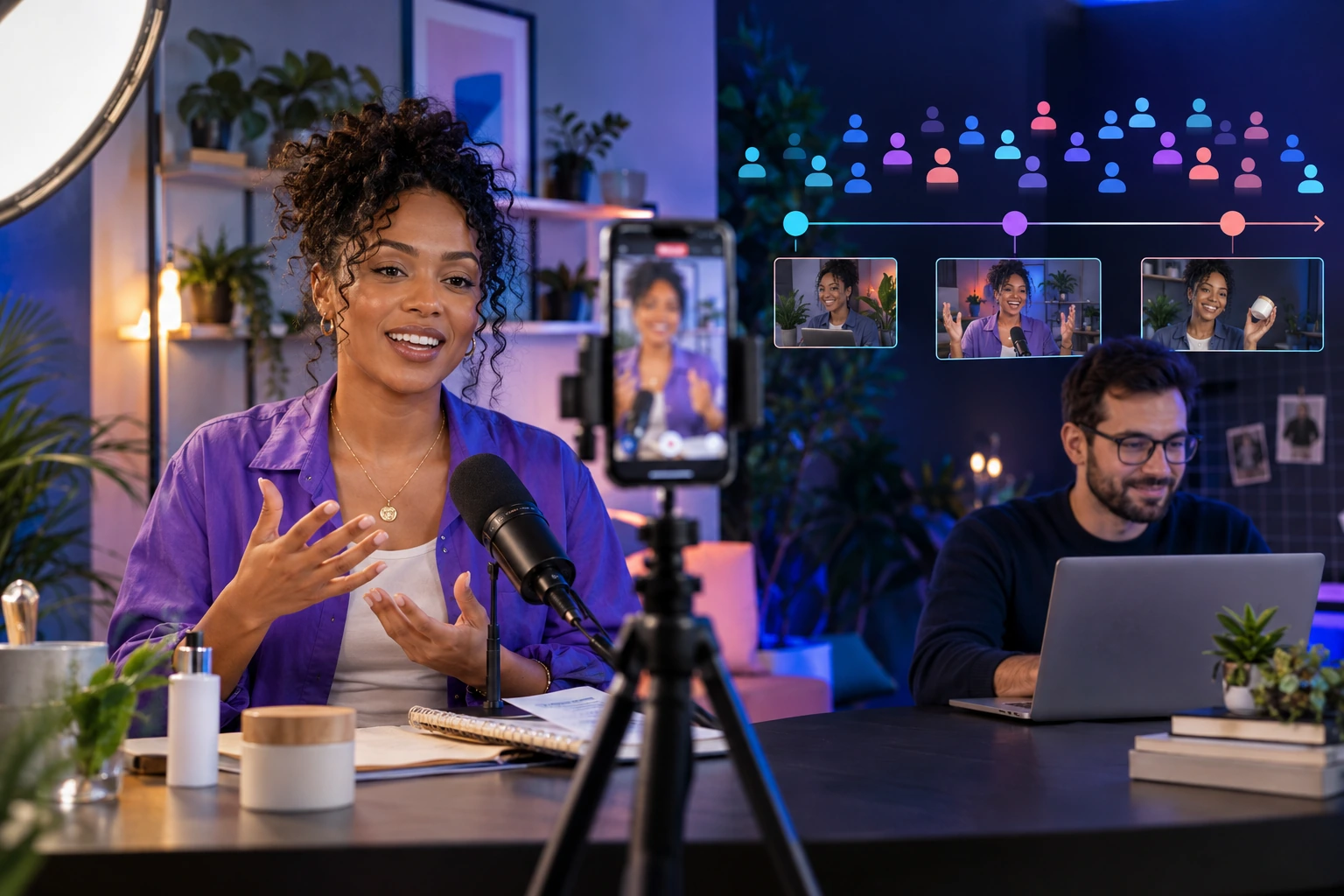

A simple comment decision table to agree before going Live
| What appears | Moderator's first move | When the host needs to know |
|---|---|---|
| Relevant question or correction | Save the point for the next natural pause; avoid promising an answer the host has not given | When it changes the topic, factual claim or answer |
| Off-topic repetition or promotional spam | Use the available comment control under the agreed rule; do not argue in the feed | If it continues or overwhelms the discussion |
| Targeted insult or harassment | Apply the current Live control and report where appropriate | Immediately if a person is at risk or the exchange is escalating |
| Threat, doxxing or apparent imminent harm | Reduce exposure, preserve only necessary details privately, and use in-app reporting | Immediately; pause or end the Live if a safe response needs attention |
| Customer order or private account detail | Redirect to the official private support route without reading the detail aloud | Only if the host must correct an on-air disclosure |
Know what an Instagram Live moderator actually does
Meta introduced Instagram Live moderators in 2022 so a host could ask another person to help manage comments during a broadcast. Its launch description said the host could choose a person already watching the Live, and that the moderator could report comments, turn off comments from a particular viewer or remove a viewer from the Live. The host could remove the moderator, and the moderator could step away. Meta also said a guest cohost could not take the moderator role in that original design. These details explain the feature at launch; do not assume the same limit, label or control path exists for every account in 2026.
The role is narrower than account administration. A moderator is there to protect a specific conversation while the host presents. They do not need the host's password, access to business settings or permission to answer private customer messages. Nor is the job to delete every disagreement. A fair correction, difficult but relevant question or respectful criticism can make a session more useful. The moderator needs a brief that distinguishes disagreement from harassment and a reliable way to alert the host when a claim needs correction.
This guide deals with the live comment stream. Controls for comments under an ordinary feed post, message requests, account restrictions and audience growth are related but different jobs. A team might use all of them across a campaign, yet it should not assume a setting in one surface automatically applies to another. Check the current Live controls on the device that will broadcast and rehearse the workflow with the actual people involved.
Choose a person who can make calm, limited decisions
A good moderator understands the event, the host's boundaries and the people likely to attend. For a bookstore author discussion, that might be a colleague who knows which questions can be answered on air and which should go to the shop's support inbox. For a health professional's session, choose someone able to recognise when a question should not receive casual advice. Familiarity with the audience helps, but trust and judgement matter more than having a large personal following. Choose someone who can say 'I need the host' without improvising a promise.
Define what authority the person has before giving them any in-app role. They may deal with obvious spam or targeted abuse under a pre-agreed rule; they should not make price commitments, disclose customer information or adjudicate a serious safety incident alone. Check availability for the whole session, a dependable internet connection, a second way to contact the host, and enough attention to read comments. A friend who can watch only the first five minutes is a poor sole plan for a half-hour event.
Write a brief with three comment lanes and an escalation signal
The best brief fits on one page. Start with the session's purpose, expected audience, key claims and topics the host will not answer. Then sort likely comments into three lanes: useful questions to queue, disruption to handle under a clear rule, and safety issues that require an immediate host decision. The table above gives a starting point. Adapt it to the subject, language and audience. A comment asking for a source is not abuse because it challenges a claim; a repeated demand for someone's home address is a safety concern even if phrased as a question.
Agree on a private escalation signal outside the public comment feed, such as a short call or a prearranged message to the host's second device. The signal should say what action is needed, not expose the viewer's private details. For example, 'pause for safety issue' is more useful than posting a person's name into the Live. If the host cannot see a private message while presenting, agree a visible cue in the room or a word spoken by the moderator off camera. Test it before the audience arrives.
Give the moderator a short response rule as well. For a book launch, the moderator can collect several questions about the reading and tell the host at a planned pause. They should not promise a signed copy, refund or private appointment without checking. If someone posts an order number, direct them to the official support route rather than reading it aloud. If the event includes a minor or a vulnerable participant, be more conservative about showing personal details. This is an operational brief, not a substitute for the platform's own reporting tools.
- Set a short list of comment rules and an example for each decision lane.
- Agree how the moderator will tell the host to pause without posting private details publicly.
- Name a backup moderator or a host-only fallback if the chosen person leaves.
- Keep customer support, emergencies and account-security concerns on their proper private routes.

Appoint the moderator in the current Live interface
At launch, Meta described the host selecting a moderator from people watching the Live, then granting that person the moderation role. It also described a way for the host to remove that role. Do not follow an old screenshot tap for tap: Instagram can move controls and roll features out differently by account, app version, device or region. Before the public event, make a short test Live or use an internal rehearsal to find the present control on the host's device. Ask the candidate to join from their own account and confirm that both sides recognise the role.
In the rehearsal, verify the actions that are actually visible. Can the selected person see a comment action? Can the host see who has the role? Can either side end the arrangement without logging into someone else's account? Record the current path in your team notes, but avoid treating it as permanent documentation. If the person has not appeared in the eligible participant list, check that they have joined and that the account and app are up to date. A cohost invitation is not a substitute for moderator access.
If no Live moderator control appears, do not create a second login, share the host's password or ask a third-party tool to unlock it. Run a smaller Live with the host's own available comment controls, postpone a high-risk session, or choose a platform and format the team can supervise. The point is to reduce risk with a verified workflow. A scheduled Live reminder does not prove that the moderation feature will be present when the broadcast starts, so check both parts separately.
- Ask the chosen person to join the Live from their own trusted Instagram account.
- Check the current in-Live participant and moderator controls on the host's app.
- Confirm both people can see the role and the available actions before relying on it.
- If the feature is absent, use the host's own comment controls or change the event plan; never share login credentials as a workaround.
Open the broadcast with a predictable review rhythm
At the start, the host can explain the subject, approximate structure and how questions will be chosen. The moderator should be in place before inviting a sensitive question or a guest. Agree on predictable pauses, perhaps after a demonstration or chapter reading, when the host can look at a short queue. This keeps the host from reacting to every passing line and lets the moderator group repeated questions. For a small broadcast, two or three well-chosen questions may be more useful than a frantic attempt to read the entire feed.
The moderator should distinguish urgent from merely frequent. Ten people asking where to find a book may deserve one clear answer; one person posting a direct threat deserves immediate attention. They should avoid replying to trolls in a way that gives them the floor. If the host makes an incorrect factual statement, the moderator should flag the correction privately and promptly rather than burying it because it is uncomfortable. The rule is to preserve a useful and safe discussion, not to manufacture praise.
Handle spam, abuse and viewer removal proportionately
When a comment is disruptive, read enough context to avoid a mistaken action if it is safe to do so. A joke, quotation or criticism can look harsher as an isolated line. Apply the rule written in the brief rather than the moderator's mood. For obvious repeated spam, a current Live control that stops the viewer's comments may be enough. For harassment, the stronger available control may be appropriate. Meta's launch description listed reporting comments, turning off a viewer's comments and removing a viewer; the exact 2026 wording and effects should be confirmed in the app.
Reporting is a way to ask the platform to review conduct; removing a viewer is an immediate session action. They are not interchangeable. A moderator can also signal the host to pause or end the Live if threats, doxxing, sexual harassment or a surge of coordinated abuse makes normal conversation unsafe. Do not argue with a harasser on air or promise the audience that a report will produce a particular platform outcome. Protect the people in the conversation first, then record what the team needs for a measured follow-up.
Use a private escalation path for apparent imminent harm and follow local emergency procedures where appropriate. A moderator's in-app tools are not emergency services. If a person has disclosed a phone number, address or order detail, avoid repeating it in the public response. Reduce exposure using the controls available to the host and moderator, then decide whether the broadcast can continue. When the situation is less severe, a short neutral host line such as 'We are moving back to the topic' often does more than a lengthy public debate.
- Read the exact comment in context before acting when doing so is safe.
- Use a proportionate available control and do not debate a bad-faith account on air.
- Report credible abuse through the in-app route when the conduct warrants it.
- Signal the host at once for threats, exposed private information or an incident beyond the agreed brief.
Keep customer questions and private data on the right route
A Live can attract support requests, but the public chat is a poor place to solve an order problem or ask for account details. The moderator can acknowledge that a customer needs help and point them to the official private support path. They should not ask the viewer to type an email, order number, phone number or payment detail into the Live. If a detail has already appeared, alert the host if it is visible or repeated, then use an available control to limit exposure. Do not read it aloud to prove that the team noticed.
Some questions can be answered in general terms: delivery information already published by the business, the event schedule or where to find a public guide. Others need a private conversation or a specialist. A medical, legal or financial question should not be converted into improvised individual advice just because it arrived during a broadcast. If the host has promised a follow-up, note the topic rather than copying the entire comment stream. Keep a clear difference between an on-air education answer and a private customer resolution.
Instagram also offers broader tools against unwanted interactions, including Limits and Hidden Words, which Meta has described in its safety communications. Those are not the same as the Live moderator role, and their effect on this specific broadcast should be tested rather than assumed. Prepare the account's general safety settings before the event, but rely on a person with a live brief to recognise context that a word filter may miss. A filter can hide an ordinary question as well as an insult.
Plan the handoff if the moderator leaves or the host intervenes
The chosen moderator can lose connection, need to leave or become part of the issue. Agree ahead of time who tells the host and what happens next. Meta's original announcement said the host could remove a moderator and the moderator could step down. The current app may present those actions differently, so rehearse them. If a replacement is available, confirm they have joined and can see the role before relying on them. Do not leave an unbriefed friend to guess the boundaries during a difficult Live.
If no replacement is available, simplify the session. The host can pause Q&A, continue only the planned material while watching the feed, or end early. For a product demonstration with heavy customer questions, stopping early may be kinder than presenting while harassment goes unmanaged. Decide who has authority to recommend an end to the broadcast. The moderator can warn, but the host needs a clear way to act without debating the choice publicly in the moment.
After any handoff, check whether the previous moderator still has an active role and whether the current person has the controls expected. Do not confuse removing a moderator with blocking them as a person; those are separate actions. If the relationship with a team member has changed, review account security and business access separately from the Live role. A person's temporary role in one event should never become an excuse to share permanent login credentials.
Review the session without turning moderation into a score
Meta's 2022 announcement described a report of moderation actions after a Live, but the information currently available may vary. Check what your account actually shows once the broadcast ends. Even if there is no accessible report, a five-minute debrief can answer the useful questions: Which viewer questions went unanswered? Did the moderator act under the agreed rule? Was the host alerted quickly when necessary? Did anyone's private information appear, and what follow-up is needed? Keep safety notes limited and access controlled.
Separate the content lesson from the safety incident. If many people asked for the book's publication date, add that to the next event opening or caption. If abuse focused on one participant, address their welfare and privacy before planning promotional content. Do not count removed viewers as a success target or retain screenshots of ordinary people merely to prove activity. The adjacent image shows a private review and an anonymous flagged item; it is illustrative, not evidence that Instagram supplies those cards or folders.
Live viewer counts answer a different question. They do not tell you whether a session felt safe or whether questions were handled fairly. A broadcast with fewer viewers and a useful exchange may deserve repeating; a larger session dominated by spam may need a stronger brief. Choose one concrete improvement for the next Live, such as a clearer Q&A pause, a better escalation signal or a second trained person. Review moderation in service of the audience, not as a contest to remove more comments.
- Record only the action, reason and essential follow-up; do not copy an entire chat unnecessarily.
- Separate genuine unanswered questions from safety incidents.
- Decide whether a public correction, private reply or no further response is appropriate.
- Update the next moderator brief using one concrete lesson, not a vague target to delete more comments.

Make the next Live useful before thinking about promotion
Moderation belongs inside a wider editorial plan. Give viewers a reason to attend, prepare material worth showing, and decide what question the session should answer. The bookshop could host a short reading followed by questions about the author's research; a service business might demonstrate a process and answer general booking questions. Schedule and announce the session through the current Instagram tools if available, then test the moderator workflow independently. The person looking after comments cannot make a vague subject compelling or rescue a host who has no answers prepared.
After the review, revise the one-page brief and use it again. Put the three comment lanes, escalation signal, host pause points, privacy route and backup plan on the same sheet. Keep the public rules short and fair; viewers should know they can ask hard questions without being removed for disagreement. A clear safety process also gives the host permission to stop when a conversation crosses a boundary. That is a better measure of readiness than the number of accounts invited to watch.
If you separately consider HitsBoost's Instagram Live views service for an eligible public session, review its current package, price and terms on their own merits. A purchased view count cannot moderate comments, make viewers interested, guarantee engagement or produce customers. Complete the content and safety plan first. Keep any service purchase separate from an assessment of the Live's actual questions and audience experience. The next useful step may be a clearer topic and a better prepared moderator, with no purchase at all.
Frequently asked questions
How do I add a moderator to Instagram Live?+
Ask a trusted person to join from their own account, then inspect the current host-side Live participant or moderation controls. Meta's 2022 launch described selecting a current viewer for the role. Rehearse with the actual account and device because labels, availability and limits can change.
Can the guest cohost also be my Live moderator?+
Meta's original 2022 design treated guest and moderator as separate roles and said a guest could not be selected as moderator. Verify your current app rather than assuming that historic rule is universal. Arrange another trusted person or a host-only fallback if needed.
Does a moderator need my Instagram password?+
No. Use Instagram's in-Live role if it is available. Do not share a password or permanent business access merely to supervise comments during one broadcast. If the feature is unavailable, change the event plan instead of handing over the account.
What can an Instagram Live moderator do?+
Meta's launch announcement described reporting comments, turning off a viewer's comments and removing a viewer from a Live. Confirm the exact actions your moderator sees today. The role does not make them the account owner or a private customer-support agent.
Should a moderator remove every negative comment?+
No. Relevant criticism, factual corrections and difficult questions can improve the session. Agree a rule that distinguishes disagreement from spam, harassment, threats and private-data exposure. Use a proportionate response, and have the host address legitimate corrections.
What if the moderator disconnects during a Live?+
Use the agreed handoff signal, confirm any replacement has joined and received the role, or simplify the event. The host can pause Q&A, manage comments directly where practical, or end early if the topic or audience requires stronger supervision.
Can a moderator answer order questions in the comments?+
They can point people to official public information or private support, but they should not ask for an order number, email or payment detail in the public Live. Personal cases need a separate secure support route and a person authorised to resolve them.
Will using a moderator increase Live views?+
There is no guaranteed view effect. A moderator may help keep the discussion usable and protect participants, but audience size depends on many factors. Evaluate safety, clarity and question handling separately from the viewer count.
Compare Instagram Live Views packages.
Prepare the public destination, then review the quantity and terms that fit your goal.
Review Instagram Live views packages and conditions