A starter reply library for a fictional Sheffield ceramics studio; every example must be checked against the real business before use
| Repeat question | Reusable core | Check or hand off before sending |
|---|---|---|
| When is the next workshop? | Point to the maintained booking page | Check the actual date, places, access information and whether a request equals a confirmed booking |
| Can you send my order? | Explain where the current delivery information lives | Check that customer's order and any exception privately; do not promise dispatch from a template |
| How do I care for this mug? | Point to a verified care page for the exact finish | Check the item and finish; do not generalise a care instruction to every handmade piece |
| Is the blue vase in stock? | Invite the customer to name the exact piece | Check current stock and reservations; never save a fixed yes or price for changing inventory |
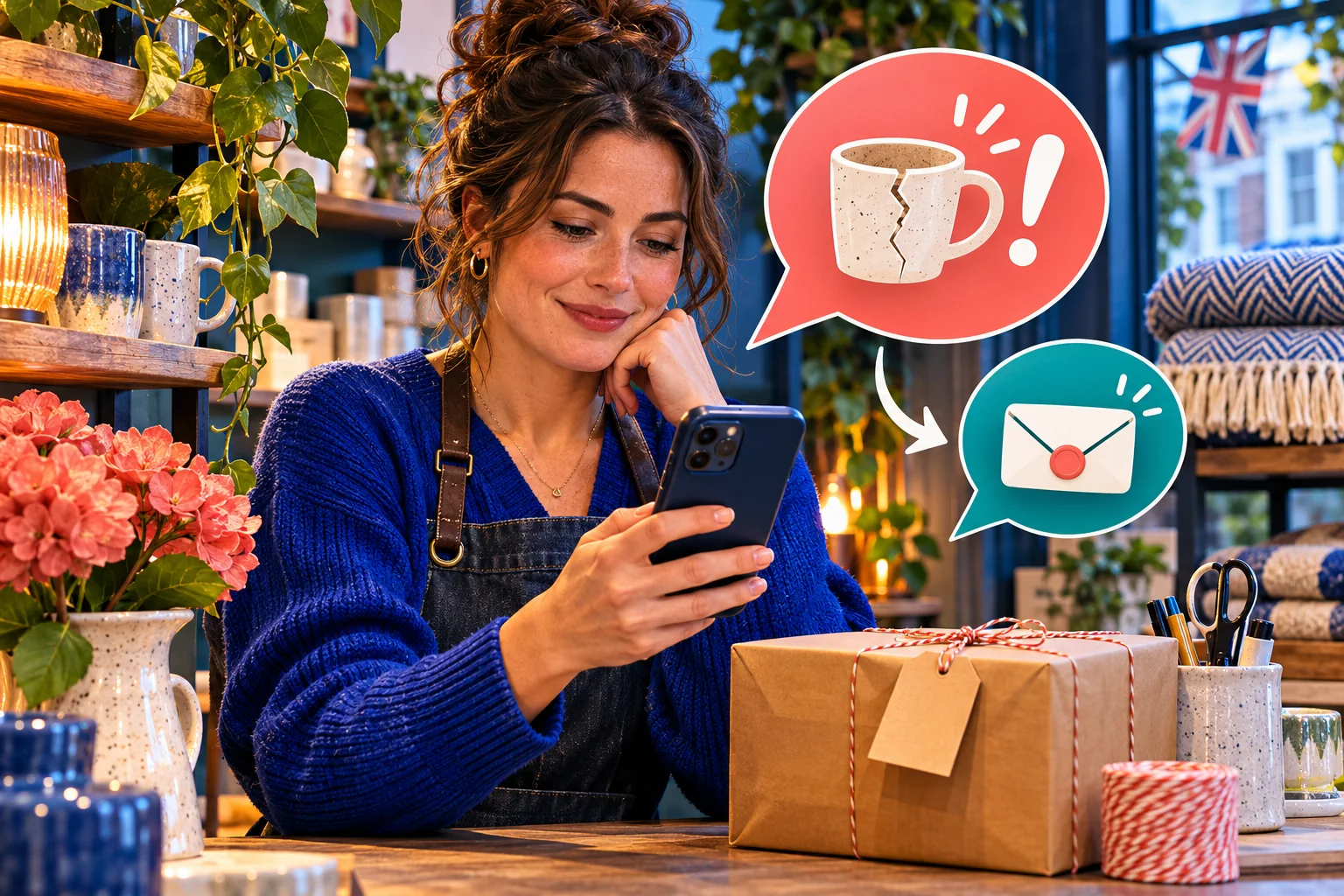
| My parcel arrived broken | Acknowledge and give the approved support route | Assign a person to review the specific order; do not send a stock apology as a final decision |
Know what a saved reply does before creating one
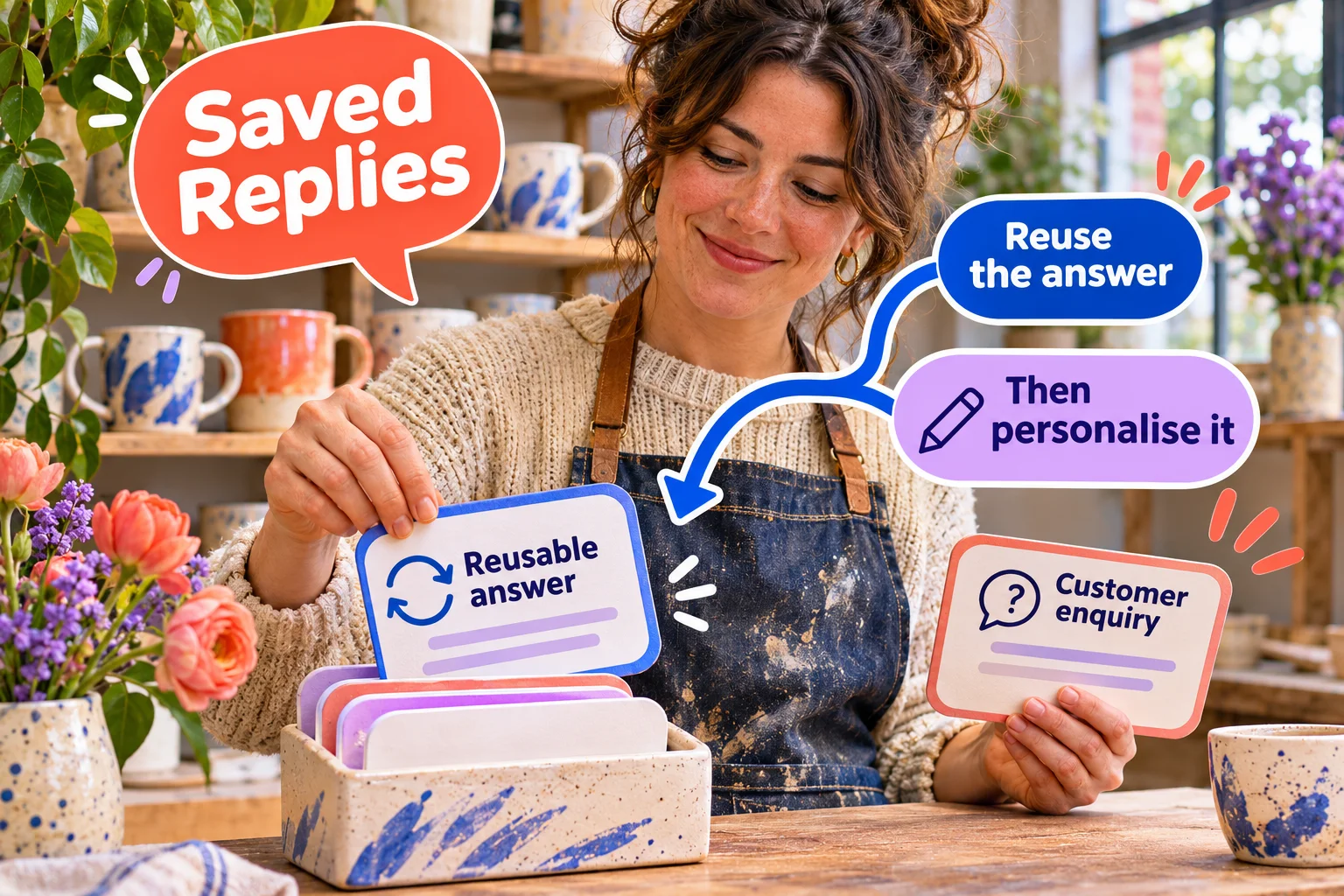
Meta described saved replies as a way for businesses to answer common questions when it introduced business messaging tools for Instagram Direct in 2019. The useful distinction is simple: a staff member opens an existing conversation, chooses stored wording, checks it and sends it. The saved text is not a scheduled broadcast and does not independently resolve a case. Meta's announcement mentioned instant replies and away messages alongside saved replies, but those are different controls with different jobs. Mixing them up is how a shop ends up believing a draft has been sent when nobody has answered the customer.
Consider a fictional ceramics studio in Sheffield. Customers often ask how to book a workshop, what the delivery route is and how to care for a glazed mug. The owner can prepare a short answer for each recurring topic. A person asking about a cracked item, a reserved seat or an order that has not moved needs an individual check instead. The studio's repeatable answers reduce retyping; the value lies in giving a consistent starting point while a person remains accountable for whether this particular reply is accurate.
Check that the feature fits the account and working surface
Instagram's professional inbox guidance describes saved replies among tools for Business and Creator accounts. An older Meta announcement establishes the feature's purpose, but it cannot guarantee the same button, shortcut gesture or availability on every app version in 2026. Before writing ten templates, check the authorised account where the team actually answers messages. Make sure the account type, device and message permissions are what staff think they are. A personal profile, an unconnected business inbox and a colleague without message access can show different controls.
Instagram's current Help Centre says that, in its professional mobile inbox, you can hold a message you sent, choose More and Save, then give it a keyboard shortcut. Typing that shortcut in a conversation offers an icon that fills the saved text for review. Check the live app before relying on those labels. If the business instead uses Meta Business Suite's Inbox, verify its Instagram message connection and available controls separately. Do not ask a colleague to use the owner's password merely because their own account does not expose a button.
- Confirm the account is the intended professional profile and that the staff member has authorised message access.
- Look for the saved-replies control in the current Instagram professional inbox or the Meta inbox used by the business.
- Draft and test one harmless answer in an appropriate conversation before making a library.
- If the control is missing, use an approved, private draft document and manual copy-and-review; do not install an untrusted tool.
Choose a few questions worth reusing
A good saved reply begins with a repeated question and a reliable source of truth. Look at recent inbound conversations without exporting or circulating customer details unnecessarily. Which questions recur and can be answered from a maintained page or business record? The ceramics studio might group workshop booking, dispatch process and care instructions. These are categories, not interchangeable scripts: a dispatch question about an individual parcel cannot be settled by the general delivery page, and care for a special finish may differ from care for a standard mug.
The table above is a starter worksheet. Its middle column is deliberately modest: point to a checked booking page, explain where current delivery information lives, or ask for the exact product. The last column contains the decision that a person must make. This keeps a fixed sentence from claiming an item is in stock, a place is reserved or a delivery is due on a particular day. If the studio has no maintained booking page, it should fix that destination before saving a reply that promises to link to it.

Write a draft with a clear shortcut and a fact boundary
A saved answer should sound as if the shop has read the question. For a workshop enquiry, an illustrative starting draft could be: 'Thanks for asking about a ceramics workshop. The current dates and booking process are on our workshop page [checked link]. Tell us which session you mean if you need help with a specific booking.' This does not say that a seat is available or that a request has been accepted. The final sender still checks the page and the customer's context. Replace the bracketed instruction with an actual verified destination before saving the reply.
Choose a shortcut that a teammate can recognise and distinguish from other entries, such as a short internal label for workshop information. The precise shortcut format and insertion control depend on the current Instagram or Meta surface. Save a name that describes the question, not the customer's identity. If the platform lets staff store a longer message under that name, read it in the preview instead of assuming the label proves its contents. A reply labelled 'hours' could still contain last winter's timetable.
- Write one answer per recurring question, with a clear purpose and an owner of the fact.
- Use a short shortcut the team can recognise without guessing; avoid generic names such as answer1.
- Mark every detail that must be checked before sending, especially dates, prices, stock and order status.
- Have another staff member read the draft as if they had just asked the question.
Leave space to personalise without collecting excess detail
The reusable part should be small enough that a sender can adapt it in one pass. A customer asks whether the studio's blue mug can go in a dishwasher; the care reply can point to the published care guidance, but staff must first identify the exact mug and glaze. A message asking about a private workshop may need the session date, accessibility needs or number of places checked with the organiser. If those details are unknown, ask one necessary question rather than inserting a paragraph that sounds like a final answer.
A name is optional and should never be a substitute for reading the thread. Personalisation means acknowledging what the customer actually asked and choosing the correct next step, not automatically inserting 'Hi [first name]' into a mismatched script. Keep bracketed placeholders in the internal draft obvious enough that staff cannot accidentally send them. In a live response, remove any placeholder that has no verified value. Check that a link goes to the shop's real page and that the page still explains the action described in the message.
Verify current facts before a confident sentence goes out
The main failure mode is a good answer becoming old. A public workshop page may be updated after a cancellation; a delivery cut-off may change for a bank holiday; one hand-finished piece may be sold before a colleague opens the DM. Treat a saved reply as a draft, not as an approved real-time data feed. Before using it, check dates, price, stock, opening hours, delivery process and any linked page against the source the business has nominated for each fact. If the source is unclear, pause and ask the responsible person.
For the fictional ceramics studio, a customer asks on Thursday whether the Saturday wheel workshop still has space. The saved reply explains where sessions are listed, but the staff member must check the booking system. If no place can be confirmed, the answer should say that plainly and give the actual request or waiting-list route, if one exists. A staff member must not turn a link to a booking form into a promise of a confirmed seat. A later correction in DM may not reach every person who saw the earlier wrong answer or screenshot.
Meta's 2024 DM update introduced editing a sent message within a stated time window, but that does not make inaccurate saved text harmless. A customer may act before an edit; controls can change; a booking, price or dispatch statement can become part of a real transaction. Check before sending rather than relying on an edit option. If the business changes a foundational fact, update the saved text itself and retest its link. Do not leave an obsolete version in place because the team remembers to override it most of the time.
Insert, review and send one reply to one conversation
Open the actual customer thread and read it from the beginning needed to understand the current question. A recent 'Can you send it tomorrow?' may refer to a previously discussed vase, an order that already exists, or a gift note, not a new generic dispatch enquiry. Choose the closest saved answer only after that context is clear. Insert it through the current professional inbox control or, if unavailable, paste it from the approved private draft. Do not send immediately just because the shortcut produced text in the composer.
Read the composed message as a customer would. Remove internal bracketed notes, verify the specific product or date, correct the salutation, and test any link. Does the first sentence answer this person's question? Does the reply distinguish an enquiry from a completed booking or an order from a general delivery policy? If the answer would be misleading, delete the inserted draft and write an individual response. A saved reply is a convenience, not a quota staff should use in every conversation.
- Read the customer's full message and any relevant earlier context.
- Choose the answer that fits the question; verify its linked facts in the approved record.
- Insert, personalise and preview the full reply and destination link.
- Send once, then assign any promised follow-up to a real person.
Keep saved replies distinct from automatic messaging
Meta's business messaging announcement mentioned saved replies, instant replies and away messages together because they help with different moments. A saved reply is selected by a person inside a conversation. An instant reply can acknowledge an initial contact automatically; an away message can explain that the business is closed. A chat FAQ presents a prompt or answer at the start of a conversation where the feature is available. None of those means the studio has checked whether a particular mug exists or a particular order has shipped.
Comments under a public post are another surface. A saved DM reply does not insert itself below the post or turn a comment into an authorised private conversation. If the public question is general, a checked public answer may help other readers. If it concerns an identifiable order, give the person the genuine private support route without repeating the details publicly. Our UK enquiry-routing guide deals with that channel decision; this guide deals with the reusable wording a staff member may then choose inside a suitable message thread.
Separate factual service replies from UK promotional DMs
An inbound customer asking when an order can be collected is asking for factual service information. It is not automatically asking to receive promotional offers later. The ICO distinguishes service messages that provide information needed for the customer relationship from material that encourages a new purchase. It warns that adding promotional content can change the nature of a message. Keep the saved reply for an order update limited to that order and the next service step; do not append a discount or an invitation to buy another item as routine boilerplate.
A separate campaign that sends offers by DM needs its own assessment of the current UK direct-marketing rules, the intended recipients and the messages themselves. An Instagram handle appearing in the inbox is not a marketing permission list. The ICO's small-organisation guidance also emphasises using personal information fairly and securely. For day-to-day saved replies, the practical control is to avoid copying addresses, order histories or private circumstances into a shared template. Use only the detail necessary for the case, on the approved business route.
A shop may ask for the minimum identifying information needed to find an order, but it should not ask for passwords, payment card details or a public posting of a receipt. If the customer sends sensitive information unexpectedly, follow the business's own support and data-handling process. This article gives an editorial workflow, not a legal decision for a particular business. Check the ICO's current guidance when designing a marketing campaign or handling a data-rights request, rather than stretching a customer-service shortcut into a compliance rule.
Hand an exception to a person instead of forcing a template
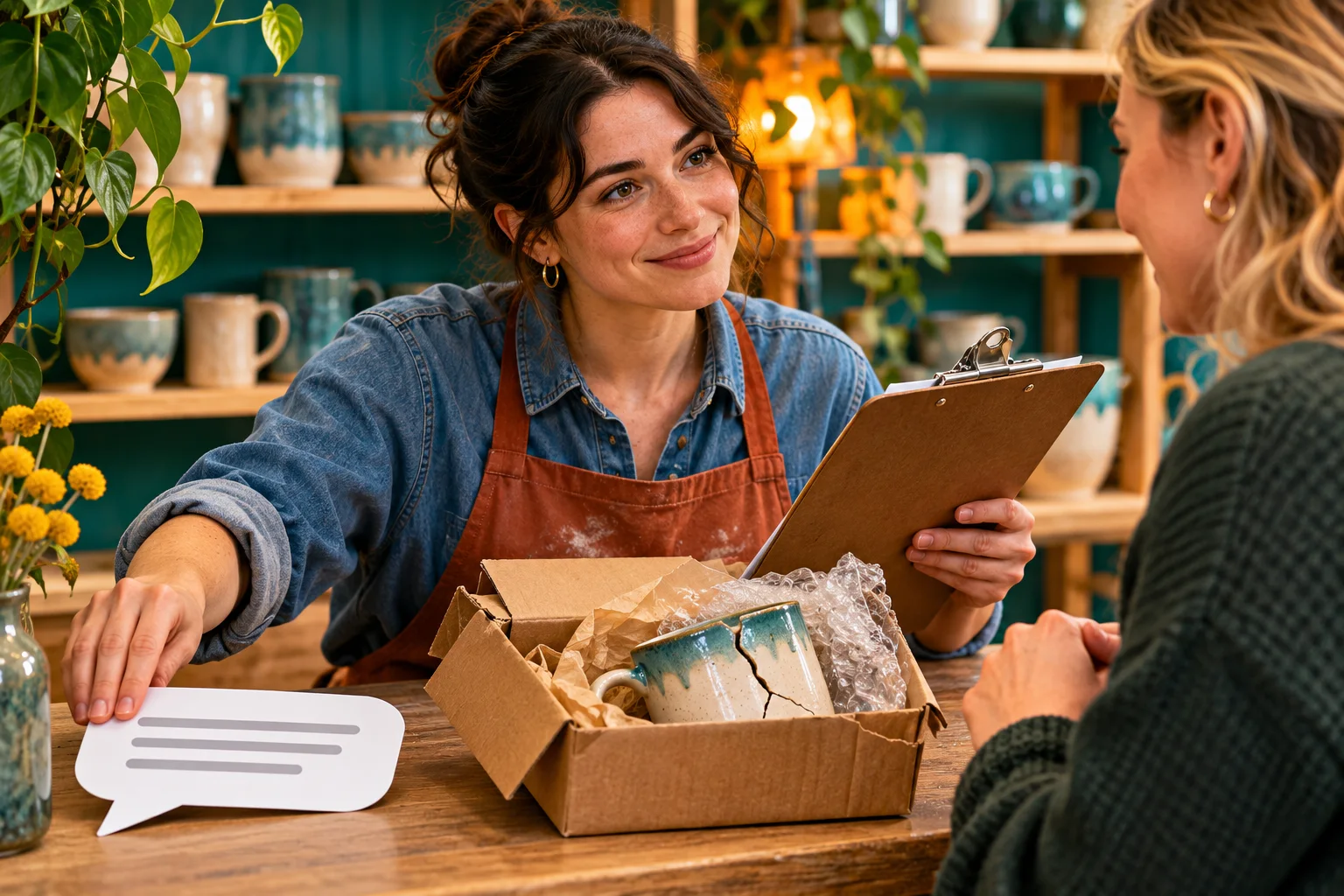
The customer holding a cracked mug is not asking the same thing as someone checking general delivery times. A standard reply can acknowledge the message and identify the approved support route, but it cannot decide whether this order is damaged, what remedy applies or whether a particular photo proves the issue. Give the case to a named colleague who can review the actual order and business policy. Do not imply the customer must post a photograph publicly or send card details in an Instagram chat to be heard.
Other exception signals include a refund request, a safety concern, an access need for a workshop, a missing parcel, a disputed price or a person who says the earlier answer was wrong. The sender should stop after the acknowledgement, preserve the relevant context through the normal support process and record who will provide the substantive response. For a public comment, avoid confirming private facts there. The separate UK complaint guide covers the full case workflow; a saved reply should be a short bridge to it, not a hidden way to close the case.
- Stop using the ordinary answer when a damaged order, refund, access need or safety concern appears.
- Acknowledge what the person has actually reported without publishing personal or payment details.
- Give the case to a named colleague through the approved support route and note the next check.
- Close the conversation only when the promised individual action has been checked.
Maintain the library and judge it by corrected answers
A saved reply needs an owner and a review trigger. For each entry, note the question category, the maintained source of truth, who approves changes and what event makes the text stale. Opening-hours changes, new workshop dates, a revised delivery page, a product-care update or a new customer-support address should trigger a check. A monthly review can catch gradual drift, but a material fact change should be reflected when it happens. Remove a draft that cannot be kept accurate or whose destination no longer works.
Review what went wrong in real conversations: how often did staff replace the entire template, find a broken link, correct an outdated fact, or move a case to an individual owner? Those observations tell the studio whether the library is useful. Do not invent minutes saved, conversion lifts or a causal sales figure from the presence of a shortcut. If two categories always need an individual check, combine them into a brief route-to-support answer or stop saving them. The point is fewer avoidable errors and a clearer customer next step.
If the business separately considers a UK Instagram follower package, check the live service terms, public profile destination, current tier, quantity, price and checkout charge on that page. A follower count is not a customer-service system; it cannot verify a saved answer, generate authentic enquiries or guarantee views, recommendations, sales or response quality. The sensible sequence is to make the shop's information and support route work for the people already asking, then assess any profile-count purchase on its own terms. Keep those records separate from the inbox's actual customer cases.
- Give each saved reply an owner, a source of truth and a review trigger.
- Retest the live link and wording after a price, hours, stock, delivery or booking change.
- Remove a stale template rather than relying on every sender to remember an exception.
- Review customer confusion and corrected answers, not an invented time-saved or sales figure.
Frequently asked questions
What are saved replies on Instagram?+
They are stored pieces of text that an authorised person can insert into a direct-message conversation and send after checking the recipient's question. They do not automatically answer every new message. Meta introduced them for common business questions; inspect the current professional account for the control available today.
Are saved replies the same as Instagram instant replies?+
No. A saved reply is selected and sent by a person. An instant reply is an automated initial acknowledgement where available. An away message is a separate out-of-hours notice. Neither automatic notice verifies a particular order, booking or product fact.
How do I make an Instagram saved reply for my business?+
On the authorised Business or Creator account, find the current saved-replies control in the professional message workflow, write a short answer and give it a recognisable shortcut if the interface asks for one. Preview it in a suitable thread and verify its link and facts. Menu labels and device availability can change.
Why can't I see the saved-replies option?+
Check that the intended professional account is selected, the app or Meta inbox is current, the Instagram message connection is available and your own role has message access. If the option is still absent, use an approved private draft and review it manually; do not enter the owner password into an untrusted add-on.
Can a saved reply answer an Instagram comment?+
A saved reply belongs to a direct-message conversation. A public comment needs an appropriate public answer or a legitimate move to the business's private support route. Do not assume inserting stored text in a DM has answered the visible comment or resolved an order issue.
Should a saved reply include today's stock or a fixed price?+
Usually not when either changes. Point to a maintained page or leave an obvious staff check, then verify the exact item, variant and current terms before sending. A template that was correct last week can mislead a customer today.
Can staff use the same reply for a complaint or damaged order?+
Use a short acknowledgement and approved support route only. Assign the individual case to a named person who can inspect the order and respond. A prewritten paragraph cannot decide the facts or remedy for that customer.
May I send promotions to everyone who has messaged the shop?+
An inbound service question does not by itself authorise later promotional DMs. The ICO distinguishes factual service messages from direct marketing. Assess a proposed marketing campaign and its current UK rules separately before sending any offer.
How often should I update saved replies?+
Review whenever the underlying fact changes, such as opening hours, booking dates, price, delivery, care instructions or the support route. A periodic check helps catch stale links and wording. Remove a reply that no longer has a reliable owner or source.
Review UK Instagram follower packages separately
If a profile count is a separate goal, compare the current UK package, public handle and checkout terms. Followers do not write accurate customer replies or guarantee reach, enquiries or sales.
See current UK Instagram follower options