
This English guide is shared with our global site. Follow related UK service links for current packages. Other service links open the global catalog in its stated currency.

Compare the response with the question you need to answer. Suggested interpretations are possibilities, not conclusions from the count alone.
| Response | Useful review question | Additional evidence | Do not assume |
|---|---|---|---|
| Likes | Did this creative receive the reaction you hoped for? | The post's purpose, audience and other relevant responses | Every like is a product endorsement or a buying intention |
| Comments | What did people ask, explain or challenge? | The actual messages, participant overlap and creator replies | Every message is positive or comes from a different customer |
| Saves | Could this content be useful to keep? | The content itself and any later voluntarily reported use | Every saver returned, followed the advice or bought something |
| Combined selected actions | How much of this chosen activity was recorded? | The included measures and their reporting scope | The sum is the number of different people engaged |
| Business response | Did the intended enquiry, booking or task happen? | The relevant actual record and its attribution limits | An interaction counter proves the cause of a sale |
The difference between comments, likes and saves
The action and its meaning are separate. Pressing Like is an action; approval, politeness, interest and familiarity are possible reasons. Writing a comment is an action; the message might be a question, correction, compliment or complaint. Saving a post is an action; keeping a recipe, comparing products and remembering an idea are possible uses. A counter records activity without identifying every motive behind it.
Instagram's post Insights guidance groups likes, comments, saves and shares as interactions. That makes them related measures, not equivalent evidence. Choose the relevant count and read it alongside the content. A useful reference post can be saved with little discussion, while a customer question can produce a detailed thread without receiving many likes.
The table helps you connect a response with a review question. It does not rank one action above the others or assign a secret value to the algorithm. Keep the comparison grounded in what your reader needed. If the purpose was to explain delivery, the clarity of the answer matters alongside visible activity, not merely the largest number on the screen.
Choose the reader's task before choosing the main measure
Write a simple sentence before reviewing a post: this helps a new customer understand our delivery options, or this gives home bakers a recipe they can refer to later. Those are different jobs. The first may prompt specific questions; the second may fit saving. Neither needs the same main measure as a design reveal intended to receive a quick reaction.
Use the four planning categories below as a starting point. Pick one main job for the review, while leaving room for other responses. A product guide can be both appealing and useful to keep, so you do not have to force every post into a single action. The point is knowing which evidence deserves attention when deciding what to publish next.
Also name a result outside these three counters when the business needs one. For an appointment announcement, that might be a relevant enquiry or an actual booking record. A comment asking about availability is not the same as a booked appointment. Keeping those stages separate gives you a clearer picture than calling all activity conversion and hoping the total explains the campaign.
- Reaction: a new design or creative reveal, judged with its intended audience and context.
- Reference: instructions, a checklist or a comparison someone may want to keep.
- Discussion: a genuine question where the content of responses can guide a decision.
- Customer task: an enquiry, booking or other action that needs its own evidence.
Read likes as reactions without turning them into endorsements
Likes can help you describe the response to a visual, idea or announcement. Compare similar work rather than assuming that an attractive product image and a detailed tutorial should receive identical reactions. A familiar topic may be easy to like, while a useful explanation may give the reader a different reason to act. A quieter like count does not, by itself, make that explanation unsuccessful.
Avoid expanding the claim beyond the evidence. A person liking a cake photograph has not necessarily tasted the cake, checked delivery coverage or decided to place an order. A like on a customer's criticism also does not automatically endorse your business. Look at the item receiving the reaction before using likes in a presentation about trust or satisfaction.
Use likes as one part of the review. If a reveal receives many reactions but the practical questions remain unanswered, improve the information before declaring the launch complete. If a guide receives fewer likes and useful feedback, preserve that distinction. You can explain what happened around a post without treating a visible number as proof that its audience will become customers.
Read comments for meaning, participants and replies
The most useful feature of a comment is the information in it. A delivery question identifies uncertainty; a practical example may extend a tutorial; a correction may expose an error. Praise and criticism can both be relevant. Count the activity, then read enough of the thread to describe what it contains rather than reporting every message as positive engagement.
Separate audience messages from your own replies when doing a manual review. In a hypothetical thread with 20 visible comment actions, imagine 14 audience messages from eight participating accounts and six business replies. Twenty is the action total in that example; eight is the number of audience accounts you actually observed. Neither should be relabelled 20 prospective customers. The example assumes that the described messages are visible and reviewed, not that every reporting screen provides this breakdown.
Record the question or useful finding, not unnecessary personal details. A long argument may require more moderation without teaching you much about the post's purpose. If a comment is missing, investigate visibility separately before drawing a content conclusion. This guide compares responses; troubleshooting filters or removals belongs to a different task.
Read saves as bookmarks without identifying future buyers
Instagram's current saving help describes ordinary saved posts as private and says the post creator cannot tell that an individual saved their post. A save total therefore is not a list of people to approach. Use aggregate activity honestly, without assigning names or purchase intentions to a count.
Saving may fit content with a later use: a recipe, packing checklist, product comparison or instructions. That is a reasonable planning hypothesis, not evidence that every saver used the material. Someone might keep a post while deciding, return much later, or never reopen it. The count cannot distinguish those histories or tell you that a lesson was followed successfully.
For a useful guide, combine the aggregate with information people voluntarily provide. A reader saying they tried a method supplies a different kind of evidence from an anonymous save total. Do not assume one comment represents everyone who saved. Private bookmarking, a person deliberately sharing information with you, and the business's own customer records are separate sources. Keep those boundaries when writing a report or deciding whom to contact.
Why adding the three counts does not count different people
One account can like a post, leave several comments and save it. The activities can overlap. A sum of those action counts can describe selected activity, but cannot identify how many different accounts participated. This is a basic counting limitation, not a reason to discard the numbers. Name the sum accurately if it answers a useful question.
Imagine one hypothetical post with 120 likes, 20 comments and 40 saves. Adding them gives 180 selected actions. It does not establish 180 different people engaged. Some likes and saves could come from accounts also commenting, and the comment total could contain repeated participants or creator replies. The three totals alone do not reveal the overlap. You cannot recover it by choosing an arbitrary adjustment.
Instagram distinguishes interactions from Accounts engaged, its separate unique-account measure. Use the relevant available account measure with its own definition when audience participation is the question. Keep the original label rather than pretending a home-made sum is an official aggregate. If the required account figure is unavailable, state that limitation; an unknown audience total is more honest than an invented one.
Compare actions per audience size with a clear denominator
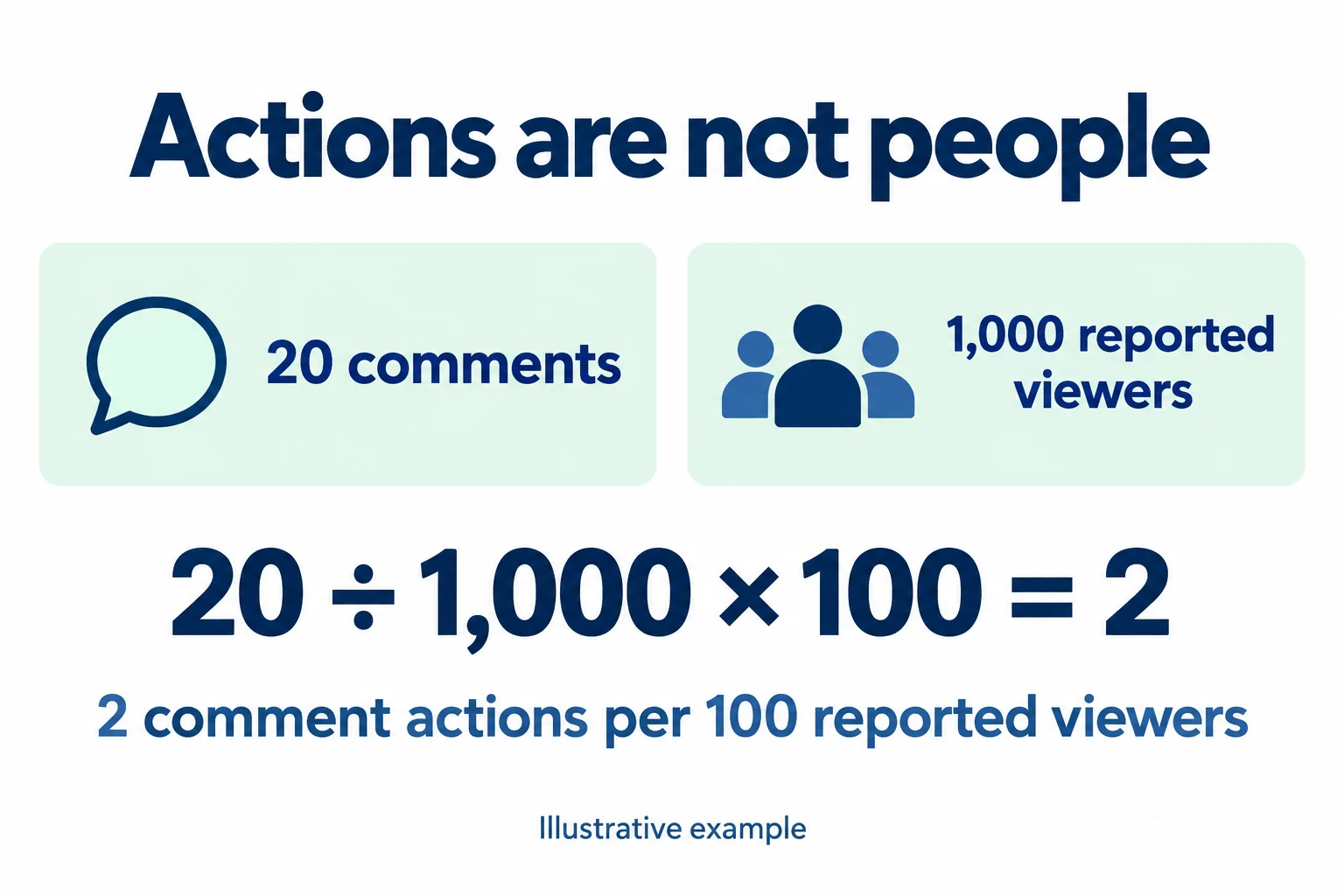
A larger audience can provide more opportunities for activity, so raw counts may need context. For a hypothetical report with 1,000 Viewers and 20 comments at the stated observation time, calculate 20 ÷ 1,000 × 100 = 2. That gives two comment actions per 100 reported viewers. It does not prove that 2% of different people commented, because comments can include repeat actions and replies.
Using the same illustrative record, 120 likes give 12 like actions per 100 reported viewers, and 40 saves give four save actions per 100. The selected-action sum gives 18 actions per 100. Keep the measure names visible. The combined figure is not a percentage of unique customers and cannot tell you which accounts took several actions. These figures are teaching examples, not real customer outcomes or targets.
Use a matching audience measure and report scope, not a rounded public view counter from another day. State whether the denominator is Viewers, reach under that source's definition, or followers; each answers a different question. A zero denominator makes the ratio undefined, and missing inputs make it unavailable. Action ratios can exceed 100 when the numerator contains repeated actions, so do not force them into a percentage-of-people interpretation.
A product reveal and care guide can succeed differently
Consider the two hypothetical records below. Post A reveals a new product; Post B explains how to care for it. Assume you have comparable audience measures, observation ages and reporting conditions for this teaching example. A receives more likes in absolute terms, while B receives more comments and saves. The purpose of each post matters before choosing which one deserves another version.
The audience context changes the comparison. A's 200 likes across 2,000 reported viewers produce 10 like actions per 100; B's 90 across 1,000 produce nine. Their like ratios are much closer than the raw counts suggest. Their save ratios differ more: eight ÷ 2,000 × 100 = 0.4 for A, while 45 ÷ 1,000 × 100 = 4.5 for B. That describes the reported activity, not which creative caused more customer demand.
Read B's 18 comments before celebrating them. They may contain useful experiences, or repeated questions showing that an instruction was unclear. Similarly, A's reactions may fit a reveal while its eight saves have no obvious commercial meaning. The next decision might be to keep the reveal format and clarify one step in the guide. Nothing in these totals alone selects a universal winner or establishes later sales.
- Post A, hypothetical product reveal: 2,000 reported viewers, 200 likes, 10 comments and eight saves.
- Post B, hypothetical care guide: 1,000 reported viewers, 90 likes, 18 comments and 45 saves.
- At matching conditions, A has 10 like actions per 100 reported viewers; B has nine.
- A has 0.4 save actions per 100 reported viewers; B has 4.5. Those figures do not establish future use or sales.
Keep recording conditions consistent between posts
Current post Insights help describes access for public personal or professional accounts. Open the specific post and use the measures actually available to you. Preserve the screen's labels, source and observation time. Do not fill a blank Saves field with an estimate from likes or assume a missing number means a measured zero.
Compare similar formats at similar elapsed ages, and note differences that affect interpretation. A week-old reference carousel has had a different opportunity to receive activity from an announcement published an hour ago. Audience restrictions, paid distribution, a collaboration, sharing and other promotion belong in the record. If you cannot separate those sources, disclose the mixed context rather than guessing which activity was organic.
Do not compare only the two most impressive posts in an account. Keep a small set of comparable examples, including ordinary results, and record the creative purpose of each. A single difference may be worth noticing without establishing a reliable pattern. Use it to choose a question for the next similar post; a counter by itself cannot explain every reason people responded differently.
Turn the response pattern into a useful content decision
Start with the evidence you can inspect. Many likes with recurring questions may mean the presentation is appealing while necessary information is hard to find. A save-heavy checklist with little discussion may simply serve a reference task. Few likes alongside a detailed, relevant conversation may suit a focused question. Treat these as hypotheses to check against the actual material, not diagnoses produced automatically by the ratio.
Choose a change that answers the reader's need. Move an essential product detail into the post, make a confusing instruction clearer, or create a separate answer to a recurring question. If the task is genuinely to build discussion, use a dedicated comment-content plan. You do not need to add a demand for comments to every reference guide just to make its response mix look more balanced.
For the next comparable post, record what changed and why. Keep the remaining context as steady as practical, and resist claiming that one edit caused every difference. The useful outcome is a better explanation or a supported editorial choice. A report saying all three counters rose is incomplete if nobody can explain what the audience received or what the business learned.

Write a report that separates activity from business results
Use the short reporting checklist below. A clear summary states the post's job, separate counts, relevant audience context and one finding from the responses. For example: this guide received 40 saves and several questions about storage; we will add a storage example. That is a supported content decision. Forty customers intend to buy would be a different claim without the required evidence.
Add relevant enquiries, bookings or purchases in separate fields when you have actual records. Explain how you connected them to the post and what remains uncertain. A customer may see several posts, hear about the business elsewhere or arrive through another campaign. Activity occurring after publication is not sufficient evidence that likes, comments or saves caused the result.
Keep the report readable for a colleague who did not collect it. Name your calculation, show its inputs and mark missing data. Avoid a weighted score such as ten points per save unless you clearly identify it as your own planning convention; it would not establish Instagram's ranking rules. Often the simplest report is the most useful: what happened, what we learned and what we will change.
- Identify the post, its reader task and the observation time.
- List likes, comments and saves separately using the report's exact labels.
- Record the relevant audience measure and any unavailable values.
- Summarise one useful thread finding without exposing private information.
- Add the relevant business result separately, with the limits of the evidence.
- Choose one next content decision and explain why the record supports it.
Keep ordered comments separate from genuine customer feedback
A comments service concerns the eligible activity described in its offer. It does not supply the customer's lived experience or prove that people voluntarily recommend a product. Keep ordered comments and any other paid activity annotated when reviewing response patterns. Do not present a supplied message as an authentic customer testimonial unless that experience actually occurred and you have appropriate evidence.
Meta has described enforcement against artificial engagement, so review platform rules as well as the selected service's conditions. Password-free ordering does not establish platform approval. Protect credentials, confirm the eligible public post and read the current quantity, timing and support terms. Those practical checks are separate from measuring whether your content helped its audience.
If you are considering HitsBoost, its Instagram comments page explains the current options for supported content. Use that page for the defined service and contact support about unclear order details. Continue assessing real conversation by its substance, likes as reactions and saves as aggregate bookmarking activity. Neither a purchased quantity nor a stronger-looking response mix guarantees recommendations, reach, customer satisfaction or sales.
Frequently asked questions
Are Instagram comments better than likes?+
They answer different questions. A relevant comment can explain a need or misunderstanding, while a like records a reaction without that detail. Neither count is automatically better for every post. Choose the reader's task and examine what the responses actually contain.
Are saves more valuable than comments?+
A save may fit a reference guide, while comments may help with a genuine question. The count does not reveal why every person acted or whether they used the content later. Review saves and discussion against the post's purpose instead of assigning one universal winner.
Can I see who privately saved my Instagram post?+
Instagram's current ordinary-save guidance says the creator cannot tell that an individual saved their post. Treat aggregate saves as a count, not a list of names. Someone separately telling you they saved it is a different piece of information.
Does a saved post mean the person will buy something?+
No. Keeping content does not establish a purchase intention, later return or completed order. A save could serve many purposes. Use an actual enquiry or transaction record for a business result and explain the limits of connecting it to the post.
Can I add likes, comments and saves to calculate engaged people?+
Their sum counts selected actions, not different people. One account may perform several actions, and a comment total can contain repeat participants or creator replies. Use the relevant available unique-account measure with its definition, or leave that audience figure unknown.
How do I compare comment rates between posts?+
Choose matching reporting conditions and a stated denominator. Twenty comments divided by 1,000 reported viewers, multiplied by 100, gives two comment actions per 100 viewers. It does not prove 2% of different people commented. Leave the calculation unavailable when inputs are missing or the denominator is zero.
Which response has the biggest Instagram algorithm weight?+
This guide does not assign universal ranking weights to comments, likes or saves. Counts alone cannot disclose those weights or guarantee distribution. The practical comparison here concerns reader responses and content decisions, with each measure kept inside what it can establish.
Will buying comments also improve likes and saves?+
A defined comments quantity does not include other response measures or guarantee organic discussion, recommendations or sales. Review the actual offer and platform rules, then keep paid activity separate from genuine feedback and other content results.
Compare Instagram Comments packages.
Prepare the public destination, then review the quantity and terms that fit your goal.
Review Instagram comments packages and conditions