
This English guide is shared with our global site. Follow related UK service links for current packages. Other service links open the global catalog in its stated currency.

Illustrative watch-hour calculations using one consistent set of viewing sessions
| Sessions | Average seconds watched | Total seconds | Estimated watch hours |
|---|---|---|---|
| 120 | 30 | 3,600 | 1 |
| 6,000 | 30 | 180,000 | 50 |
| 6,000 | 60 | 360,000 | 100 |
| 1,500 | 240 | 360,000 | 100 |
Watch hours measure accumulated viewing time
A watch hour is a unit of time, not a separate type of viewer. Add the viewing duration across the relevant activity and express the result in hours. Many short sessions can contribute to that total, just as a smaller set of longer sessions can. This makes watch time useful for asking how much viewing the content accumulated rather than how many counted plays it received.
For a simple illustration, imagine 120 viewing sessions that last 30 seconds each. Together they produce 3,600 seconds of viewing time, which equals 60 minutes or one hour. The example does not assume one person watched for an hour, that 120 different people watched, or that a platform necessarily reports those sessions as 120 views under its own rules.
Keep the scope beside the number. A report may concern one video, a collection of videos or a selected date range. Those totals can all be useful, but they answer different questions. A campaign for one public video should begin with that video's identity and duration reporting, rather than using a Page-wide total that also contains unrelated videos or earlier activity.
Explore Facebook Watch HoursA video view is a count with its own definition
Facebook can present view activity through different surfaces and reports. Read the explanation beside the number you use instead of assuming all views follow one threshold. A public view label, a duration-based metric and a qualified monetization view are not automatically equivalent. Meta's November 2023 professional-dashboard announcement describes content insights and Reels retention graphs; use the definitions in your current report when interpreting the figure in front of you.
A counted view does not reveal whether the viewer completed a video or how long they stayed. Two videos can each show a similar view count while accumulating different amounts of time. One may lose attention quickly; the other may hold viewers through a detailed answer. You need duration or retention information to distinguish those situations, and a raw counter cannot substitute for it.
Unique people, plays, replay activity and duration are also different concepts. Do not use a view total to estimate distinct audience members unless the report explicitly defines it that way. When buying a views package, review its stated scope separately from watch hours. A count objective and a duration objective can share a video destination while still being different services and different reporting questions.
Convert seconds and minutes into watch hours
The basic conversions are straightforward: total seconds divided by 3,600 equals hours, and total minutes divided by 60 equals hours. If an owner report already supplies accumulated minutes viewed for the relevant video and period, divide that value by 60. For example, 9,000 total minutes represents 150 hours. Preserve the original number and unit so another person can check the calculation.
A planning estimate can use the formula: viewing sessions multiplied by average seconds watched, divided by 3,600. Six thousand sessions averaging 30 seconds would produce an estimated 50 hours. If the same number averaged 60 seconds, the estimate would be 100 hours. These are hypothetical arithmetic examples, not an assertion about what a HitsBoost package or a particular Facebook view definition delivers.
The inputs must describe the same set of viewing activity. Multiplying a lifetime view count by an average from the last week is not a valid calculation of that week's duration. Nor should a threshold-based count be combined with an average that includes a different set of starts. Use compatible inputs for a planning estimate and prefer the actual accumulated-duration report when available.
Work backward from a duration goal
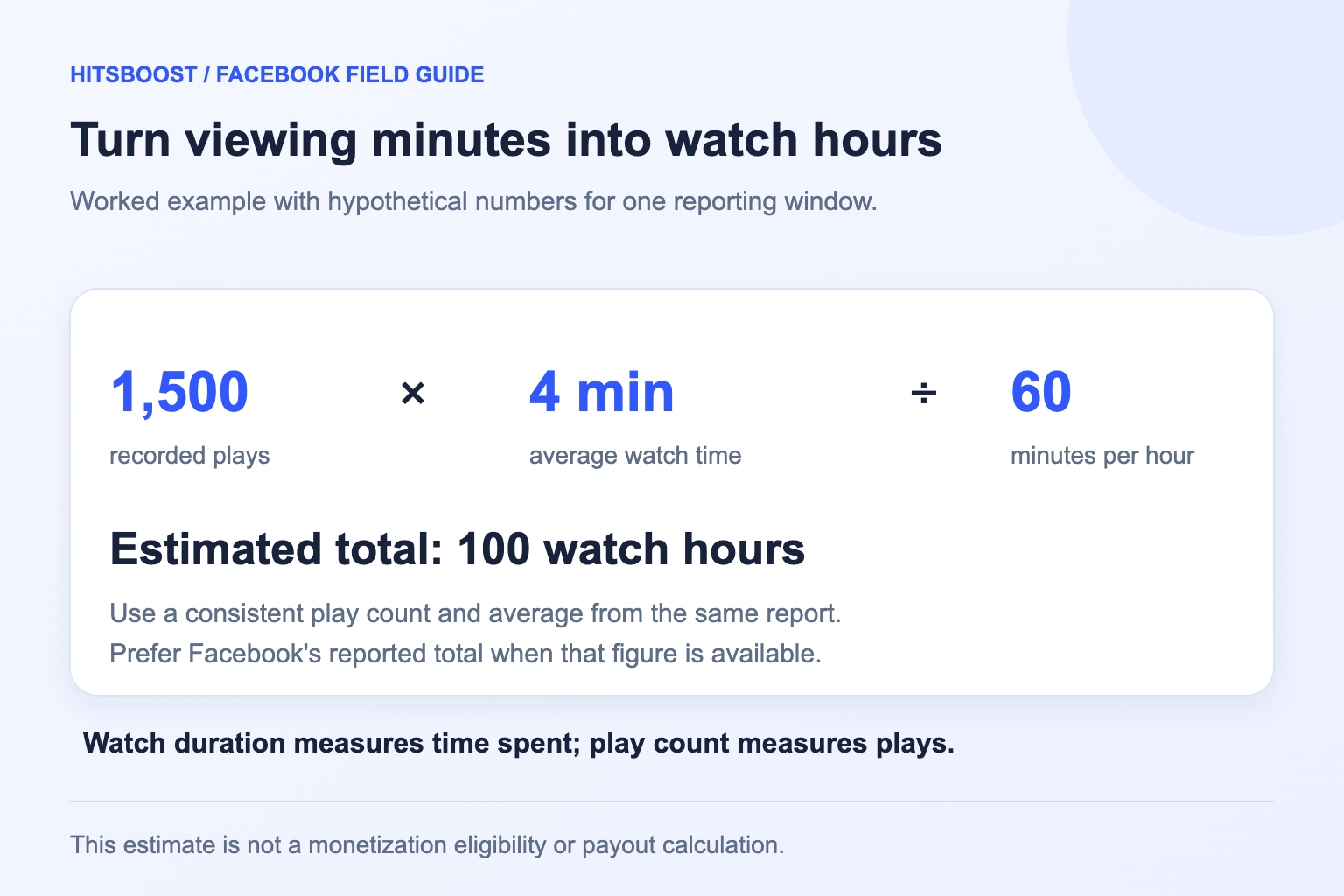
You can rearrange the planning formula to explore how average viewing time affects the number of sessions required. Estimated sessions equal desired hours multiplied by 3,600, divided by average seconds watched. If a hypothetical goal is 100 hours and the average session is 30 seconds, the estimate is 12,000 sessions. At 60 seconds it is 6,000, and at four minutes it is 1,500.
Use several plausible averages rather than treating one forecast as certain. A team's past comparable videos can offer context, provided the same reporting definitions are used. The calculation shows sensitivity to viewing duration; it cannot predict distribution, audience interest or retention on an unpublished video. A longer upload does not automatically create a longer average session, because people can leave at any point.
The free Facebook watch-time calculator helps you explore these inputs without repeatedly doing the arithmetic. Label the result an estimate and keep the source of the assumptions in your notes. If the video is newly published or its average viewing time is not available, acknowledge that uncertainty rather than borrowing an unrelated creator's figures and presenting them as your campaign's likely outcome.
Use average duration and retention together
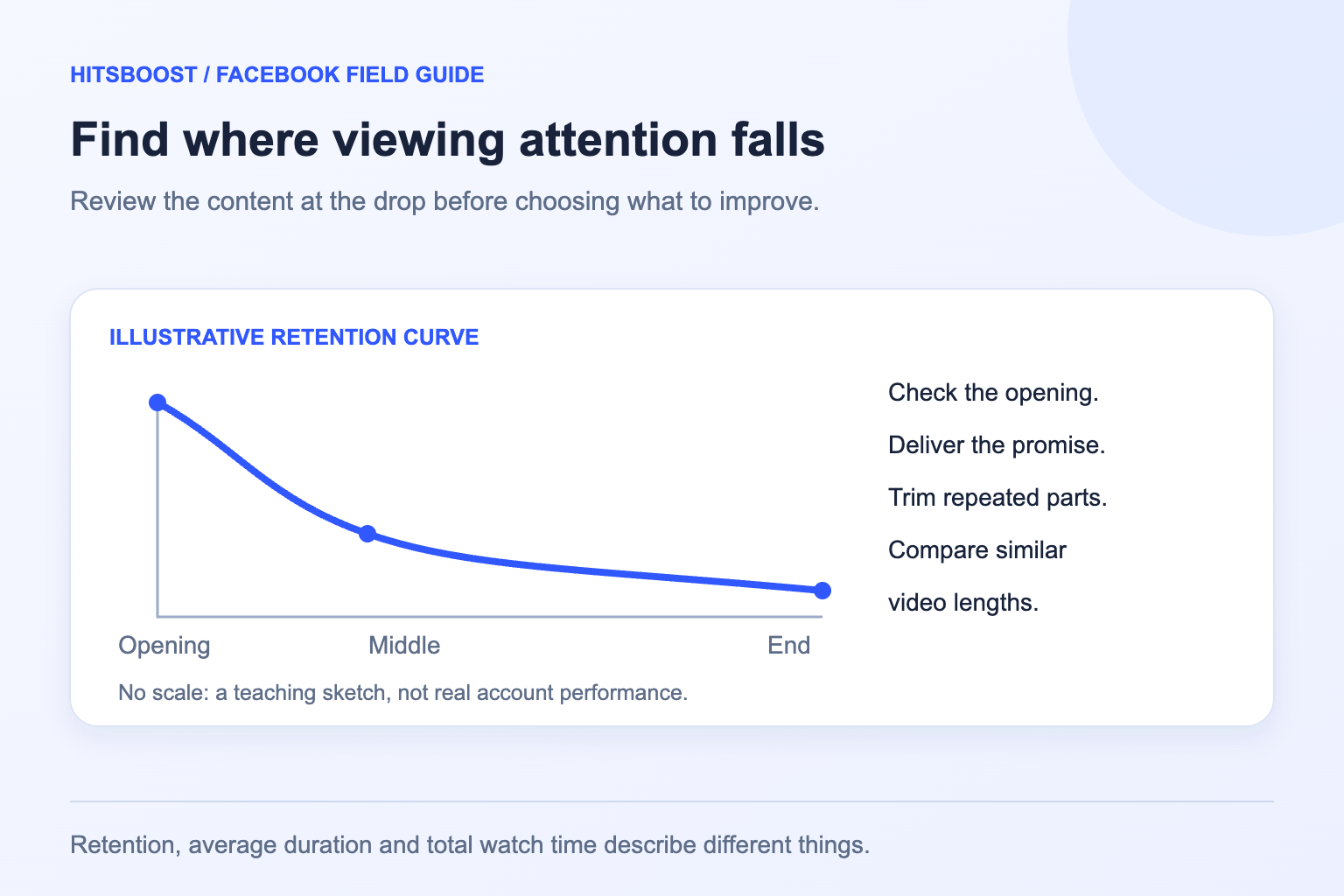
Average viewing duration summarizes time across the activity included in its definition. It can be helpful, but a single average hides variation. Some sessions may be very short while others reach the end. A retention report, where available, adds information about viewing at different moments in the video. Use the two measures together to ask where the content keeps or loses attention.
Read retention shapes as a starting point for investigation. A sharp drop near an opening could suggest an unclear promise, a slow introduction or an audience that expected something else. It does not prove which explanation is correct. Watch the video at that point, check the caption and context, and compare relevant comments. Then choose one practical change that addresses the likely mismatch.
A completion percentage and accumulated watch hours also answer different questions. A short useful clip can have strong completion while generating less total time than a longer tutorial. A long video can accumulate substantial time without a high completion rate. Avoid ranking every format with one number. Decide whether the immediate question concerns total duration, understanding the message or reaching the final instruction.
Compare video length and purpose fairly
Compare a short product preview with other previews and a detailed lesson with similar lessons. They serve different expectations. A 15-second clip may deliver its entire point quickly, while a ten-minute explanation needs enough depth and pacing to justify the extra time. Raw watch hours alone do not say which video better served its audience or the business objective.
An illustrative pair makes the distinction clearer: 2,000 sessions averaging 20 seconds produce about 11.1 hours, while 500 sessions averaging three minutes produce 25 hours. The second example has more duration despite fewer sessions. That does not prove the second video's creative is universally better, because its topic, length, audience and purpose could be different. The figures simply describe different consumption patterns.
For a fair review, record length, topic, format, publication date and how the content was shared. Compare videos at similar ages or over the same defined period. Keep paid and other promotional activity visible in the notes. A tutorial distributed through an email to interested customers has different context from a clip posted to a broader audience, even when both promote the same product.
Check the report before diagnosing a problem
Confirm that you have opened the intended video and selected the correct Page or profile in the reporting area. Check the date range, lifetime versus period view and displayed unit. A result shown in minutes can look much larger than the same result shown in hours. Differences caused by the reporting scope should be resolved before deciding the video lost attention or a campaign failed.
Record the exact metric name and whether the figure is rounded, estimated or still updating according to the interface. If one report concerns your original upload and another a shared or related item, they may not contain the same activity. Do not combine reports without checking their definitions. Where a number is unavailable, leave it unavailable in the worksheet rather than replacing it with zero.
If a discrepancy persists, capture the video link, source, selected dates, labels and observation time, then consult Facebook's current help or available support. These details are enough to describe the issue without sharing a password or security code. A carefully documented reporting question is more useful than a claim that the platform is broken based on two screenshots with different scopes.
- Correct video and account selected.
- Exact duration or view metric label preserved.
- Same reporting period and measurement source.
- Minutes, seconds and hours converted correctly.
- Rounded, estimated or unavailable values identified.
- Campaign and distribution context recorded.
Keep monetization eligibility separate from watch time
A watch-time total does not, by itself, establish eligibility for a Facebook earnings program. Meta's March 2026 announcement describes Facebook Content Monetization as invite-only and introduces qualified views, non-qualified view reasons and earnings-rate reporting. Check your current Professional Dashboard and the applicable program terms for your own account, because availability and requirements can change and general viewing activity is not automatically eligible activity.
The practical distinction is between describing how long content was watched and determining which activity a program may count for earnings. Do not assume a purchased view or watch-hour total is a qualified monetization view. Originality, account status, content eligibility and other program conditions can matter independently of the duration figure. A marketing service should not promise approval or earnings from a time-based package.
Older articles may mention fixed watch-minute thresholds for earlier programs. Do not apply those numbers automatically to your current account or treat them as a universal target. Read the active program's information first. This guide uses watch hours as a measurement and campaign-planning unit; it does not provide an earnings forecast or a route around Meta's eligibility and enforcement decisions.
Improve duration through useful video structure
Make the beginning accurately describe what the viewer will learn or see. Show the relevant subject early and remove introductions that delay a simple answer. A cooking demonstration can begin with the finished dish and the skill being taught; a product tutorial can start with the problem the product solves. The point is clarity, not a claim that every opening must use an identical number of seconds.
Organize the middle so each part advances the promised answer. Clear demonstrations, readable captions, audible speech and well-timed examples can reduce avoidable confusion. Review the video on a phone as well as a larger screen and check whether important text or actions are easy to follow. Do not pad a short explanation merely to increase video length; unused duration does not create watched duration.
Use the next comparable upload to test one specific improvement. For example, move the first demonstration earlier or explain a confusing step more plainly. Record the change and compare available duration and retention figures at a consistent review point. Repeated useful observations can guide future production, while a single unusual result should not become an unsupported rule about Facebook's algorithm.
Prepare the video and choose the correct service
Open the intended public video, confirm its identity and copy its direct link. Check that the content is final, accessible under the service's requirements and appropriate for the planned campaign. A general Page URL does not identify one video. If the destination is a Reel, shared item or another format, read the supported-destination wording and ask support when eligibility is unclear.
Choose video views when the package's stated unit matches your count objective. Choose watch hours when you intend to compare a duration-based option and the selected video meets that service's requirements. Review the quantity, delivery wording and terms before paying. Do not assume one service automatically includes the other measure or supplies a fixed average viewing duration beyond its written scope.
Keep a dated baseline, confirmation and official support route, then review the stated metric from the same source at sensible intervals. Continue improving and distributing the video for its real audience. A watch-hours purchase cannot guarantee meaningful interest, complete watches, recommendations, monetization or sales. Separating the service record from those broader outcomes produces a more honest report and a clearer next decision.
Frequently asked questions
What is one Facebook watch hour?+
It is 60 minutes or 3,600 seconds of accumulated viewing time within the scope being measured. It can come from many short sessions or fewer longer sessions. One watch hour does not prove one person watched continuously for an hour, and it is not a unique-viewer count.
How do I estimate watch hours from views?+
For compatible planning inputs, multiply viewing sessions by average seconds watched and divide by 3,600. For example, 6,000 sessions averaging 30 seconds produce an estimate of 50 hours. Use the same set of activity for both inputs, and prefer the actual accumulated-duration report when available.
Why can fewer views produce more watch time?+
Longer average viewing sessions can produce more accumulated duration even when there are fewer sessions. Compare the same definitions and periods before drawing a conclusion. Video length, topic, distribution and audience context also matter, so more total time does not by itself prove that one creative is better.
Can I calculate hours from total minutes viewed?+
Yes. Divide the accumulated minutes by 60, preserving the video's identity and reporting scope. For example, 9,000 minutes equals 150 hours. Do not confuse total minutes with an average duration, and do not mix a lifetime number with a limited reporting period in the same calculation.
Do watch hours guarantee Facebook monetization?+
No. Check the program status and current eligibility information in your own Professional Dashboard. Meta distinguishes qualified and non-qualified views in monetization reporting. General or purchased viewing duration should not be assumed to qualify, and a time-based package cannot guarantee program approval, earnings or continued eligibility.
Should I buy video views or watch hours?+
Match the written service unit to your goal: counted-view activity or accumulated duration on an eligible video. Verify the direct public link and the supported format before choosing a package. Read the scope and terms because one option does not automatically include the other metric or guarantee an average watch duration.
Compare Facebook Watch Hours packages.
Prepare the public destination, then review the quantity and terms that fit your goal.
Compare Facebook watch-hours packages