This English guide is shared with our global site. Follow related UK service links for current packages. Other service links open the global catalog in its stated currency.

A practical triage table for a falling Instagram follower count
| Pattern you can observe | What to check next | Reasonable next action | What the pattern does not prove |
|---|---|---|---|
| One small change between rounded public totals | Exact counts, same account, and a later comparable observation | Keep a dated log before changing the content plan | A precise number of unfollows |
| A sustained decline across matching weekly windows | Available follows/losses figures, content themes, and audience feedback | Test one adjustment to the account's content promise | That one recent post caused every loss |
| A sudden decline near an account or moderation change | Official notices, your team's follower removals, and access changes | Verify the documented change; keep uncertain causes separate | A platform-wide cleanup of your particular account |
| Count decline together with unfamiliar logins or profile edits | Login activity and official recovery options | Secure the account before working on growth | That buying another package will resolve the access problem |
| A decline during or after a follower order | Order status, dated counts, destination, and written refill terms | Ask the provider to review the relevant order | That every net loss belongs to that order |
Confirm the decline before looking for a cause
Begin with the simplest question: are you comparing the same account in the same way? A creator managing several profiles can accidentally compare a business account with a personal one. A saved screenshot may show a rounded total while a newer screen shows an exact number. Those are easy mistakes to make, especially when you are worried, and they can send an investigation in the wrong direction.
Record the current username, the place you read the figure, and the observation time. Keep the original screenshot. If the public profile displays a shortened figure such as 12.4K, label it rounded; it cannot support a claim that exactly 37 followers disappeared. Refresh the official app or check the same profile again later if the display seems inconsistent. Avoid treating repeated refreshes as separate evidence.
Then define the interval. A count at Monday morning and another at Thursday evening describe that interval, not a full seven-day week. Write the finding in plain words: the displayed total fell between these two observations. If that is all you know, leave the cause open. You already have a useful starting point without assuming an algorithm penalty or blaming the latest post.
- Save the starting and ending counts with dates, times, and the account username.
- Use the same source and avoid mixing rounded public numbers with exact figures.
- Write down any promotion, profile change, account notice, or follower removal during the interval.
- Separate what you observed from the explanation you want to test.
Compare matching date windows and available Insights
For a professional account, open the audience or follower information available in Instagram's Insights and note the selected dates. Use the labels actually shown on your account. Where follows and losses are available separately, record both. Do not assume every account has the same menus, reporting history, or audience breakdowns. A missing figure should stay missing rather than being estimated from the public total.
Compare equal periods, such as one complete week with the preceding complete week. Keep the reporting source consistent and note any timezone or boundary difference. A rolling last-seven-days view moves each day, so yesterday's screenshot and today's screenshot may cover different dates. That can make a daily comparison look like a new problem when an older high-growth day has simply left the selected window.
If you use a personal account without those figures, a small manual log still works: date, visible count, source, and a short event note. It answers the direction and size of visible movement; it does not reconstruct every follow or departure. Instagram's professional dashboard also offers Best Practices guidance on creation, engagement, reach, and account policies. Use the advice available to you alongside your own records, rather than copying another account's targets.
Separate net change from the people who left
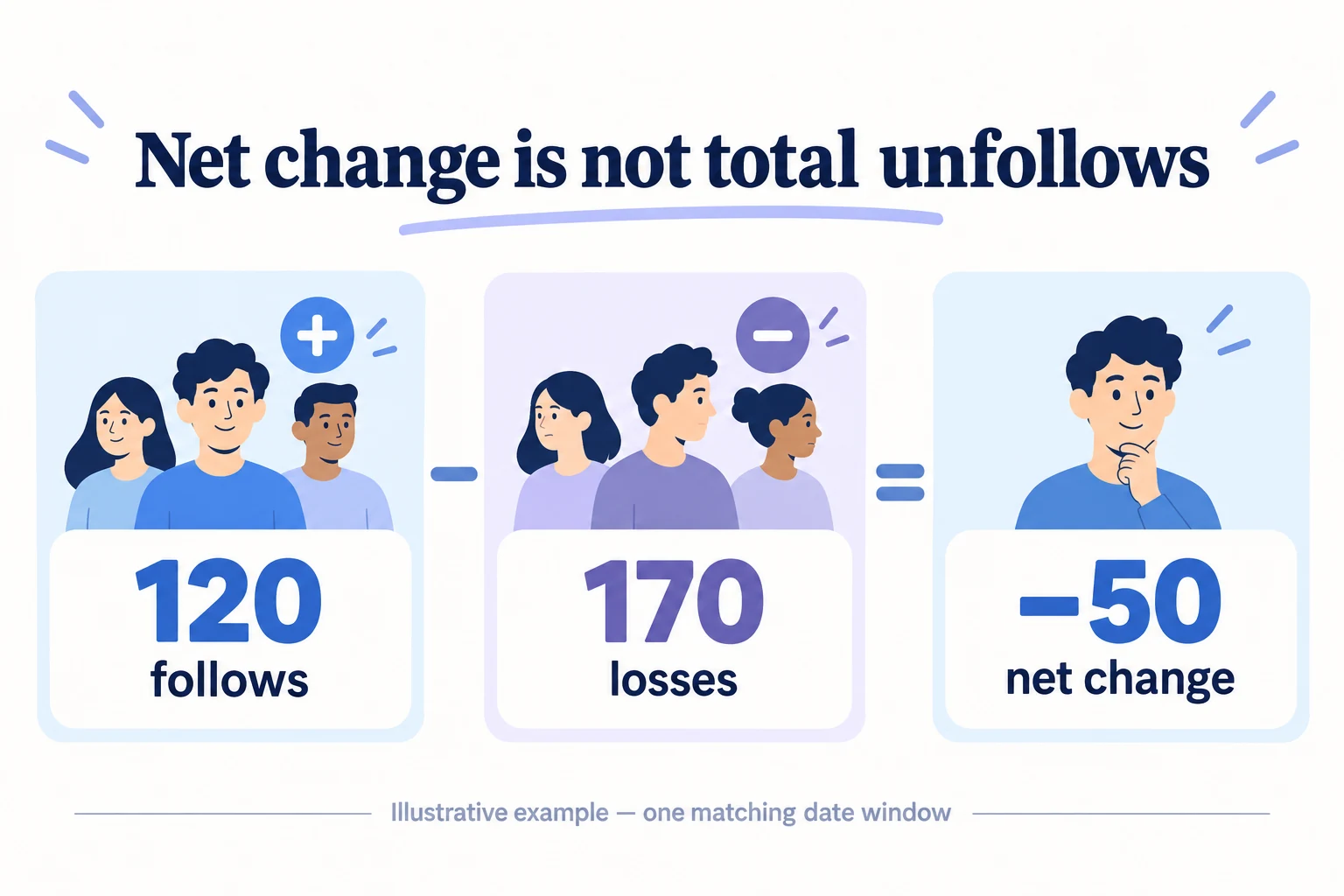
Net follower change equals ending followers minus starting followers. Suppose an imaginary account begins a week at 5,000 and ends at 4,950. Its observed net change is minus 50. That does not establish that only 50 accounts left. If a matching report shows 120 follows and 170 losses, the arithmetic is 120 minus 170 equals minus 50. The incoming audience partly offsets the outgoing audience.
The same net result can describe very different situations. A week with five follows and 55 losses also ends at minus 50. In the first example the account still attracts considerable interest; in the second, acquisition may need attention as well. These are invented examples for understanding the calculation, not HitsBoost results or an Instagram benchmark. Use your own available figures to identify which question deserves work.
You can also express observed net movement relative to the starting size: minus 50 divided by 5,000, multiplied by 100, equals minus 1%. Label that net follower change for the stated week. Do not call it a complete churn rate or claim it measures how many original followers stayed. If the two sources do not reconcile, check their dates and definitions first; do not force the figures to agree by inventing an adjustment.
Check account changes and follower moderation
A follower relationship can disappear for reasons beyond a person's decision about your content. Accounts can become unavailable, and your team may remove followers or block an account. Ask anyone with account access whether they used follower-management tools during the period. A moderation action you can document is stronger evidence than an internet rumor about a cleanup that supposedly happens on a fixed schedule.
Meta has publicly described tools that help Instagram creators detect potential spam and remove spam followers in bulk. That establishes that follower moderation exists. It does not establish that Instagram ran a specific cleanup on your profile yesterday, that every lost account was fake, or that inactive people are automatically removed after a particular number of days. Review any relevant notice or action visible on your own account before using that explanation.
When a particular follower appears missing, a changed username can make a manual search fail even though it does not explain an aggregate count decline by itself. Keep those two questions separate. Similarly, if an account is unavailable, you may not know whether it was deleted, deactivated, or restricted. Record the observable fact and avoid contacting or accusing people based on a count graph. Some cases remain uncertain, and that is an honest result.
Look for audience mismatch rather than chasing names
People can deliberately unfollow when an account no longer fits their interests. A giveaway, collaboration, or popular post can attract people who want one thing while your usual content offers another. The important question is whether your recent work matches the reason your intended audience followed. You do not need to identify every departing person to examine that question, and a list of names cannot reliably tell you their motives.
Review the content around the decline alongside the earlier period. Note topic, format, promotional frequency, and any change in the account's purpose. Read the questions in comments and messages. For example, an account that gained attention for beginner baking tutorials but switched to unrelated lifestyle promotions has a testable relevance problem. The timing suggests a hypothesis; it does not prove that each loss resulted from the switch.
Choose one useful response: clarify the bio, restore a valued series, explain a new direction, or reduce repetitive promotions. Avoid compensating with frantic posting or buying a number simply to hide the decline. If your actual question is whether one known person still follows you, use our separate unfollower guide. Here the goal is understanding overall audience movement and improving the experience offered to the people you want to retain.
Do not diagnose a shadowban from follower count alone
A shrinking total does not prove that Instagram stopped recommending your content. Follower movement, reach, video views, and interactions measure different things. An account can lose followers while a particular Reel reaches new people, or keep a stable follower total while fewer people see its posts. Keep those findings in separate columns so one number does not become an explanation for every other change.
If discoverability also appears weaker, examine the account notices and status information available in Instagram, then compare several similar posts at a similar age. Check whether visibility settings, deleted content, topic changes, or posting gaps make the comparison unfair. A documented recommendation restriction deserves the review process shown by Instagram. A lower view count with no such notice needs further investigation, not a confident label taken from a social-media forum.
Resetting the recommendations you see is also a different action from restoring the audience for your own posts. Instagram's recommendation reset changes suggested content in your experience; it is not a promised follower-recovery tool. Avoid switching account types, mass-following people, or clearing settings repeatedly because someone claims it resets your account's growth. Make the next decision from a documented symptom and a clear purpose.
Secure the account if the decline accompanies unfamiliar activity
Treat unfamiliar logins, unexplained profile edits, messages you did not send, or actions you did not approve as an account-access issue first. A follower decline alone is not evidence of a compromise. Combined with those warning signs, however, it is sensible to review access before planning a growth campaign. Your priority is regaining reliable control of the account and its recovery details.
Use the official app or website to review login activity and connected access. If you shared a password with a tracking service, change it through Instagram and check what else that service could access. Protect your recovery email and authentication method as well. Do not hand an unfamiliar person a code, session information, or a complete account-data archive because they promise to diagnose the loss.
If you cannot sign in or changes continue, follow Instagram's official account-recovery route and preserve relevant evidence. For a shared business account, agree who is allowed to manage access and who records changes. Once control is stable, establish a new dated baseline for audience monitoring. Trying to judge the success of content changes while another person is changing the account creates an unreliable comparison.
- Review unfamiliar sign-ins and unexpected changes from the official Instagram app or site.
- Change a compromised password and remove access you do not recognize.
- Protect recovery details and enable two-factor authentication where available.
- Use official recovery and reporting tools if you cannot control the account.
Handle a follower drop during or after a paid order
A decline near a follower purchase raises a reasonable order question, but timing alone cannot identify which followers belong to that purchase. Ordinary follows, departures, and account changes can happen during delivery. Find the order confirmation, the destination you supplied, and the provider's current status for that order. Compare dated counts while remembering that the visible total is a net figure, not a delivery ledger.
Read the written terms for the selected service. Check whether a refill or retention condition was included, how long it applies, and what information support needs. An available refill is a contractual option under those terms, not proof of permanent retention or a platform guarantee. Avoid starting overlapping orders just to replace a loss before you understand the first transaction; doing so makes the timeline and support question harder to explain.
Send a short message such as: my order reference is X, this is the public profile, these are the dated counts, and this is the condition I would like reviewed. Include relevant screenshots with private information hidden. You do not need to send your Instagram password or every campaign detail. If the order is with HitsBoost, use the contact route to ask about its actual status and terms rather than assuming every package includes identical protection.
Explore Instagram FollowersBuild a focused two-week content review
Once measurement and access issues are checked, choose a practical review period. Two weeks is a planning example, not a guaranteed recovery deadline; a quieter account may need longer to publish enough comparable content. Start by writing the account's promise in one sentence: who it serves and what useful material they should expect. Compare that promise with the bio, pinned posts, and recent work.
Select one adjustment that answers a real audience need. A local shop might publish a clear product demonstration and answer common availability questions. A creator teaching photography might restore a repeatable beginner tip series. Keep the production schedule realistic, make the subject clear early, and answer relevant comments. Relevant hashtags can help describe the content, but a long list of tags cannot make an unrelated post fit the audience.
Record what changed and leave other major choices reasonably consistent. Review the follower trend alongside available profile activity, content responses, and useful conversations. A stable count with more relevant enquiries can be a better business result than a larger count with no interested audience. The review may also show that the proposed cause was wrong. Keep the evidence, revise the hypothesis, and avoid treating an unsuccessful test as a reason to make unsupported promises.

Make the weekly record simple enough to keep
A useful log can fit on one page. Include the period, starting followers, ending followers, net movement, separate follows and losses where available, and a brief note about the content and account changes. Add the observation source and whether the count was rounded. You do not need a complex dashboard or a paid tracker to preserve this information.
Give each review one decision. For example: keep the tutorial series for another cycle, revise the profile introduction, follow up on an unresolved order, or continue monitoring because the last observation was inconsistent. Write a review date beside it. This turns the record into a working plan rather than a collection of screenshots that becomes more alarming every time you scroll through it.
For a team, choose one person to maintain the record and ask others to note major account or campaign changes. Use the same definition when reporting to a client or partner. Say that followers fell by a stated net amount during a named period, then describe what you checked and what remains uncertain. That report is more useful than a claim that an algorithm update removed a precise number without evidence.
- Choose one repeatable reporting window, such as a full week.
- Record total followers and available follows/losses figures separately.
- Add a short note about content, promotions, and account changes.
- Record the adjustment you made and the date you will review it.
Choose the next step from the problem you found
If the count comparison was unreliable, improve the record first. If account access is uncertain, secure it. If you found a documented order issue, ask support to review the relevant terms. If the audience no longer matches the content, improve the account's promise and test useful work. These responses address different problems, so one universal follower-recovery trick is unlikely to answer all of them.
You can compare Instagram follower packages when the purchased follower count is the specific service you want, after reviewing the destination, price, delivery information, and terms. Keep that decision separate from diagnosing organic audience retention. Instagram's policies restrict artificial engagement, and a password-free checkout is not a promise of platform approval or freedom from account risk. A purchased number does not establish genuine interest, future recommendations, monetization eligibility, or sales.
The strongest outcome of this investigation is clarity: a defensible description of the change, a short list of plausible causes, and an action you can review. You may recover the total, stabilize it, or decide that a different audience goal matters more. Continue judging the account by useful content and meaningful responses as well as its public number. That gives you a plan even when Instagram cannot explain every missing follower.
Frequently asked questions
Why am I suddenly losing Instagram followers?+
Possible explanations include people leaving, accounts becoming unavailable, follower moderation, a change in audience fit, or an inconsistent comparison. Confirm the same account, source, and dates, then look for notices or documented changes. The public count alone cannot identify the cause.
Does losing 100 followers mean 100 people unfollowed me?+
No. A decline of 100 is net movement between two observations. New follows can offset losses during that interval, and account changes can affect the total. Use separate follows and losses figures where available, with matching dates and the definitions shown by Instagram.
Can Instagram remove spam followers?+
Meta describes Instagram tools that identify potential spam and help creators remove spam followers in bulk. That does not prove a particular decline on your account was a cleanup. Check your own moderation actions and notices rather than assuming every lost follower was spam.
Is a follower drop proof that I am shadowbanned?+
No. Follower movement and content discoverability are different measurements. Review any official account-status notice and compare relevant content results separately. A falling total by itself does not establish a recommendation restriction or explain its cause.
Should I buy more followers to replace a decline?+
First understand the decline and resolve any access or existing-order issue. A follower purchase concerns a specific service under its written terms; it does not fix audience relevance, guarantee retention, or guarantee reach and sales. Review Instagram's policies before making a separate purchase decision.
What should I send support if followers drop after an order?+
Send the order reference, public destination, relevant dates, observed counts, and the written condition you want reviewed. Hide unrelated private information in screenshots. Ask about the actual order status and any applicable refill terms; keep your Instagram password and authentication codes private.
How often should I check my Instagram follower count?+
A consistent weekly review is a practical starting point for many active accounts. Use a longer window when you publish less often, or check sooner for account-access and order concerns. Repeated minute-by-minute checks rarely establish why the number changed.
Can a username change explain a lower follower total?+
A changed username can make one follower difficult to find in a manual search. By itself it does not explain why the aggregate total fell. Separate an individual identity check from a count comparison, and do not label every missing search result an unfollow.
Compare Instagram Followers packages.
Prepare the public destination, then review the quantity and terms that fit your goal.
Review Instagram follower packages and terms